Five minutes. That is roughly how long it takes to brew a cup of coffee or scroll through a social media feed. The idea that a 5-minute HIIT workout could actually improve your fitness sounds too good to be true — but a growing body of research suggests it is not as far-fetched as it seems. The real question is not whether ultra-short HIIT works, but what it works for and how to structure it.
What the Research Says About Ultra-Short HIIT
The scientific case for brief, high-intensity exercise has strengthened considerably over the past decade.
A landmark 2016 study by Gillen et al. published in PLoS ONE compared two groups over 12 weeks: one performed 3 x 20-second all-out sprints within a 10-minute session (just 1 minute of intense exercise), while the other did 45 minutes of moderate continuous cycling. The result: both groups showed similar improvements in VO2 max, insulin sensitivity, and skeletal muscle mitochondrial content — despite a five-fold difference in time commitment.
A 2024 meta-analysis by Yin et al. in Applied Physiology, Nutrition, and Metabolism reviewed 21 studies involving 849 participants and found that low-volume HIIT — defined as 5 minutes or less of high-intensity work within sessions lasting 15 minutes or less — significantly improved cardiorespiratory fitness, blood pressure, metabolic syndrome scores, and body composition. These sessions required only 14–47% of the time compared to traditional moderate-intensity training, with comparable outcomes.
And in a 2019 study by Cuddy, Ramos, and Dalleck, participants who performed Reduced Exertion HIIT (REHIT) — just two 20-second sprints in a 10-minute session — achieved a 12% improvement in VO2 max over 8 weeks, compared to 7% for a group doing 30 minutes of moderate exercise five days per week.
The pattern is clear: when intensity is genuinely high, even very short sessions drive real physiological adaptations.
 Man doing push-ups on a gym floor during a high-intensity training session
What 5 Minutes Can — and Can't — Do
Not every benefit of exercise responds equally to ultra-short training. Here is an honest breakdown:
| Outcome | Can 5 Minutes Help? | Notes |
|---|---|---|
| Cardiovascular fitness | Yes | VO2 max improvements documented with as little as 1 min of intense work per session |
| Insulin sensitivity | Yes | Improved even with very low-volume protocols |
| Blood pressure | Yes | Meta-analysis shows significant reductions |
| Functional strength | Yes | 6-minute daily sessions improved push-up and squat performance by 7.8–26.9% |
| Muscle hypertrophy | Limited | Insufficient volume for significant muscle growth |
| Endurance for long events | Limited | Aerobic base requires longer sustained efforts |
| Flexibility and mobility | No | Requires dedicated stretching or mobility work |
The takeaway: a 5-minute HIIT session is a legitimate cardiovascular and metabolic stimulus, not a watered-down substitute. But it is not a replacement for every type of training.
Free on iOS
TRAIN SMARTER
Build custom HIIT, Tabata, AMRAP, EMOM and Circuit workouts. Precision timer, streak tracking and analytics — free on iOS.
A 5-Minute HIIT Workout You Can Do Anywhere
This routine uses a 30 seconds on / 30 seconds rest format — 5 rounds, 5 minutes total. No equipment needed.
| Round | Exercise | Work | Rest |
|---|---|---|---|
| 1 | Burpees | 30s | 30s |
| 2 | Squat jumps | 30s | 30s |
| 3 | Mountain climbers | 30s | 30s |
| 4 | Push-ups (fast) | 30s | 30s |
| 5 | High knees | 30s | 30s |
Intensity matters more than duration. Each 30-second work interval should be performed at maximum effort — the kind of effort you could not sustain for much longer. If you can comfortably chat during the work intervals, you are not going hard enough.
For a lower-impact version, swap burpees for squat to calf raises, squat jumps for bodyweight squats, and high knees for marching in place with high arm drive.
How to Make 5 Minutes Count
Ultra-short workouts only work if you respect the intensity requirement. Here is how to get the most from every second:
1. Skip the Slow Warm-Up
You do not have time for a 5-minute warm-up before a 5-minute workout. Instead, use ramping — perform your first round at 70–80% effort as an active warm-up, then go all-out from round 2 onward.
2. Choose Compound Movements
Exercises that recruit large muscle groups across multiple joints — burpees, squat jumps, mountain climbers — create a far greater metabolic demand than isolation exercises. More muscles working means higher heart rate, more oxygen consumed, and a stronger training stimulus.
3. Minimise Transition Time
Pre-plan your exercises so you move immediately from one to the next when the rest period ends. Fumbling with equipment or deciding what to do next wastes the limited time you have.
4. Train Consistently
A 2018 study by Sperlich et al. found that daily 6-minute bodyweight sessions improved functional strength by up to 26.9% in just four weeks — but only because participants completed over 85% of planned sessions. Frequency is what makes short sessions powerful. One 5-minute workout per week will not move the needle. Five per week will.
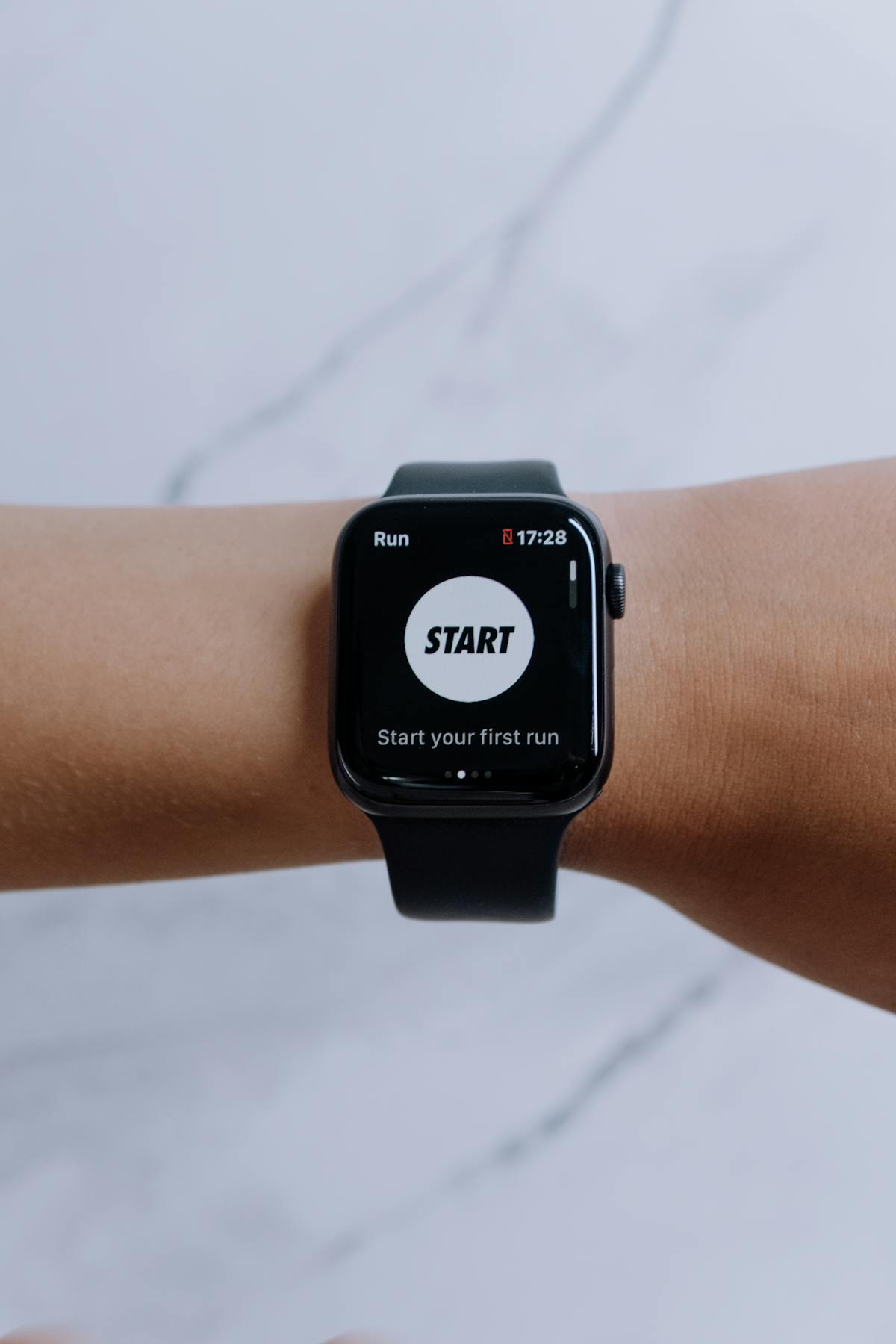 Black smartwatch displaying a fitness timer app
When 5 Minutes Is Enough — and When It Is Not
5 minutes is enough when:
- You are a beginner building a daily exercise habit
- You have zero time and the alternative is skipping entirely
- You want a quick metabolic boost on a recovery day
- You are stacking it with other training (strength, running, sport)
5 minutes is not enough when:
- Your primary goal is building significant muscle mass
- You are training for an endurance event (marathon, triathlon)
- You need dedicated mobility or flexibility work
- You want a complete, standalone fitness programme with nothing else
The honest answer to "is a 5-minute HIIT workout worth it?" is yes — if you actually do it at high intensity, and you do it consistently. A perfect 5-minute session done five days a week will always beat a 45-minute plan you never start.
Track Your Quick HIIT Sessions With Hiitify
Hiitify is built for exactly this kind of training. Set up a custom 5-minute interval timer with your preferred work and rest periods, track every session to build a workout streak, and watch your consistency compound over weeks. When your workout is only 5 minutes, the hardest part is showing up — and Hiitify makes showing up count.
Free on iOS
TRAIN SMARTER
Build custom HIIT, Tabata, AMRAP, EMOM and Circuit workouts. Precision timer, streak tracking and analytics — free on iOS.
Sources & Further Reading
Research
- Gillen, J.B. et al. (2016). Twelve Weeks of Sprint Interval Training Improves Indices of Cardiometabolic Health Similar to Traditional Endurance Training despite a Five-Fold Lower Exercise Volume and Time Commitment. PLoS ONE. View on PubMed
- Yin, M. et al. (2024). Is low-volume high-intensity interval training a time-efficient strategy to improve cardiometabolic health and body composition? A meta-analysis. Applied Physiology, Nutrition, and Metabolism. View on PubMed
- Cuddy, T.F., Ramos, J.S. & Dalleck, L.C. (2019). Reduced Exertion High-Intensity Interval Training is More Effective at Improving Cardiorespiratory Fitness and Cardiometabolic Health than Traditional Moderate-Intensity Continuous Training. International Journal of Environmental Research and Public Health. View on PMC
- Sperlich, B. et al. (2018). A 4-Week Intervention Involving Mobile-Based Daily 6-Minute Micro-Sessions of Functional High-Intensity Circuit Training Improves Strength and Quality of Life. Frontiers in Physiology. View on PMC
- Gillen, J.B. & Gibala, M.J. (2014). Is high-intensity interval training a time-efficient exercise strategy to improve health and fitness? Applied Physiology, Nutrition, and Metabolism. View on PubMed
Further Reading
- The Science of Vigorous Exercise — Dr. Martin Gibala on FoundMyFitness
- HIIT — The Nutrition Source, Harvard T.H. Chan School of Public Health
- How Much HIIT Training Per Week? — HIIT Science
Image Credits
- Cover: Side view of a man doing superman push-ups — Pexels
- Man doing push-ups on a gym floor — Pexels
- Black smartwatch on a marble surface — Pexels
All images free to use under the Pexels License.