You finish a hard HIIT session, collapse onto the gym floor, and your heart is still pounding five minutes later. That elevated breathing isn't wasted effort — it's your body burning extra calories as it recovers. This is the afterburn effect, and while the fitness industry has both hyped and dismissed it, the science tells a more interesting story than either camp admits.
Here's what EPOC (Excess Post-Exercise Oxygen Consumption) actually is, how many calories it really burns, and how to make it work for you.
What EPOC Actually Is
EPOC stands for Excess Post-Exercise Oxygen Consumption — the measurable increase in oxygen uptake that occurs after exercise as your body restores itself to its resting state. The concept was first identified in 1910 and was originally called "oxygen debt," though the mechanisms are now understood to be far more complex than simple repayment.
After intense exercise, your body needs extra oxygen to:
- Resynthesize ATP and creatine phosphate — the immediate energy currencies depleted during high-intensity work
- Clear lactate and convert it to pyruvate, glycogen, or glucose
- Reduce core temperature — elevated body temperature increases metabolic rate, and your metabolism stays elevated until temperature normalises
- Repair muscle tissue — protein synthesis for micro-tear repair requires energy
- Rebalance hormones — adrenaline, noradrenaline, and cortisol need to return to baseline
- Re-oxygenate blood and myoglobin — restoring oxygen stores in blood and muscle
All of these processes require energy — which means your body continues burning calories at an elevated rate after you've stopped exercising.
The Two Phases of EPOC
EPOC isn't a single event. It has two distinct components, each driven by different recovery mechanisms.
The Fast Component (Alactacid)
This phase lasts 2–3 minutes and involves the rapid resynthesis of ATP and creatine phosphate (PCr). During intense exercise, PCr stores can drop to less than 30% of resting levels. Your body uses aerobically produced ATP to rephosphorylate creatine, and this process consumes 2–4 litres of oxygen. Roughly 50% of PCr stores are replenished within 30 seconds, and 75% within 60 seconds.
The Slow Component (Lactacid)
This phase is where the real afterburn happens. It involves lactate clearance, glycogen resynthesis, elevated fat oxidation, thermoregulation, and continued hormonal recovery. The slow component can last from 1 hour to 14 hours after most vigorous workouts, and research by Schuenke, Mikat & McBride (2002) found that after intense resistance training, oxygen consumption remained significantly elevated for up to 38 hours.
| EPOC Phase | Duration | Key Processes | Oxygen Used |
|---|---|---|---|
| Fast (alactacid) | 2–3 minutes | ATP/PCr resynthesis, myoglobin re-oxygenation | 2–4 L |
| Slow (lactacid) | 1–14+ hours | Lactate clearance, glycogen restoration, thermoregulation, fat oxidation, tissue repair | Variable |
 Man training on a rowing machine during an intense gym session
How Many Extra Calories Does EPOC Actually Burn?
This is the question everyone asks — and the answer depends entirely on what you did during the workout.
Free on iOS
TRAIN SMARTER
Build custom HIIT, Tabata, AMRAP, EMOM and Circuit workouts. Precision timer, streak tracking and analytics — free on iOS.
A landmark 2003 review by Børsheim & Bahr in Sports Medicine analysed the existing EPOC literature and found that exercise intensity explains five times more of the EPOC response than exercise duration. That finding has been reinforced by every major review since. In short: how hard you push matters far more than how long you go.
Here's what the research shows across different intensity levels:
| Exercise Type | Intensity | Duration | Extra Calories from EPOC |
|---|---|---|---|
| Light walking | 60–65% HRmax | 30 min | ~0–5 kcal |
| Moderate cardio | 65–75% HRmax | 30–45 min | ~15–20 kcal |
| Vigorous cycling | 73% VO₂max | 45 min | ~190 kcal |
| HIIT intervals | 90% VO₂max | 20 min | ~50–80 kcal |
| Heavy resistance training | 85% 1RM | 40 min | ~80–150 kcal |
The most striking data comes from the Knab et al. (2011) metabolic chamber study at Appalachian State University. Ten male subjects completed 45 minutes of vigorous cycling at 73% VO₂max inside a sealed metabolic chamber — the gold standard for measuring energy expenditure. The workout itself burned 519 kcal, and over the following 14 hours (including sleep), metabolic rate remained significantly elevated, adding an extra 190 kcal above resting levels.
That's a meaningful number — roughly 37% on top of the exercise cost. But there's an important caveat: the subjects in this study were exercising at a genuinely vigorous intensity for 45 minutes. Most people's "moderate" gym session doesn't come close to this threshold.
A 2024 study by Li et al. directly compared HIIT (90% VO₂max) and moderate continuous training (60% VO₂max) in men with obesity. EPOC was significantly higher after HIIT — 66.20 kcal vs 53.91 kcal (p = 0.045) — and post-exercise fat oxidation was 33% greater after the high-intensity session.
Intensity Is the Multiplier
The relationship between exercise intensity and EPOC isn't linear — it's curvilinear (exponential). This is the key insight from the EPOC literature, confirmed by LaForgia, Withers & Gore (2006) in the Journal of Sports Sciences.
What this means practically:
- Doubling your exercise duration roughly doubles your EPOC (linear relationship)
- Increasing your intensity from moderate to vigorous can multiply your EPOC by 3–5x (exponential relationship)
This is why a 20-minute HIIT session can produce comparable or greater EPOC than a 45-minute moderate jog — even though the jog burns more total calories during the session. The intensity creates a deeper physiological disruption that takes longer to resolve.
The 2003 Børsheim & Bahr review also noted that trained individuals recover faster than untrained individuals, meaning their EPOC window is shorter for the same relative intensity. As you get fitter, you need to push harder to maintain the same afterburn response — another reason progressive overload matters.
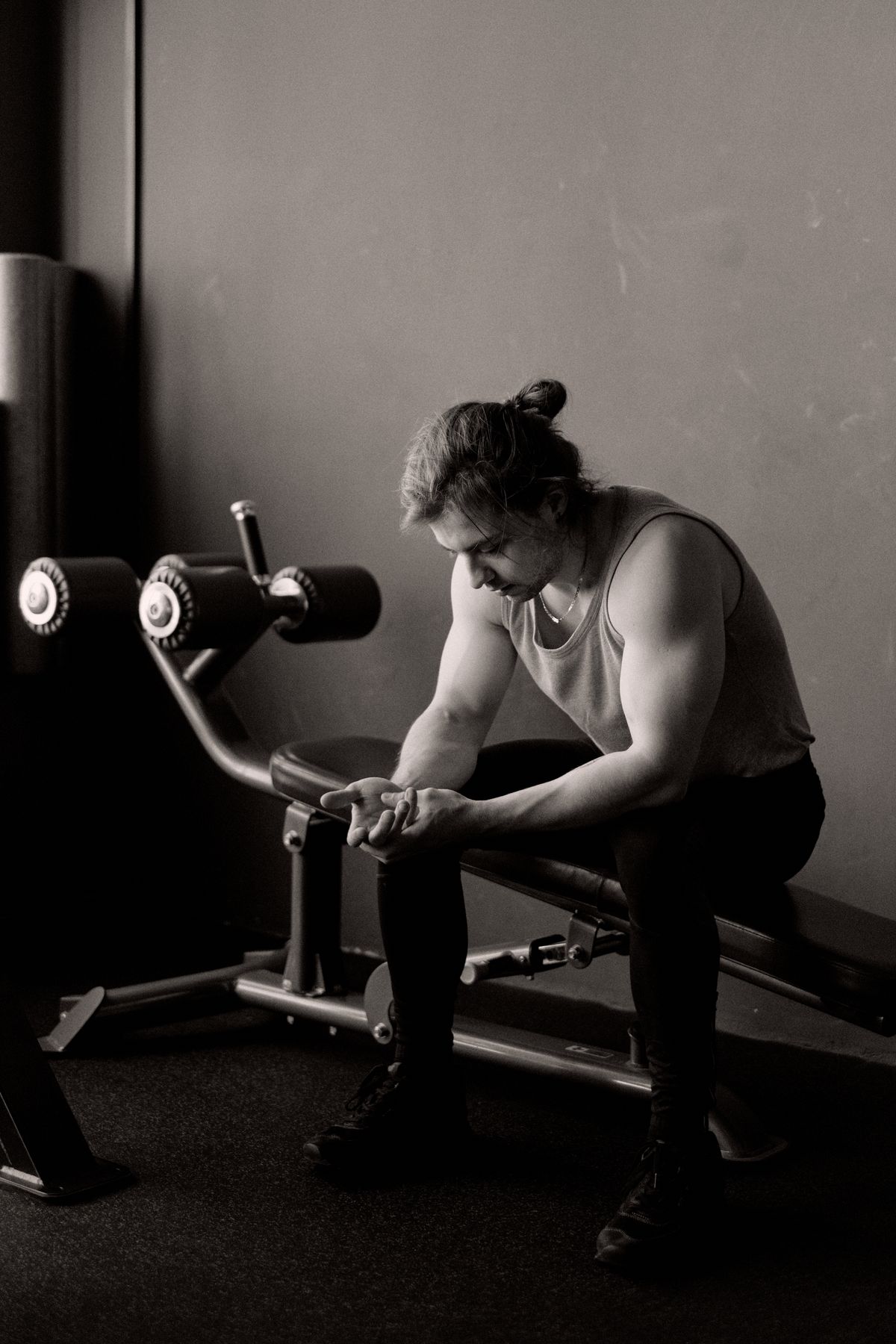 Man resting after exercising, recovering from an intense training session
EPOC and Resistance Training
Cardio gets most of the afterburn attention, but heavy resistance training may produce the longest-lasting EPOC of any exercise modality.
The Schuenke, Mikat & McBride (2002) study is frequently cited for good reason: after a heavy resistance circuit (bench press, power cleans, and squats at 85% 1RM), oxygen consumption was significantly elevated at 14, 19, and 38 hours post-exercise. Mean daily metabolic rate was elevated for two full days after a single session.
A 2021 study by Greer et al. in aerobically fit women compared EPOC between circuit-style resistance training and HIIT. Both modalities elevated resting metabolic rate at 14 hours post-exercise — confirming that the afterburn isn't exclusive to cardio-based protocols.
Why does resistance training produce such prolonged EPOC? Heavy compound lifts create a large anaerobic energy deficit, significant muscle tissue damage requiring repair, and a sustained hormonal response (elevated growth hormone, testosterone, and cortisol). All of these recovery processes consume oxygen and energy for hours — sometimes days — after the session.
The Honest Take: Real, but Not Magic
The afterburn effect is genuinely real and scientifically measurable. But it's not the fat-loss shortcut that fitness marketing often implies.
Here's the honest picture:
1. EPOC adds 6–15% of calories on top of the workout itself. If you burn 300 calories during a HIIT session, EPOC might add 20–45 more. Over weeks and months of consistent training, that accumulates. Over a single session, it's not transformative.
2. The magnitude depends on intensity, not wishful thinking. Walking, light cycling, and low-intensity classes produce negligible EPOC. You need to work above 70% of VO₂max (roughly 80%+ of max heart rate) for a meaningful afterburn response.
3. The cumulative effect is where EPOC matters most. As Meirelles & Gomes (2004) noted, a single session's EPOC doesn't dramatically shift energy balance — but the cumulative effect across weeks and months of high-intensity training is relevant for body composition.
4. EPOC doesn't replace a calorie deficit. No amount of afterburn overcomes poor nutrition. The most rigorous fat-loss research shows that exercise works best when combined with dietary awareness.
How to Maximise Your Afterburn
- Train at high intensity — above 80% max heart rate for HIIT, or 80–85% 1RM for resistance training
- Use compound movements — squats, deadlifts, cleans, and presses create larger metabolic disruption than isolation exercises
- Keep rest periods short — 30–60 seconds between HIIT intervals, 60–90 seconds between resistance sets
- Train for at least 15–20 minutes of high-intensity work — below this threshold, EPOC is minimal
- Include 2–3 high-intensity sessions per week — consistency compounds the effect
Track Your Afterburn Workouts With Hiitify
Maximising EPOC means pushing intensity — and that requires precise interval timing. Hiitify lets you build custom HIIT workouts with exact work and rest periods, chain multiple rounds, and use audio cues to manage the clock so you can focus on effort. Whether you're running Tabata sprints, EMOM circuits, or classic HIIT intervals, the app handles the structure while you handle the intensity.
Free on iOS
TRAIN SMARTER
Build custom HIIT, Tabata, AMRAP, EMOM and Circuit workouts. Precision timer, streak tracking and analytics — free on iOS.
Sources & Further Reading
Research
-
Børsheim, E. & Bahr, R. (2003). Effect of Exercise Intensity, Duration and Mode on Post-Exercise Oxygen Consumption. Sports Medicine, 33(14), 1037–1060. View on PubMed
-
LaForgia, J., Withers, R.T. & Gore, C.J. (2006). Effects of exercise intensity and duration on the excess post-exercise oxygen consumption. Journal of Sports Sciences, 24(12), 1247–1264. View on PubMed
-
Knab, A.M. et al. (2011). A 45-Minute Vigorous Exercise Bout Increases Metabolic Rate for 14 Hours. Medicine & Science in Sports & Exercise, 43(9), 1643–1648. View on ResearchGate
-
Schuenke, M.D., Mikat, R.P. & McBride, J.M. (2002). Effect of an Acute Period of Resistance Exercise on Excess Post-Exercise Oxygen Consumption: Implications for Body Mass Management. European Journal of Applied Physiology, 86(5), 411–417. View on PubMed
-
Li, H. et al. (2024). Acute interval running induces greater excess post-exercise oxygen consumption and lipid oxidation than isocaloric continuous running in men with obesity. BMC Sports Science, Medicine and Rehabilitation. View on PMC
-
Greer, B.K. et al. (2021). EPOC Comparison Between Resistance Training and High-Intensity Interval Training in Aerobically Fit Women. International Journal of Exercise Science, 14(4), 1479–1490. View on PMC
Further Reading
- 7 Things to Know About EPOC — ACE Fitness
- Exploring Excess Post-Exercise Oxygen Consumption — NASM
- The Afterburn Effect: Tips, Workouts and Recovery — U.S. News
Image Credits
- Cover: Fit man resting after intense workout session — Pexels
- Man training on rowing machine in gym — Pexels
- Man resting after exercising — Pexels
All images free to use under the Pexels License.