You do not need a gym membership, dumbbells, or a dedicated workout room. Home workouts with no equipment are one of the most effective ways for beginners to build strength, improve cardiovascular fitness, and establish an exercise habit — and the research backs it up. All you need is enough floor space to lie down and about 20 minutes.
Why Bodyweight Training Works
The fitness industry sells complexity, but muscle growth follows a simple rule: apply enough mechanical tension, take the set close to failure, and recover. That tension can come from a barbell or from your own bodyweight.
A 2017 study by Kikuchi and Nakazato published in the Journal of Exercise Science and Fitness put this to the test. Eighteen men were randomly assigned to either a push-up group or a bench press group for 8 weeks. The results: push-ups produced an 18.3% increase in chest muscle thickness versus 19.4% for bench press — a difference that was not statistically significant. Triceps growth was nearly identical too.
A meta-analysis of 21 studies confirmed the broader principle: low-load resistance training produces equivalent muscle hypertrophy to heavy lifting when sets are performed to failure. For beginners — whose muscles respond to almost any new stimulus — bodyweight exercises are more than enough.
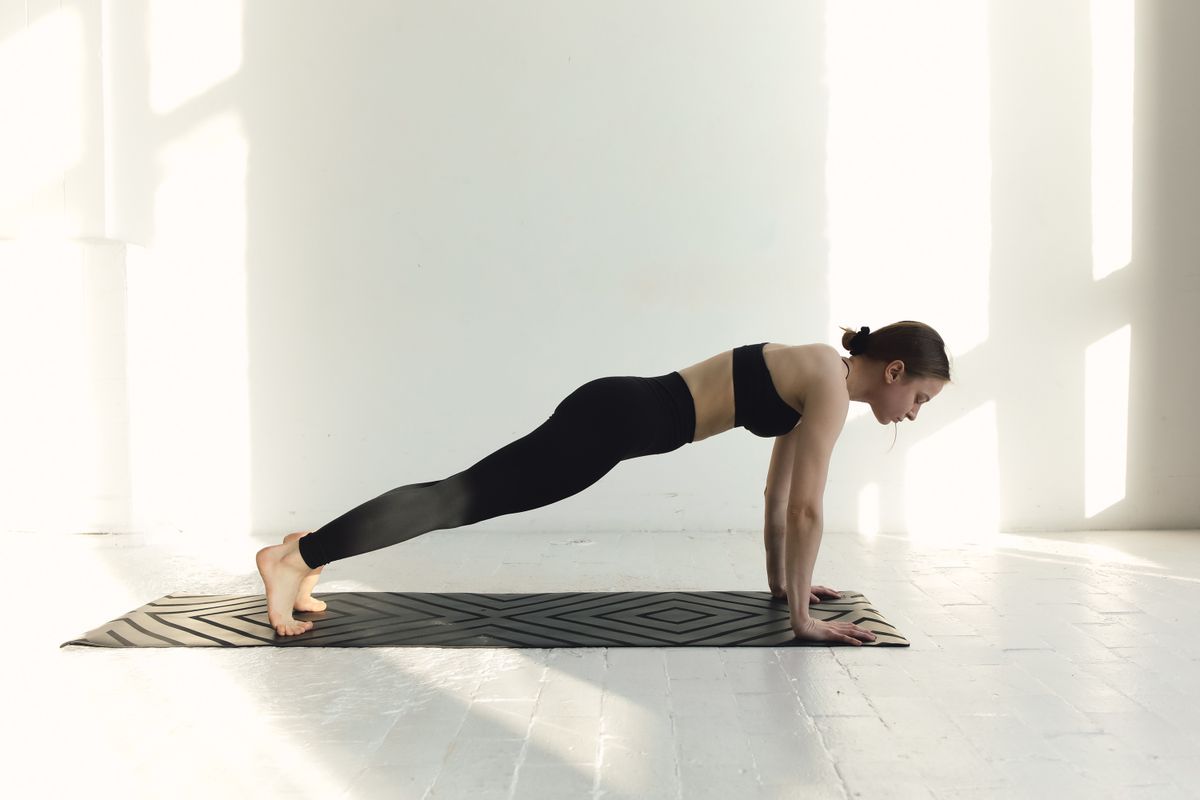 Woman doing push-ups on a yoga mat in a bright indoor setting
The 6 Best Beginner Exercises (No Equipment)
These six movements cover every major muscle group. Each one can be modified to match your current fitness level.
| Exercise | Primary Muscles | Beginner Modification |
|---|---|---|
| Bodyweight squat | Quads, glutes, core | Squat to a chair |
| Wall push-up | Chest, triceps, shoulders | Step closer to the wall |
| Reverse lunge | Quads, glutes, hamstrings | Hold a doorframe for balance |
| Plank (knees down) | Core, shoulders | Reduce hold to 10–15 seconds |
| Glute bridge | Glutes, hamstrings, lower back | Reduce range of motion |
| Dead bug | Core, hip flexors | Extend one limb at a time |
Why these six? They are all compound movements — exercises that work multiple joints and muscle groups simultaneously. The ACSM recommends compound exercises for beginners because they deliver more training stimulus per minute and mirror real-world movement patterns.
Free on iOS
TRAIN SMARTER
Build custom HIIT, Tabata, AMRAP, EMOM and Circuit workouts. Precision timer, streak tracking and analytics — free on iOS.
A 20-Minute Starter Routine
This routine requires zero equipment and hits every major muscle group. Perform it 3 days per week with at least one rest day in between.
Warm-up (3 minutes)
- March in place: 60 seconds
- Arm circles: 30 seconds each direction
- Bodyweight hip hinges: 60 seconds
Main circuit — repeat 2–3 rounds
| Exercise | Work | Rest |
|---|---|---|
| Bodyweight squats | 12 reps | 30s |
| Wall push-ups | 10 reps | 30s |
| Reverse lunges (alternating) | 10 total | 30s |
| Plank (knees down) | 20s hold | 30s |
| Glute bridges | 12 reps | 30s |
| Dead bugs (alternating) | 10 total | 60s before next round |
Cool-down (2 minutes)
- Quad stretch: 20 seconds each leg
- Chest doorway stretch: 20 seconds
- Child's pose: 30 seconds
Total time: roughly 20 minutes for 3 rounds. If 3 rounds feel too long, start with 2 — the most important thing is finishing the session.
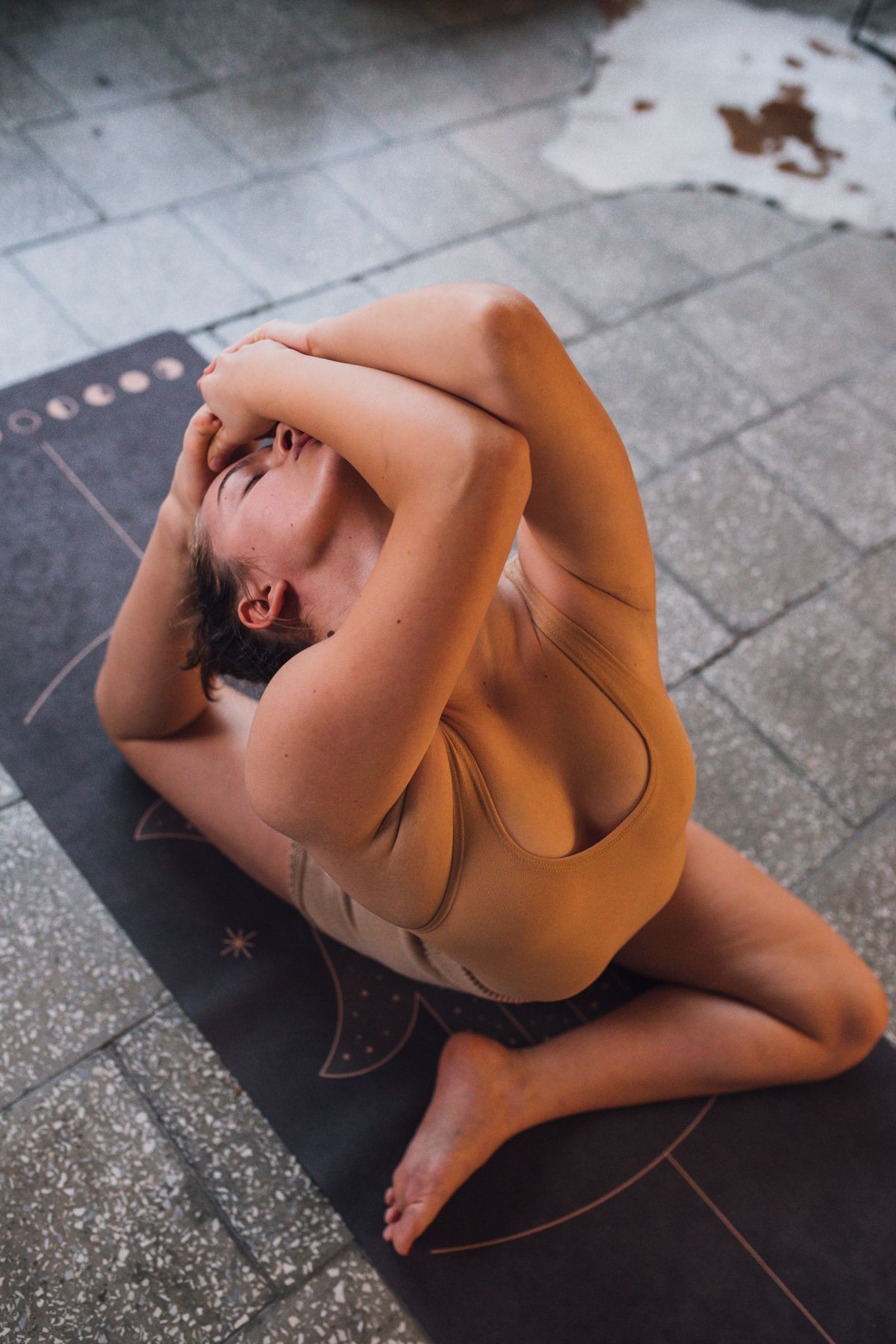 Woman in activewear stretching on a yoga mat at home
How to Progress Without Equipment
One of the biggest myths about home workouts is that you will "outgrow" bodyweight exercises quickly. In reality, there are several ways to apply progressive overload without ever touching a weight:
1. Add reps or sets. Once 12 squats feel easy, move to 15. Once 2 rounds feel comfortable, do 3.
2. Slow down the tempo. A 3-second lowering phase on each rep dramatically increases time under tension. A squat that takes 1 second to lower and 1 second to stand is a very different stimulus from one that takes 3 seconds to lower.
3. Reduce rest periods. Cutting rest from 60 seconds to 30 increases cardiovascular demand and overall training density.
4. Move to harder variations. This is the most powerful lever. The progression chain for push-ups alone — wall, incline, knee, full, decline, archer — can keep you challenged for months.
| Exercise | Level 1 | Level 2 | Level 3 |
|---|---|---|---|
| Push-up | Wall | Knee | Full |
| Squat | Chair-assisted | Bodyweight | Pause squat (3s at bottom) |
| Plank | Knees down | Full plank | Plank shoulder taps |
| Lunge | Static hold | Reverse lunge | Walking lunge |
The Research on Home Workout Adherence
Starting is one thing. Sticking with it is another.
A 2026 study by Skarabot et al. published in Frontiers in Sports and Active Living tracked resistance exercise adherence across a large cohort of mobile app users. The findings were sobering: only 18.1% of beginners remained adherent at 6 months, and the median dropout time was 14 weeks.
But the study also identified the single strongest predictor of long-term success: consistency during the first 28 days. Beginners who trained regularly in that early window were significantly more likely to still be training months later. The takeaway is clear — the first month matters more than the first workout.
A 2025 PMC study on previously inactive adults reinforced this. Participants following a home-based bodyweight interval programme achieved a 12.5% increase in relative muscular strength over just 6 weeks — with a 93% adherence rate and zero injuries. The programme was video-guided, required no equipment, and sessions were under 30 minutes.
The message from the research: short, simple, home-based routines produce real results and high adherence — exactly what beginners need.
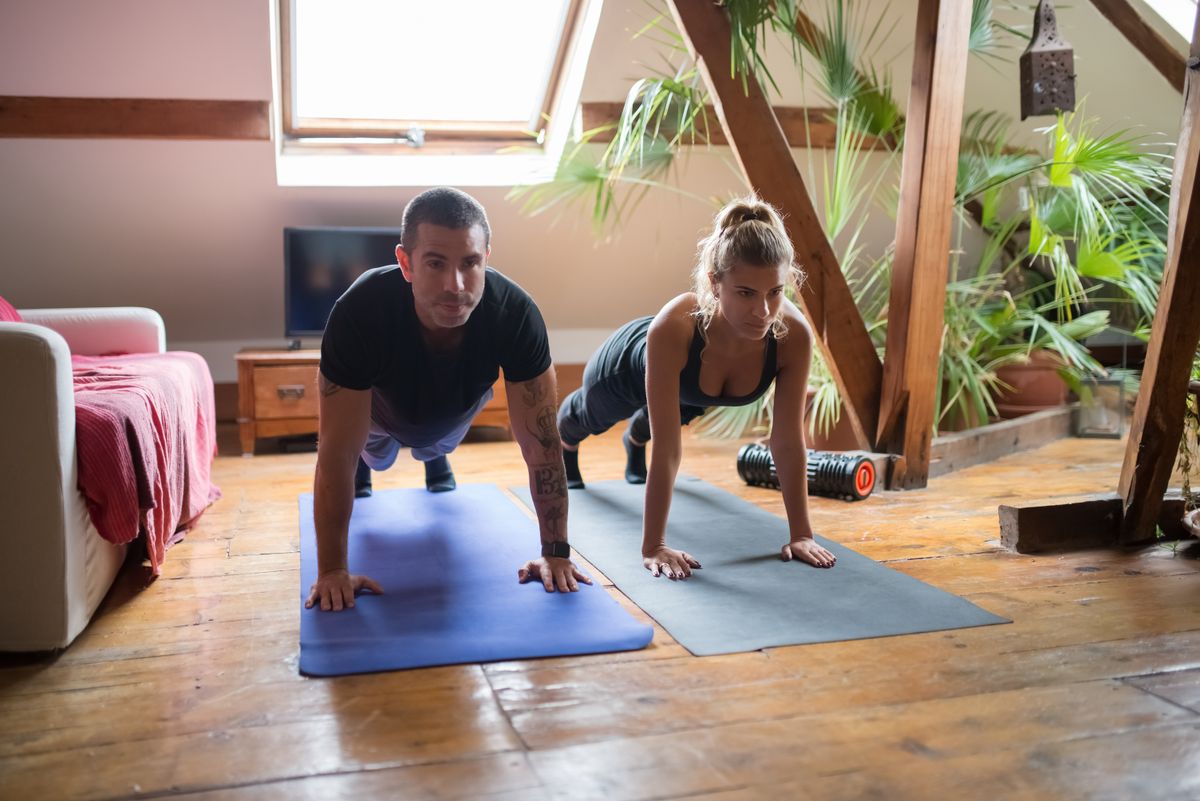 A man and woman working out together at home on yoga mats
Track Your Home Workouts With Hiitify
Hiitify is built for exactly this kind of training. Set up a custom interval timer for your bodyweight circuit — work periods, rest periods, and rounds all adjust to match your level. Log every session to build your streak, and use the progression data to know when it is time to add a set, cut your rest, or move to a harder variation.
Free on iOS
TRAIN SMARTER
Build custom HIIT, Tabata, AMRAP, EMOM and Circuit workouts. Precision timer, streak tracking and analytics — free on iOS.
Sources & Further Reading
Research
- Kikuchi, N. & Nakazato, K. (2017). Low-load bench press and push-up induce similar muscle hypertrophy and strength gain. Journal of Exercise Science & Fitness. View on PubMed
- Schoenfeld, B.J. et al. (2017). Strength and Hypertrophy Adaptations Between Low- vs. High-Load Resistance Training: A Systematic Review and Meta-analysis. Journal of Strength and Conditioning Research. View on PubMed
- Skarabot, J. et al. (2026). Predictors of long-term resistance exercise adherence among beginners: Evidence from a large cohort of mobile app users. Frontiers in Sports and Active Living. View on Frontiers
- Ponce-González, J.G. et al. (2025). Impact of exercise video-guided bodyweight interval training on psychophysiological outcomes in inactive adults with obesity. Frontiers in Physiology. View on PMC
- Garber, C.E. et al. (2011). Quantity and Quality of Exercise for Developing and Maintaining Cardiorespiratory, Musculoskeletal, and Neuromotor Fitness in Apparently Healthy Adults. Medicine & Science in Sports & Exercise (ACSM Position Stand). View on PubMed
Further Reading
- The Advantages of Body-Weight Exercise — Harvard Health
- New Resistance Training Guidelines Emphasize Consistency — Healthline
- The Complete Beginner's Guide to Working Out at Home — Daily Burn
Image Credits
- Cover: Woman doing pushups on a yoga mat — Pexels
- Woman doing push-ups indoors — Pexels
- Woman stretching on a yoga mat — Pexels
- Man and woman working out together at home — Pexels
All images free to use under the Pexels License.