You do not need a complicated program to start building strength. The most effective full body workout for beginners is built on five movement patterns, uses no equipment, and takes under 40 minutes. Research consistently shows that simple, compound-movement routines produce the same results as complex gym programs for people in their first months of training — often better, because they are easier to stick with.
Why Full Body Training Is Ideal for Beginners
A 2024 systematic review and meta-analysis published in the Journal of Strength and Conditioning Research analyzed 14 studies with 392 participants and found that full body training produces equivalent muscle and strength gains to split routines when total training volume is matched. For beginners, full body has a practical edge: it trains every muscle group two to three times per week in just two to three sessions.
This matters because of how muscle adapts. After a resistance training session, muscle protein synthesis (MPS) — the process that repairs and grows muscle fibers — peaks within a few hours and stays elevated for roughly 36 to 48 hours in untrained individuals. After that window closes, the muscle is ready for another stimulus. Training a muscle only once per week means five days of missed growth potential. Full body training keeps the signal active.
A 2017 meta-analysis by Schoenfeld et al. confirmed this directly: training a muscle group twice per week produced significantly greater hypertrophy than training it once per week, even when total weekly volume was the same.
The Five Movement Patterns
Every effective full body routine covers five fundamental movement patterns. Each one targets a different set of muscle groups and trains a different real-world function.
| Pattern | What It Trains | Example Exercise |
|---|---|---|
| Squat | Quads, glutes, core | Bodyweight squat |
| Hinge | Hamstrings, glutes, lower back | Glute bridge |
| Push | Chest, shoulders, triceps | Push-up |
| Pull | Back, biceps, rear delts | Inverted row or band pull-apart |
| Core | Deep stabilizers, obliques | Dead bug or plank |
A 2017 review by Gentil et al. found that for beginners, adding isolation exercises like bicep curls or tricep extensions on top of a compound program produced no additional benefit for muscle size or strength. These five patterns are all you need.
 Man doing push-ups during an outdoor workout in a city park
Free on iOS
TRAIN SMARTER
Build custom HIIT, Tabata, AMRAP, EMOM and Circuit workouts. Precision timer, streak tracking and analytics — free on iOS.
The Beginner Full Body Workout
Perform this routine two to three times per week with at least one rest day between sessions. Each session takes 25 to 40 minutes.
Warm-Up (5 Minutes)
- March in place — 60 seconds
- Arm circles (forward and backward) — 30 seconds each direction
- Bodyweight squats (slow, controlled) — 60 seconds
- Hip circles — 30 seconds each direction
The Workout
| Exercise | Sets | Reps | Rest | Pattern |
|---|---|---|---|---|
| Bodyweight squat | 3 | 10–15 | 60s | Squat |
| Glute bridge | 3 | 12–15 | 60s | Hinge |
| Push-up (or incline push-up) | 3 | 8–12 | 60s | Push |
| Inverted row (or band row) | 3 | 8–12 | 60s | Pull |
| Dead bug | 2 | 8 per side | 45s | Core |
| Plank | 2 | 20–30 seconds | 45s | Core |
The updated 2026 ACSM resistance training guidelines confirm that one to three sets per exercise produce measurable strength gains in beginners — you do not need high volume to see results. What matters is training close to failure, roughly within two to three reps of your limit on each set.
Exercise Notes
Bodyweight squat: Stand with feet shoulder-width apart. Push your hips back and lower until your thighs are parallel to the floor. Keep your chest up and weight in your heels.
Glute bridge: Lie on your back with knees bent and feet flat. Drive through your heels to lift your hips, squeezing your glutes at the top for two seconds.
Push-up: If you cannot do a full push-up from the floor, start with your hands on a counter or sturdy chair. Lower your chest to the surface, then push back up. Gradually lower the surface height as you get stronger.
Inverted row: Use a sturdy table edge or a low bar. Hang underneath with your body straight, then pull your chest to the bar. No equipment? Use a resistance band anchored to a door for band rows.
Dead bug: Lie on your back with arms pointing to the ceiling and knees bent at 90 degrees. Slowly extend one arm overhead and the opposite leg toward the floor, keeping your lower back pressed into the ground. Return and switch sides.
How to Progress Week by Week
The key to continued results is progressive overload — gradually increasing the challenge over time. Here is a simple four-week progression framework:
| Week | Sets | Reps | Tempo | Frequency |
|---|---|---|---|---|
| 1 | 2 | 8–10 | Normal | 2x per week |
| 2 | 2 | 10–12 | Normal | 2x per week |
| 3 | 3 | 10–12 | Normal | 2–3x per week |
| 4 | 3 | 12–15 | Slow (3 seconds down) | 3x per week |
After four weeks, progress to harder exercise variations:
- Squat → Split squat → Bulgarian split squat
- Glute bridge → Single-leg glute bridge → Hip thrust
- Incline push-up → Floor push-up → Diamond push-up
- Band row → Inverted row → Feet-elevated inverted row
- Plank → Plank shoulder tap → Body saw
Research shows most beginners see measurable strength improvements within two to four weeks and visible changes in muscle tone by six to eight weeks of consistent training.
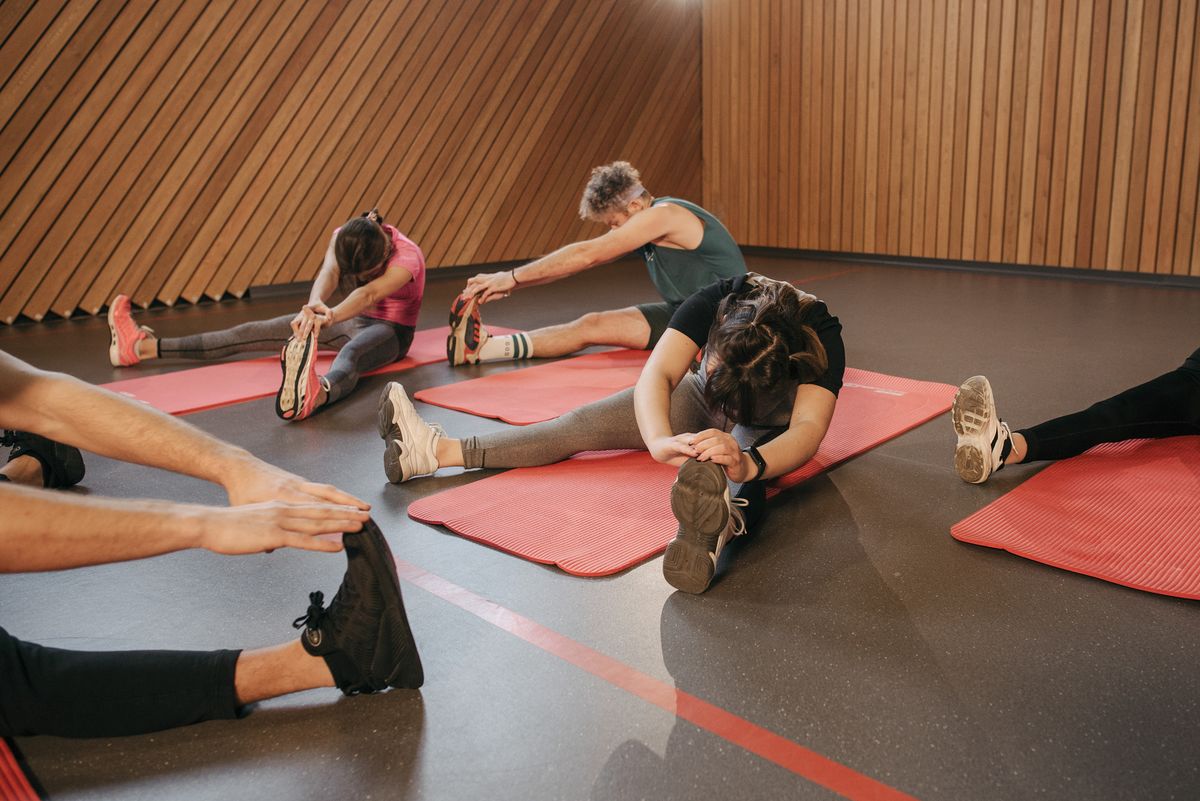 Group of people exercising together on mats during a fitness class
Common Mistakes to Avoid
Going too hard, too fast. Your muscles adapt quickly, but your tendons and connective tissue take longer. Starting with two sets and moderate reps lets your body build a resilient foundation.
Skipping the pull pattern. Beginners tend to focus on push-ups and squats but neglect pulling movements. This creates muscle imbalances and increases shoulder injury risk. Always include a row variation.
Chasing soreness. Severe muscle soreness is not a sign of a good workout — it usually means you did too much, too soon. Research shows that after just three weeks of consistent training, muscle damage decreases significantly and protein synthesis is redirected toward actual muscle growth rather than repair.
Resting too little between sets. Rest periods matter. Sixty seconds between sets allows enough recovery for beginners to maintain good form and effort across all sets. Cutting rest short reduces total training quality.
Track Your Full Body Workouts With Hiitify
Hiitify lets you build custom interval timers for every exercise in this routine — set your work periods, rest intervals, and number of rounds, then follow along with audio cues. Log every session, track your weekly consistency with workout streaks, and watch your progress build over time. Whether you are doing two sessions or three, Hiitify keeps you on track.
Free on iOS
TRAIN SMARTER
Build custom HIIT, Tabata, AMRAP, EMOM and Circuit workouts. Precision timer, streak tracking and analytics — free on iOS.
Sources & Further Reading
Research
- Schoenfeld, B.J. et al. (2024). Efficacy of Split Versus Full-Body Resistance Training on Strength and Muscle Growth: A Systematic Review With Meta-Analysis. Journal of Strength and Conditioning Research. View on JSCR
- Schoenfeld, B.J. et al. (2016). Effects of Resistance Training Frequency on Measures of Muscle Hypertrophy: A Systematic Review and Meta-Analysis. Sports Medicine. View on PubMed
- Gentil, P. et al. (2017). Effect of adding single-joint exercises to a multi-joint exercise resistance-training program on strength and hypertrophy in untrained subjects. Applied Physiology, Nutrition, and Metabolism. View on PubMed
- MacDougall, J.D. et al. (1995). The time course for elevated muscle protein synthesis following heavy resistance exercise. Canadian Journal of Applied Physiology. View on PubMed
- Vieira, A.F. et al. (2022). A randomized trial on the efficacy of split-body versus full-body resistance training in non-resistance trained women. BMC Sports Science, Medicine and Rehabilitation. View on PMC
Further Reading
- ACSM 2026 Resistance Training Guidelines Update — ACSM
- The PERFECT Full Body Workout Routine — Built With Science
- Compound Exercises: The Complete Strength Guide — Stronger
Image Credits
- Cover: Man Exercising at Home — Pexels
- Man Doing Push-Ups in Park — Pexels
- People Exercising Together on Mats — Pexels
All images free to use under the Pexels License.