You don't need a gym membership, a rack of dumbbells, or even a lot of space. Some of the most effective HIIT exercises you can do at home require nothing but your body weight and a few square feet of floor. And the science confirms it — a 2023 systematic review and meta-analysis published in BMC Sports Science, Medicine and Rehabilitation found no significant difference in cardiorespiratory fitness between home-based HIIT and lab-based HIIT (SMD: -0.35, 95% CI: -0.73, 0.03). The location doesn't matter. The effort does.
Here are the 10 best exercises for building a home HIIT workout that actually delivers results.
Why Home HIIT Works as Well as the Gym
The evidence is clear: training location has minimal impact on results when intensity stays high.
A 2025 study published in Frontiers in Public Health investigated the effects of an 8-week high-intensity bodyweight interval resistance training (HIIRT) programme on 30 overweight women. The results were striking — participants saw an average body weight reduction of 11.4 kg (p = 0.001), along with significant improvements in blood lipid profiles including triglycerides, total cholesterol, and LDL. No gym equipment was used.
Research on EPOC (excess post-exercise oxygen consumption) reinforces this. A 2025 study in Sports (Basel) found that HIIT and high-intensity circuit training produced EPOC values of 319 mL and 329 mL respectively — nearly double the 169 mL measured for moderate-intensity continuous training. These elevated metabolic effects persisted for at least 60 minutes post-exercise, with significantly greater carbohydrate and lipid oxidation.
The bottom line: your living room is a perfectly adequate training facility.
The 10 Best Home HIIT Exercises
1. Burpees
The single most metabolically demanding bodyweight exercise. Burpees engage your chest, shoulders, core, quads, glutes, and arms in one continuous movement, producing a MET value of approximately 10–12 and burning 10–15 calories per minute in trained individuals.
How to do it: From standing, squat down and place your hands on the floor. Jump your feet back into a plank, perform a push-up, jump your feet forward, and explode into a jump overhead.
Scale it down: Replace with squat-to-stands — squat, hands to floor, step feet back one at a time, step forward, stand. No jump, no push-up.
2. Jump Squats
An explosive plyometric exercise that builds power in your quads and glutes while driving your heart rate up fast. Jump squats burn approximately 8–12 calories per minute at high intensity.
How to do it: Perform a bodyweight squat, then explode upward into a jump. Land softly with bent knees and immediately drop into the next rep.
Scale it down: Perform fast bodyweight squats, rising onto your toes at the top instead of jumping.
3. Mountain Climbers
A full-body cardio exercise performed from a plank position that targets your core, shoulders, hip flexors, and quads simultaneously. Mountain climbers carry a MET value of approximately 8–11, placing them among the most metabolically demanding bodyweight exercises.
How to do it: Start in a high plank. Drive one knee toward your chest, then quickly switch legs in a running motion. Keep your hips level and your core tight.
Scale it down: Slow the pace — step each foot forward deliberately instead of running.
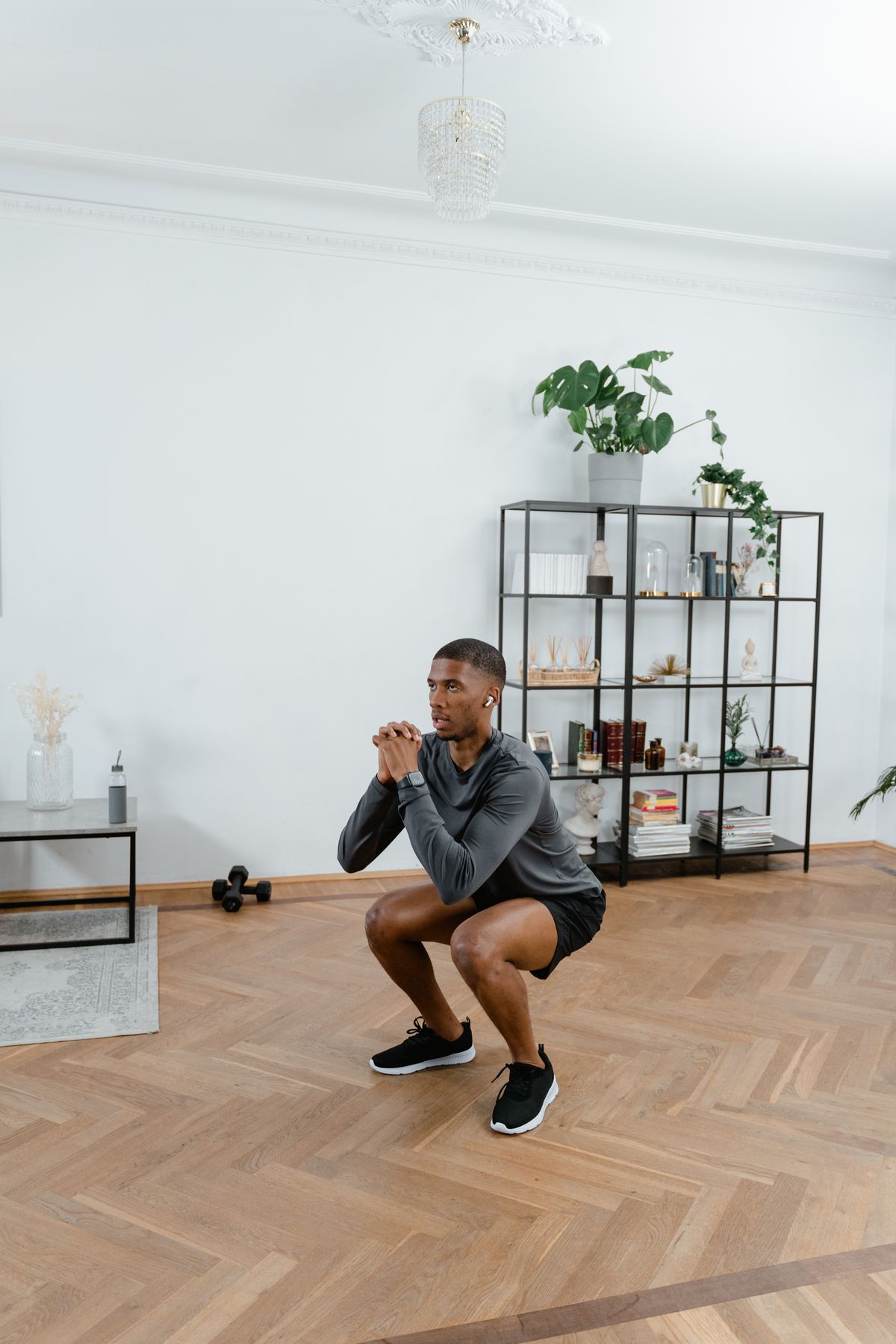 Man performing bodyweight squats at home in athletic wear
4. High Knees
A simple but brutally effective cardio exercise that targets your hip flexors, quads, and core while rapidly elevating your heart rate. High knees produce a MET value of approximately 8, making them one of the most efficient standing cardio exercises.
How to do it: Run in place, driving each knee to hip height. Pump your arms to match the pace of your legs.
Scale it down: March in place with exaggerated knee lifts.
5. Plank to Push-Up
A strength-focused exercise that challenges your chest, shoulders, triceps, and core through a continuous transition between two demanding positions.
How to do it: Start in a forearm plank. Press up to a high plank one arm at a time, then lower back down to your forearms. Alternate which arm leads each rep.
Scale it down: Perform from your knees, or hold a standard plank for the work interval.
6. Skater Jumps
A lateral plyometric exercise that builds single-leg power, improves balance, and works your glutes and outer thighs — muscles that forward-backward exercises often miss.
How to do it: Stand on one leg. Leap laterally to the opposite foot, landing softly on one leg with your other foot behind you. Immediately leap back the other way. Swing your arms for momentum.
Scale it down: Reduce the distance of each leap and tap your trailing foot down for balance.
7. Tuck Jumps
One of the most explosive bodyweight exercises available. Tuck jumps develop lower-body power and send your heart rate through the roof in seconds.
How to do it: From standing, jump as high as you can while driving both knees toward your chest. Land softly with bent knees and immediately repeat.
Scale it down: Replace with squat jumps or fast bodyweight squats if tuck jumps are too demanding on your joints.
8. Push-Ups
The gold standard for upper-body bodyweight strength. Push-ups target your chest, shoulders, and triceps while engaging your core as a stabiliser. A review published in Life (Basel) found that HIIT significantly improves neuromuscular activation by increasing motor unit recruitment, particularly in fast-twitch fibres — and push-ups performed at speed in a HIIT format maximise this effect.
How to do it: Start in a high plank, hands just wider than shoulder-width. Lower your chest to the floor keeping your elbows at roughly 45 degrees. Push back up explosively.
Scale it down: Perform on your knees or do incline push-ups with hands on a bench, step, or couch.
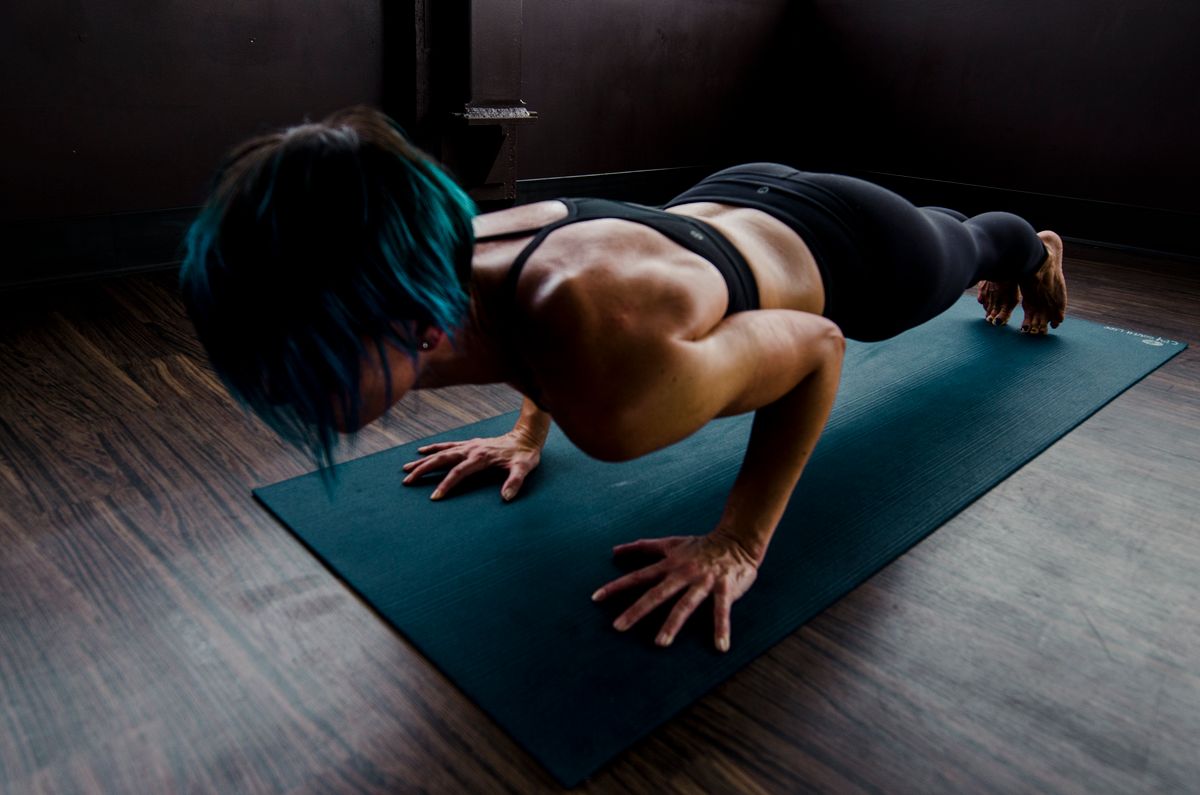 Woman performing push-ups on a wooden floor during a home workout
9. Reverse Lunges
A knee-friendly unilateral exercise that targets your glutes, quads, and hamstrings while challenging your balance and coordination. Alternating lunges at speed make an excellent HIIT exercise because they keep your heart rate elevated while building single-leg strength.
How to do it: Step one foot back and lower your rear knee toward the floor until both legs form 90-degree angles. Drive through your front heel to return to standing. Alternate legs each rep.
Scale it down: Hold onto a wall or chair for balance, or reduce your range of motion.
10. Bicycle Crunches
A core-focused exercise that targets your rectus abdominis and obliques through a twisting, pedalling motion. Including a dedicated core exercise in your HIIT circuit ensures balanced muscular development and provides a brief cardiovascular "dip" that lets your legs recover between explosive sets.
How to do it: Lie on your back with hands behind your head. Lift your shoulders off the floor and drive one knee toward the opposite elbow while extending the other leg. Alternate sides in a pedalling motion.
Scale it down: Keep your feet on the floor and perform slow, controlled twists instead of the full pedalling motion.
Calorie Burn Comparison
Not all home HIIT exercises deliver the same metabolic demand. Here's how the top exercises compare for a 70 kg (155 lb) person:
Free on iOS
TRAIN SMARTER
Build custom HIIT, Tabata, AMRAP, EMOM and Circuit workouts. Precision timer, streak tracking and analytics — free on iOS.
| Exercise | Calories/Min | Approx. MET | Primary Muscles |
|---|---|---|---|
| Burpees | 10–15 | ~10–12 | Full body |
| Tuck jumps | 10–14 | ~10 | Quads, glutes, core |
| Mountain climbers | 8–15 | ~8–11 | Core, shoulders, legs |
| Jump squats | 8–12 | ~8 | Quads, glutes, hamstrings |
| High knees | 8–10 | ~8 | Hip flexors, quads, core |
| Skater jumps | 7–10 | ~7–8 | Glutes, quads, outer thighs |
| Push-ups (fast) | 5–8 | ~5–6 | Chest, shoulders, triceps |
| Reverse lunges | 5–7 | ~5–6 | Glutes, quads, hamstrings |
The highest-calorie exercises are explosive, full-body movements. But the smartest HIIT circuits alternate between high-output moves and strength-focused exercises — this keeps your heart rate elevated while giving specific muscle groups time to recover.
Sample 20-Minute Home HIIT Workout
Here's a complete workout using exercises from this list. No equipment. No excuses.
Format: 30 seconds work / 15 seconds rest. 5 exercises. 4 rounds.
Each Round:
- Burpees (or squat-to-stands) — 30 sec work / 15 sec rest
- Reverse lunges (alternating) — 30 sec work / 15 sec rest
- Mountain climbers — 30 sec work / 15 sec rest
- Push-ups — 30 sec work / 15 sec rest
- Jump squats (or fast squats) — 30 sec work / 15 sec rest
Rest 60 seconds between rounds.
Total time: ~20 minutes including rest.
How to Progress
Once this workout feels manageable, progress one variable at a time:
- Week 1–2: 30s work / 15s rest, 3 rounds
- Week 3–4: 30s work / 15s rest, 4 rounds — add tuck jumps and skater jumps
- Week 5–6: 35s work / 10s rest, 4 rounds
- Week 7+: 40s work / 10s rest, 4 rounds — use the hardest variation of each exercise
Track Your Home HIIT Workouts With Hiitify
The best home workout is the one you actually do consistently. Hiitify lets you build custom HIIT timers with precise work and rest intervals, save your favourite home workouts for instant replay, and track your training streak so you never lose momentum. Add exercises with notes and modifications, follow along with audio countdown cues, and focus on the effort — not the clock.
Free on iOS
TRAIN SMARTER
Build custom HIIT, Tabata, AMRAP, EMOM and Circuit workouts. Precision timer, streak tracking and analytics — free on iOS.
Sources & Further Reading
Research
-
Batacan, R.B. et al. (2017). Effects of high-intensity interval training on cardiometabolic health: a systematic review and meta-analysis of intervention studies. British Journal of Sports Medicine, 51(6), 494–503. View on PubMed
-
Wen, D. et al. (2023). Home-based high-intensity interval training improves cardiorespiratory fitness: a systematic review and meta-analysis. BMC Sports Science, Medicine and Rehabilitation, 15, 167. View on PMC
-
Yamaner, E. et al. (2025). Impact of an 8-week high-intensity bodyweight interval training on body composition and blood lipid metabolism in young women with overweight. Frontiers in Public Health, 13, 1578569. View on PMC
-
Faleiro, V. et al. (2025). Isocaloric High-Intensity Interval and Circuit Training Increases Excess Post-Exercise Oxygen Consumption and Lipid Oxidation Compared to Moderate-Intensity Continuous Training. Sports (Basel). View on PubMed
-
Tsirigkakis, S. et al. (2025). The Role of High-Intensity Interval Training (HIIT) in Neuromuscular Adaptations: Implications for Strength and Power Development — A Review. Life (Basel), 15(4), 657. View on PMC
-
Hurst, C. et al. (2022). Equipment-free, unsupervised high intensity interval training elicits significant improvements in the physiological resilience of older adults. BMC Geriatrics. View on PMC
Further Reading
- Best HIIT Workouts at Home — Sports Medicine Weekly
- The Workout Debate: Experts Weigh In on Cardio vs. HIIT — Penn Medicine
- HIIT Exercises at Home: No-Equipment Workouts — Pressed
Image Credits
- Cover: Woman exercising at home with online coaching — Pexels
- Man doing squats at home — Pexels
- Woman doing push-ups — Pexels
All images free to use under the Pexels License.