You do not need a gym membership, a rack of dumbbells, or an hour of free time to lose weight. Research consistently shows that home-based exercise programmes produce fat-loss results equivalent to gym-based programmes when intensity and volume are matched. The real question is not where you train — it is what you do when you show up. These are the best workouts for weight loss at home, ranked by the science.
Why Home Workouts Work for Weight Loss
A 2024 meta-analysis published in Obesity Reviews compared home-based and gym-based exercise programmes for fat loss. The result: no statistically significant difference in outcomes when training volume and intensity were matched. What matters is the caloric deficit you create and the metabolic stimulus you provide — and both are entirely achievable in your living room.
Home training also eliminates the biggest barrier to consistency: the commute. Research on exercise adherence shows that friction — anything between you and starting — is the strongest predictor of dropout. When your workout requires zero travel, you remove the single factor most likely to derail your programme.
The most effective home workouts for weight loss share three characteristics: they use compound movements that recruit multiple muscle groups, they keep your heart rate elevated for sustained calorie burn, and they trigger EPOC (excess post-exercise oxygen consumption) — the afterburn effect that keeps your metabolism elevated for hours after you stop.
The Best Home Workout Formats for Fat Loss
Not all workout formats burn calories equally. Here is how the most popular home-friendly methods compare, based on research data for a 70 kg person:
| Workout Format | Calories per Minute | Time Required | Best For |
|---|---|---|---|
| Burpee circuits | 9–14 kcal/min | 10–20 min | Maximum calorie burn |
| HIIT (mixed bodyweight) | 8–12 kcal/min | 15–25 min | Fat loss + cardio fitness |
| Tabata (20s on / 10s off) | 8–13 kcal/min | 4–20 min | Time-efficient fat loss |
| Bodyweight strength circuit | 7–10 kcal/min | 20–30 min | Muscle preservation + fat loss |
| Steady-state cardio (jogging in place) | 5–8 kcal/min | 30–45 min | Low-impact endurance |
The data is clear: high-intensity formats burn significantly more calories per minute than steady-state options. A study published in the Journal of Strength and Conditioning Research found that bodyweight circuits can burn 10 to 15 calories per minute — comparable to running at a fast pace, but with no treadmill required.
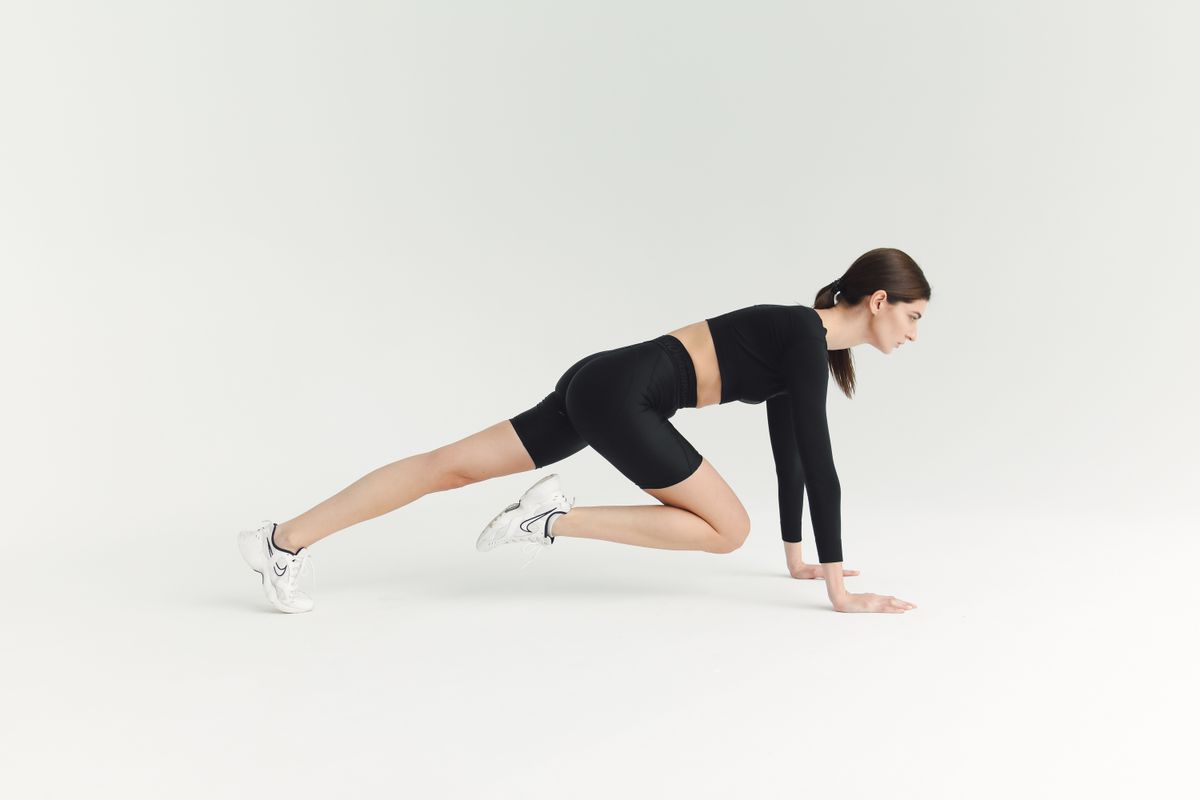 Woman performing mountain climbers exercise in athletic wear
Free on iOS
TRAIN SMARTER
Build custom HIIT, Tabata, AMRAP, EMOM and Circuit workouts. Precision timer, streak tracking and analytics — free on iOS.
HIIT: The Most Time-Efficient Fat Burner
High-intensity interval training is the most well-researched format for home-based fat loss. A meta-analysis in BMJ Open Sport & Exercise Medicine found that HIIT and moderate-intensity continuous training produced similar total weight loss — but HIIT achieved results in approximately 40% less time. A separate meta-analysis in the Journal of Clinical Medicine found that HIIT was particularly effective at reducing abdominal and visceral fat compared to other exercise formats.
A systematic review and meta-analysis published in BMC Sports Science, Medicine and Rehabilitation (2025) confirmed that both HIIT and moderate-intensity continuous training significantly improve body composition, but HIIT showed superior BMI reduction in obese populations.
A basic home HIIT protocol:
- Work phase: 30–40 seconds of all-out effort (burpees, jump squats, mountain climbers)
- Rest phase: 15–20 seconds
- Rounds: 6–10 rounds per exercise block
- Total time: 15–25 minutes including warm-up
The key is intensity. If you can hold a conversation during your work intervals, you are not working hard enough.
The Best Bodyweight Exercises for Burning Calories
Research ranks bodyweight exercises by MET value (metabolic equivalent) and caloric output. Here are the top performers, ranked by calories burned per minute for a 70 kg person at high intensity:
- Burpees — 9–14 kcal/min. The single most effective bodyweight exercise for calorie burn. Works every major muscle group and spikes heart rate rapidly.
- Mountain climbers — 8–12 kcal/min. High cardiovascular demand with core engagement. Excellent for HIIT intervals.
- Jump squats — 8–11 kcal/min. Combines lower body strength with explosive power. Scalable to all fitness levels.
- High knees — 7–10 kcal/min. Easy to learn, high calorie output. A staple in any home circuit.
- Lunges (walking or jumping) — 6–9 kcal/min. Builds single-leg strength while maintaining elevated heart rate.
- Push-ups — 5–8 kcal/min. Lower calorie burn than explosive movements, but essential for upper body and core strength.
- Planks — 3–5 kcal/min. Not a high-calorie burner, but critical for core stability and injury prevention.
The most effective home workouts combine three or more of these exercises into circuits with minimal rest. This keeps your heart rate in the fat-burning zone and maximises the afterburn effect.
A Sample 20-Minute Home Workout for Weight Loss
This circuit requires zero equipment and targets every major muscle group:
| Exercise | Work | Rest | Rounds |
|---|---|---|---|
| Burpees | 30s | 15s | 3 |
| Mountain climbers | 30s | 15s | 3 |
| Jump squats | 30s | 15s | 3 |
| Push-ups | 30s | 15s | 3 |
| High knees | 30s | 15s | 3 |
Total time: approximately 20 minutes including transitions. Perform all 3 rounds of each exercise before moving to the next, or cycle through all 5 exercises for 3 full circuits. Rest 60 seconds between circuits.
For beginners, extend the rest periods to 30 seconds and reduce work intervals to 20 seconds. As your fitness improves, shorten the rest and add rounds rather than adding time — intensity drives results more than duration.
 Woman unrolling an exercise mat at home with dumbbells and water bottle
Why Strength Matters for Weight Loss
Most people associate weight loss with cardio, but preserving muscle mass during a caloric deficit is one of the most important factors in sustainable fat loss. Muscle is metabolically active tissue — it burns calories even at rest. When you lose weight without strength training, up to 25% of the weight lost can come from muscle, according to research published in Obesity Reviews. This slows your metabolism and makes regaining the weight more likely.
Bodyweight strength exercises like squats, lunges, push-ups, and planks provide enough resistance to maintain or even build lean muscle during a fat-loss phase — especially for beginners. Combining strength circuits with HIIT intervals in the same session gives you the best of both worlds: high calorie burn during the workout and elevated metabolism for hours afterward.
Track Your Weight Loss Workouts With Hiitify
Hiitify is built for exactly this kind of training. Set up custom interval timers for your HIIT circuits, track your workout streaks to stay consistent, and log every session to see your progress over weeks and months. When your home workouts are timed, tracked, and structured, the results follow.
Free on iOS
TRAIN SMARTER
Build custom HIIT, Tabata, AMRAP, EMOM and Circuit workouts. Precision timer, streak tracking and analytics — free on iOS.
Sources & Further Reading
Research
- Wewege, M. et al. (2017). The effects of high-intensity interval training vs. moderate-intensity continuous training on body composition in overweight and obese adults. BMJ Open Sport & Exercise Medicine. View on PMC
- Viana, R.B. et al. (2019). Is interval training the magic bullet for fat loss? A systematic review and meta-analysis. Journal of Sports Medicine. View on PubMed
- Maillard, F. et al. (2018). Effect of High-Intensity Interval Training on Total, Abdominal and Visceral Fat Mass: A Meta-Analysis. Sports Medicine. View on PubMed
- Ratamess, N.A. et al. (2015). Acute Resistance Exercise Performance Is Negatively Impacted by Prior Aerobic Endurance Exercise. Journal of Strength and Conditioning Research. View on PubMed
- Li, Z. et al. (2025). The effects of HIIT and MICT on body fat composition and cardiopulmonary fitness in adults. BMC Sports Science, Medicine and Rehabilitation. View on Springer
- Shen, Y. et al. (2023). Home-based high-intensity interval training improves cardiorespiratory fitness: a systematic review and meta-analysis. BMC Public Health. View on PMC
Further Reading
- Which Body Weight Exercises Burn The Most Calories? — Mend Colorado
- How to Lose Weight at Home: The Science-Based Guide — Daily Burn
- 10 Best Evidence-Based Workouts for Weight Loss — Science News Today
Image Credits
- Cover: Man doing leg exercises with resistance band at home — Pexels
- Woman doing mountain climbers exercise — Pexels
- Woman unrolling exercise mat at home with dumbbells — Pexels
All images free to use under the Pexels License.