The best workouts for people over 40 are not watered-down versions of what younger people do — they are smarter versions. After 40, your body loses muscle faster, recovers slower, and tolerates joint stress differently. But the research is clear: the right training program can reverse muscle loss, strengthen your bones, protect your joints, and even sharpen your brain. The difference is not doing less — it is doing the right things.
What Changes After 40
The biggest shift is sarcopenia — the progressive loss of skeletal muscle mass and strength. After age 30, adults lose 3 to 5 percent of muscle mass per decade. After 40, that rate accelerates to approximately 8 percent per decade, according to a quantitative review published in Frontiers in Physiology. Strength declines even faster than muscle size, and muscular power — the ability to produce force quickly — begins dropping after age 35.
These changes are not cosmetic. Muscle loss increases injury risk, slows metabolism, reduces bone density, and is independently linked to higher all-cause mortality. The good news: exercise is the most powerful tool to slow, stop, and even reverse these declines.
Other key changes after 40:
- Recovery takes longer. Muscle protein synthesis slows, and what took 24 hours to recover from in your 20s may take 36 to 48 hours in your 40s.
- Collagen production decreases. Tendons and ligaments become stiffer, increasing injury risk during eccentric (lowering) movements.
- Hormonal shifts. Declining testosterone and growth hormone affect muscle repair speed in both men and women.
- Cardiovascular efficiency changes. Maximum heart rate decreases by roughly one beat per year after 40.
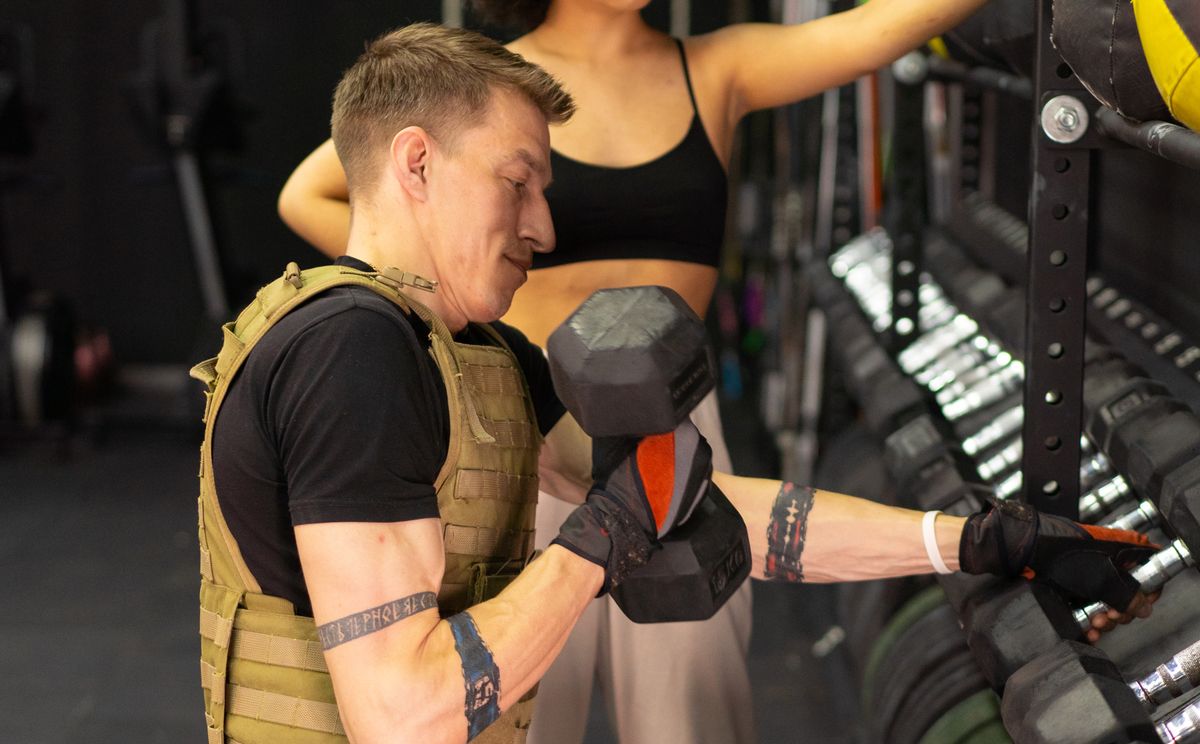 Man in a weighted vest holding a dumbbell during a strength training workout
Strength Training: The Non-Negotiable
If you only do one type of exercise after 40, it should be resistance training. The evidence is overwhelming.
A 2024 scientific review in Experimental Gerontology confirmed that resistance training promotes muscle growth in older adults at both the whole-muscle and individual muscle fiber levels. A separate 2024 study in Sports Medicine found that even low-volume resistance training substantially improved physical function and lean mass.
The benefits extend far beyond muscle. A systematic review and meta-analysis found that resistance training significantly improved:
| Benefit | Evidence Level |
|---|---|
| Upper and lower body strength | Strong |
| Bone mineral density | Strong |
| Cognitive function and memory | Strong |
| Depression and mental health | Moderate to Strong |
| Cardiovascular fitness (VO2 peak) | Moderate |
| Quality of life | Moderate to Strong |
How to train: Aim for two to three strength sessions per week, focusing on compound movements — squats, deadlifts, rows, presses, and lunges. A 2024 study showed that training with heavier loads produces bigger improvements in strength and muscle size, so do not be afraid to lift challenging weights with proper form.
Free on iOS
TRAIN SMARTER
Build custom HIIT, Tabata, AMRAP, EMOM and Circuit workouts. Precision timer, streak tracking and analytics — free on iOS.
Cardio and HIIT: Still Essential, With Modifications
Cardiovascular fitness remains critical after 40 — it is one of the strongest predictors of longevity. But the type of cardio matters more than the amount.
HIIT is safe and effective for older adults. A 2021 scoping review in Sports Medicine — Open examined HIIT protocols across multiple studies and found that 81 percent reported no adverse events. Studies that did report adverse outcomes found no serious events requiring hospitalization.
A 2024 systematic review and meta-analysis confirmed that HIIT significantly improved cardiorespiratory fitness in older adults compared to both other exercise types and non-exercise controls. HIIT also helps maintain fast-twitch muscle fibers, which are essential for quick, explosive movements and naturally decline with age.
Modifying HIIT After 40
The key adjustment is the work-to-rest ratio. Instead of the 1:1 ratio common in programs designed for younger adults, research recommends 1:2 or even 1:3 ratios for adults over 40. This means 20 seconds of work followed by 40 to 60 seconds of rest.
| HIIT Modification | Under 40 | Over 40 |
|---|---|---|
| Work-to-rest ratio | 1:1 | 1:2 or 1:3 |
| Sessions per week | 3–5 | 2–3 |
| Session duration | 20–30 min | 20–25 min |
| Impact level | Any | Low to moderate preferred |
| Recovery between sessions | 24–48 hours | 48–72 hours |
Low-impact HIIT options — cycling intervals, rowing, bodyweight circuits without jumping — deliver the cardiovascular benefits without the joint stress.
Mobility and Flexibility: The Missing Piece
Most people over 40 skip mobility work — and pay for it with injuries. Hip stiffness is one of the leading causes of lower back and knee pain in adults over 40, and decreased collagen production makes joints progressively stiffer.
Research shows that combining stretching with strength training improves how well you move — more than stretching alone. The best approach is not a separate yoga class (though that helps too) but integrating 5 to 10 minutes of targeted mobility work into every training session.
 Mature woman practicing yoga on a mat in a cozy living room
Priority Mobility Areas After 40
- Hips — hip flexor stretches, 90/90 rotations, deep squats
- Thoracic spine — cat-cow, thread the needle, foam roller extensions
- Ankles — wall ankle mobilizations, calf stretches
- Shoulders — wall slides, band pull-aparts, arm circles
A 2024 review found that yoga practitioners had lower resting heart rates, making it a valuable addition for both mobility and cardiovascular health.
A Research-Backed Weekly Plan for Over 40
| Day | Workout | Duration | Focus |
|---|---|---|---|
| Monday | Strength (upper body) | 35–45 min | Muscle preservation, bone density |
| Tuesday | HIIT (low-impact) | 20–25 min | Cardiovascular fitness, fat loss |
| Wednesday | Walk or active recovery + mobility | 20–30 min | Recovery, joint health |
| Thursday | Strength (lower body) | 35–45 min | Muscle preservation, bone density |
| Friday | HIIT or moderate cardio | 20–30 min | Cardiovascular fitness |
| Saturday | Recreational activity or yoga | 30–60 min | Mobility, enjoyment, social connection |
| Sunday | Rest | — | Full recovery |
This plan delivers three to five training days per week with adequate recovery between high-intensity sessions — exactly what the research supports for adults over 40.
The Power Training Most People Forget
Muscular power — the ability to produce force quickly — declines faster than strength after 40. Activities like sprinting, jumping, or catching yourself from a stumble all require power. A loss of power is a stronger predictor of functional decline than a loss of strength alone.
Include one to two power-focused exercises per session: medicine ball throws, kettlebell swings, box step-ups with a quick drive, or explosive push-ups. These do not need to be high-impact — even standing up quickly from a chair builds power when done intentionally.
Track Your Over-40 Fitness With Hiitify
Hiitify makes it easy to build the modified HIIT workouts that research recommends for people over 40. Set custom work-to-rest ratios like 1:2 or 1:3, track your workout consistency with streaks, and build a training habit that fits your recovery needs — not a 25-year-old's.
Free on iOS
TRAIN SMARTER
Build custom HIIT, Tabata, AMRAP, EMOM and Circuit workouts. Precision timer, streak tracking and analytics — free on iOS.
Sources & Further Reading
Research
- Distefano, G. & Goodpaster, B.H. (2018). Effects of Exercise and Aging on Skeletal Muscle. Cold Spring Harbor Perspectives in Medicine. View on PMC
- Pinto, R.S. et al. (2024). Low-volume resistance training substantially improves physical function and lean mass in older adults. Sports Medicine. View on PubMed
- (2024). Resistance training promotes muscle growth in older adults at both the whole-muscle and individual muscle fiber levels. Experimental Gerontology. View on ScienceDirect
- Marriott, C.F.S. et al. (2021). High-Intensity Interval Training in Older Adults: a Scoping Review. Sports Medicine — Open. View on Springer
- Liu, J. et al. (2024). Effects of High-Intensity Interval Training on the Parameters Related to Physical Fitness and Health of Older Adults: A Systematic Review and Meta-Analysis. Sports Medicine — Open. View on Springer
- Grgic, J. et al. (2020). Effect of resistance training on cognitive function in older adults: A systematic review and meta-analysis. View on PMC
- (2024). Effect of resistance circuit training on comprehensive health indicators in older adults: a systematic review and meta-analysis. Scientific Reports. View on Nature
- Mitchell, W.K. et al. (2012). Sarcopenia, Dynapenia, and the Impact of Advancing Age on Human Skeletal Muscle Size and Strength; a Quantitative Review. Frontiers in Physiology. View on PMC
Further Reading
- How to exercise after 40 — Baylor College of Medicine
- HIIT workouts for older adults — Harvard Health
- Preserve your muscle mass — Harvard Health
- The Benefits of Resistance Training for Older Adults — Pacific Neuroscience Institute
Image Credits
- Cover: Mature sportsman doing exercises on stadium — Pexels
- Side View of a Man in a Weighted Vest Holding a Dumbbell — Pexels
- Mature Woman Doing Yoga — Pexels
All images free to use under the Pexels License.