The biggest mistake people make when starting HIIT as a beginner is doing too much, too soon. They find an advanced Tabata workout online, push through 20 minutes of burpees and jump squats on day one, and spend the next week so sore they can barely walk — let alone train again. The research is clear: progressive overload, not heroic first sessions, is what produces lasting results. A well-structured 4-week plan starts where you actually are and builds from there.
Here's an evidence-based plan that takes you from zero HIIT experience to genuinely challenging workouts in 28 days.
Why 4 Weeks Is the Right Starting Point
Four weeks isn't arbitrary. It's the minimum timeframe where research consistently shows measurable physiological adaptations from HIIT — even in previously sedentary individuals.
A 2015 meta-analysis by Milanović, Sporiš, and Weston published in Sports Medicine analysed 28 controlled trials and found that HIIT improved VO2max by an average of 4.9 mL/kg/min — significantly more than the 1.9 mL/kg/min improvement from moderate-intensity continuous training. The gains were particularly large in participants with lower baseline fitness, meaning beginners stand to benefit the most.
Even more striking: research has shown that measurable VO2max improvements can occur in as few as 6 HIIT sessions over 2 weeks. By the end of a 4-week programme with 2–3 sessions per week, you'll have completed 8–12 sessions — more than enough for your cardiovascular system to show real adaptation.
Here's what the first 4 weeks typically deliver:
| Adaptation | Timeline | What It Means |
|---|---|---|
| Improved stroke volume | Weeks 1–2 | Heart pumps more blood per beat |
| VO2max increase | Weeks 2–4 | Body uses oxygen more efficiently |
| Lower resting heart rate | Weeks 2–4 | Cardiovascular system works less at rest |
| Muscular endurance | Weeks 2–3 | Muscles resist fatigue for longer |
| Improved exercise tolerance | Week 1 onward | Workouts feel easier at the same intensity |
The goal of this plan isn't to destroy you. It's to build a foundation of fitness, movement quality, and consistency that makes week 5 and beyond possible.
Before You Start: The Non-Negotiables
Three things separate beginners who progress safely from those who get injured or burn out:
1. Warm Up Every Session
Five minutes of light movement before HIIT isn't optional — it's protective. A dynamic warm-up raises muscle temperature, increases blood flow, and improves joint range of motion. Spend 3–5 minutes doing arm circles, leg swings, bodyweight squats at a slow pace, and light marching.
2. Prioritise Form Over Speed
Every exercise in this plan uses bodyweight only. That doesn't mean it's impossible to get hurt. Sloppy push-ups, knee-caving squats, and rounded-back mountain climbers are the most common sources of beginner injuries. If your form breaks down, slow down or reduce your range of motion. A controlled half-rep is better than a reckless full one.
3. Respect the Rest Days
The ACSM recommends at least 48 hours between vigorous-intensity sessions for untrained individuals. HIIT drives adaptation during recovery, not during the workout itself. Training on sore, under-recovered muscles increases injury risk and limits the gains you're trying to build.
 Woman doing push-ups on a yoga mat at home in a minimalist setting
Free on iOS
TRAIN SMARTER
Build custom HIIT, Tabata, AMRAP, EMOM and Circuit workouts. Precision timer, streak tracking and analytics — free on iOS.
The 4-Week Beginner HIIT Plan
This plan uses three sessions per week. Each session includes a warm-up, a HIIT block, and a cool-down. The work-to-rest ratio tightens every week, and the number of rounds increases — this is textbook progressive overload applied to interval training.
Week 1: Learn the Movements
- Sessions: 3 (e.g. Monday, Wednesday, Friday)
- Work:Rest ratio: 1:3 (15 seconds work / 45 seconds rest)
- Rounds: 5
- Exercises per round: 4
- Total HIIT time: ~10 minutes
The workout:
| Exercise | Work | Rest |
|---|---|---|
| Bodyweight squats | 15s | 45s |
| Modified push-ups (knees) | 15s | 45s |
| Marching in place (high knees, low impact) | 15s | 45s |
| Standing mountain climbers | 15s | 45s |
Repeat for 5 rounds. The generous 1:3 ratio lets your heart rate recover fully between efforts. Focus entirely on clean movement patterns — this week is about learning, not suffering.
Week 2: Build the Engine
- Sessions: 3
- Work:Rest ratio: 1:2 (20 seconds work / 40 seconds rest)
- Rounds: 6
- Exercises per round: 4
- Total HIIT time: ~14 minutes
The workout:
| Exercise | Work | Rest |
|---|---|---|
| Bodyweight squats | 20s | 40s |
| Push-ups (full or modified) | 20s | 40s |
| High knees | 20s | 40s |
| Mountain climbers | 20s | 40s |
Repeat for 6 rounds. You've added 5 seconds of work, cut 5 seconds of rest, and added a round. The total volume increase is modest but meaningful. If full push-ups aren't there yet, stay with modified — progression isn't about ego.
Week 3: Increase the Challenge
- Sessions: 3
- Work:Rest ratio: 1:1.5 (25 seconds work / 35 seconds rest)
- Rounds: 6
- Exercises per round: 5
- Total HIIT time: ~18 minutes
The workout:
| Exercise | Work | Rest |
|---|---|---|
| Jump squats (or fast bodyweight squats) | 25s | 35s |
| Push-ups | 25s | 35s |
| High knees | 25s | 35s |
| Mountain climbers | 25s | 35s |
| Alternating reverse lunges | 25s | 35s |
Repeat for 6 rounds. This week adds a fifth exercise and tightens the work-to-rest ratio further. If jump squats feel too intense, substitute fast bodyweight squats — the goal is maintaining quality across all 6 rounds.
Week 4: Test Your Fitness
- Sessions: 3
- Work:Rest ratio: 1:1 (30 seconds work / 30 seconds rest)
- Rounds: 7
- Exercises per round: 5
- Total HIIT time: ~22 minutes
The workout:
| Exercise | Work | Rest |
|---|---|---|
| Jump squats | 30s | 30s |
| Push-ups | 30s | 30s |
| Burpees (step-back or full) | 30s | 30s |
| Mountain climbers | 30s | 30s |
| Alternating reverse lunges | 30s | 30s |
Repeat for 7 rounds. You've reached a 1:1 ratio — this is where most intermediate HIIT programmes begin. If you can complete all 7 rounds with good form, you've built a serious fitness base in 28 days.
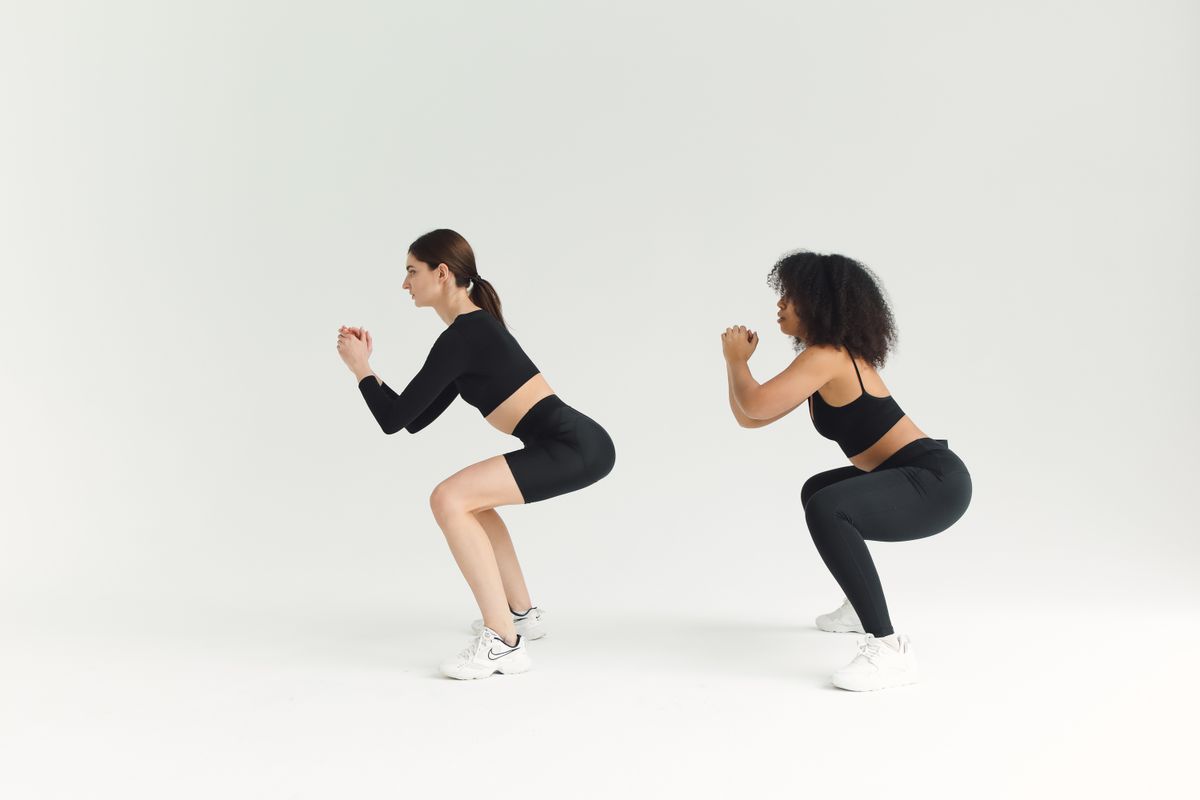 Women performing squats in sportswear during an indoor workout session
The Progression at a Glance
| Week | Work:Rest | Rounds | Exercises | Session Time | Intensity |
|---|---|---|---|---|---|
| 1 | 1:3 | 5 | 4 | ~10 min | Low-moderate |
| 2 | 1:2 | 6 | 4 | ~14 min | Moderate |
| 3 | 1:1.5 | 6 | 5 | ~18 min | Moderate-high |
| 4 | 1:1 | 7 | 5 | ~22 min | High |
Each week changes only one or two variables — never everything at once. This follows the evidence-based principle of progressive overload: increase demand gradually so your body can adapt without breaking down.
What the Research Says About Beginner Compliance
One of the biggest fears about HIIT is that it's too hard to stick with. The research says otherwise.
A 2023 systematic review and meta-analysis of 188 studies published in the International Journal of Behavioral Nutrition and Physical Activity found that:
- Supervised HIIT compliance averaged 89.4% across 8,928 participants
- Unsupervised HIIT adherence averaged 63% — still higher than many alternative exercise formats
- Compliance rates were no different between HIIT and moderate-intensity continuous training
The key finding: HIIT isn't harder to stick with than easier exercise. People show up. The dropout problem isn't about intensity — it's about structure. A clear plan with scheduled sessions, defined exercises, and trackable progress mimics the structure of supervised training, even when you're working out alone.
Common Beginner Mistakes to Avoid
Starting too intense. If you can't hold a conversation during your rest periods in week 1, you're going too hard. The 1:3 ratio exists for a reason — use it.
Skipping rest days. More isn't better when your body hasn't adapted to the stimulus. A 4-week Circuit HIIT study on previously untrained individuals found compliance rates above 85% — partly because participants respected the recovery structure.
Ignoring form for reps. Counting how many squats you did in 20 seconds is less important than whether those squats were full-depth with neutral spine. Quality reps build fitness. Junk reps build injuries.
Comparing yourself to advanced athletes. The workouts in this plan are short and the exercises are basic. That's the point. A 2025 meta-analysis in BMC Public Health confirmed that even low-volume HIIT programmes produce significant improvements in VO2max, body composition, and muscular endurance in untrained individuals.
What Comes After Week 4
If you've completed this plan consistently, you've built a genuine fitness base. From here, you have several progression options:
- Extend to 8 weeks by continuing to tighten your work-to-rest ratio (try 2:1 — 40 seconds work, 20 seconds rest) and adding rounds
- Introduce Tabata-style intervals (20 seconds all-out, 10 seconds rest) for 4-minute finishers
- Add equipment — a pair of dumbbells or a kettlebell opens up dozens of new exercises
- Try different HIIT formats like EMOM (Every Minute On the Minute) or AMRAP (As Many Rounds As Possible)
The 4-week plan is a launchpad, not a destination. The cardiovascular and muscular adaptations you've built make everything that follows more effective — and more enjoyable.
Track Your Beginner HIIT Plan With Hiitify
Following a structured plan is easier when your timer does the thinking for you. Hiitify lets you set custom work and rest intervals for each week of this plan, save your workouts for one-tap reuse, and track your training streak as you progress from week 1 through week 4 and beyond. The app handles the countdown so you can focus entirely on your form and effort — no watching the clock, no mental maths.
Free on iOS
TRAIN SMARTER
Build custom HIIT, Tabata, AMRAP, EMOM and Circuit workouts. Precision timer, streak tracking and analytics — free on iOS.
Sources & Further Reading
Research
-
Milanović, Z., Sporiš, G. & Weston, M. (2015). Effectiveness of High-Intensity Interval Training (HIT) and Continuous Endurance Training for VO2max Improvements: A Systematic Review and Meta-Analysis of Controlled Trials. Sports Medicine, 45, 1469–1481. View on PubMed
-
Taylor, J.L. et al. (2023). Rates of compliance and adherence to high-intensity interval training: a systematic review and meta-analyses. International Journal of Behavioral Nutrition and Physical Activity. View on PMC
-
Poon, E.T.C. et al. (2024). High-intensity interval training and cardiorespiratory fitness in adults: An umbrella review of systematic reviews and meta-analyses. Scandinavian Journal of Medicine & Science in Sports. View on Wiley
-
Guo, Z. et al. (2025). A meta-analysis of the effects of high-intensity interval training on circulatory system-related indicators in sedentary populations. Frontiers in Physiology. View on PMC
-
Schaun, G.Z. et al. (2018). A 4-Week Intervention Involving Mobile-Based Daily 6-Minute Micro-Sessions of Functional High-Intensity Circuit Training Improves Strength and Quality of Life of Young Untrained Adults. Frontiers in Physiology. View on PMC
Further Reading
- ACSM Information on High-Intensity Interval Training — ACSM
- HIIT Programming for Personal Trainers — Surf Sports Myo
- Understanding Injury Risk of High Intensity Interval Training — Mass General
Image Credits
- Cover: Photo of women doing squats — Pexels
- Woman doing push-ups — Pexels
- Women working out in the room — Pexels
All images free to use under the Pexels License.