Starting HIIT after 40 might be the single most impactful fitness decision you can make. After 40, your body faces an accelerating decline in aerobic capacity, muscle mass, and metabolic health — and HIIT for beginners over 40 is one of the most time-efficient, research-backed ways to fight back. But the approach matters. What works for a 25-year-old won't work for you, and pushing too hard too soon is the fastest route to injury. Here's what the science says about doing it right.
Why HIIT Matters More After 40
After your 40th birthday, your body starts losing ground faster. VO2max — the gold standard measure of cardiovascular fitness — declines by approximately 10% per decade in the general population. A landmark longitudinal study published in Circulation found that this decline isn't linear: it accelerates with age, with men losing 8.3% of peak VO2 over a decade in their 40s but 23.2% in their 70s.
The consequences extend beyond the treadmill. Lower VO2max is associated with increased risk of cardiovascular disease, type 2 diabetes, cognitive decline, and all-cause mortality. Meanwhile, sarcopenia — age-related muscle loss — kicks in at a rate of 3–8% per decade after 30, accelerating after 50.
The good news: HIIT directly targets both problems. A 2025 comparative study published in Frontiers in Aging found that HIIT produced a 15–20% increase in VO2max, a 12% improvement in muscle strength, and a 10–15% enhancement in cognitive function in adults aged 60–85. A separate study recruiting participants aged 20–70+ found that individuals across all age groups showed significant cardiovascular improvements after just 8 weeks of supervised HIIT.
The message is clear: it's not too late. But you need to train differently than you did at 25.
How HIIT Changes After 40
Your body responds to high-intensity training differently with age — not worse, but differently. Three key changes shape how you should approach HIIT after 40:
Recovery Takes Longer
Research on HIIT recovery shows that heart rate variability (HRV) — a key marker of nervous system recovery — can take 16–29 hours to return to baseline after a HIIT session in trained individuals. For older or less conditioned adults, this window extends further. Studies on adults with a mean age of ~61 found that significant health benefits were achieved with HIIT performed as infrequently as once every five days.
Joint Integrity Changes
Cartilage thins, tendons lose elasticity, and the fluid that lubricates your joints decreases with age. High-impact movements like box jumps, burpees, and depth jumps place enormous stress on joints that may no longer absorb shock as efficiently. This doesn't mean you can't train hard — it means you need to train smart by choosing low-impact alternatives.
The Cardiovascular Ceiling Shifts
Maximum heart rate declines by roughly 0.7 beats per minute per year. A 45-year-old's estimated max heart rate is approximately 175 bpm compared to 195 bpm at 25. This means your intensity zones shift — what feels like 85% effort at 25 corresponds to a lower absolute heart rate at 45. Using rate of perceived exertion (RPE) alongside heart rate is more reliable than heart rate alone.
| Factor | At 25 | At 45 | Practical Impact |
|---|---|---|---|
| Estimated max HR | ~195 bpm | ~175 bpm | Lower absolute HR targets |
| VO2max (avg. male) | ~45 ml/kg/min | ~36 ml/kg/min | Lower baseline capacity |
| Recovery window | 24–48 hours | 48–72 hours | Fewer weekly sessions |
| Joint resilience | High | Moderate | Low-impact exercises preferred |
| Muscle mass trend | Stable/growing | Declining 3–8%/decade | Strength preservation critical |
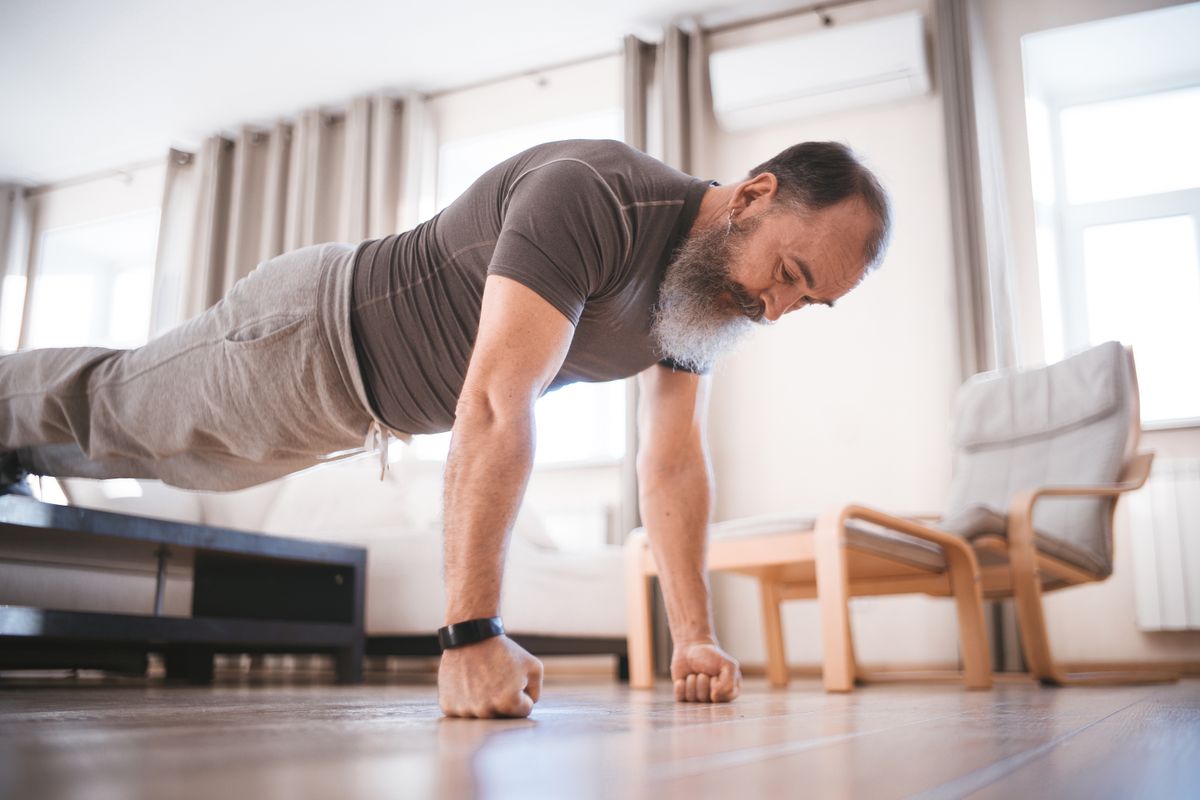 Elderly man doing push-ups at home as part of a bodyweight fitness routine
The Over-40 HIIT Starter Protocol
The biggest mistake beginners over 40 make is following a programme designed for 20-somethings. Here's a research-backed progression that accounts for longer recovery, joint health, and the gradual conditioning your body needs.
Weeks 1–2: Foundation
- Frequency: 2 sessions per week, spaced 72 hours apart
- Work:Rest ratio: 1:4 (15 seconds work, 60 seconds rest)
- Rounds: 4–6
- Total session time: 15 minutes (including warm-up and cool-down)
- Exercises: Walking intervals, bodyweight squats, wall push-ups, seated cycling sprints
Weeks 3–4: Build
- Frequency: 2 sessions per week, spaced 48–72 hours apart
- Work:Rest ratio: 1:3 (20 seconds work, 60 seconds rest)
- Rounds: 5–7
- Total session time: 18–20 minutes
- Exercises: Brisk walk/jog intervals, bodyweight squats, modified push-ups, step-ups
Weeks 5–6: Progress
- Frequency: 2–3 sessions per week, spaced 48 hours apart
- Work:Rest ratio: 1:2 (20 seconds work, 40 seconds rest)
- Rounds: 6–8
- Total session time: 20–25 minutes
- Exercises: Cycling sprints, lunges, push-ups, squat-to-stands, marching with high knees
Weeks 7–8: Consolidate
- Frequency: 2–3 sessions per week
- Work:Rest ratio: 1:1.5 to 1:1 (25–30 seconds work, 30–40 seconds rest)
- Rounds: 6–8
- Total session time: 20–25 minutes
- Exercises: Full range of low-impact exercises at higher intensity
Free on iOS
TRAIN SMARTER
Build custom HIIT, Tabata, AMRAP, EMOM and Circuit workouts. Precision timer, streak tracking and analytics — free on iOS.
Low-Impact Exercises That Deliver High-Intensity Results
You don't need burpees to get your heart rate up. These low-impact alternatives deliver comparable cardiovascular and metabolic stimulus without hammering your joints:
- Stationary cycling sprints — pedal at maximum effort for your work interval, then slow to an easy cadence during rest. Cycling is joint-friendly and allows precise intensity control.
- Walking intervals — alternate between brisk power walking (or incline treadmill walking) and easy recovery walking. Research from the Hospital for Special Surgery recommends 30 seconds of fast walking followed by 90 seconds of recovery.
- Bodyweight squats — full depth, controlled tempo. Add a pause at the bottom for extra intensity without impact.
- Step-ups — use a low step or stair. Alternate legs each interval. Builds single-leg strength and balance.
- Modified push-ups — wall push-ups progressing to incline push-ups and eventually floor push-ups over several weeks.
- Seated cycling or elliptical intervals — zero impact with full intensity potential. A 12-week study found that obese older adults performing HIIT on an elliptical improved their six-minute walking test by 12.4%.
| Exercise | Impact Level | Joint Stress | Intensity Potential | Best For |
|---|---|---|---|---|
| Cycling sprints | None | Very low | Very high | Cardio, leg power |
| Walking intervals | Low | Low | Moderate-high | Beginners, outdoor training |
| Bodyweight squats | Low | Moderate | High | Leg strength, mobility |
| Step-ups | Low | Low-moderate | High | Balance, single-leg strength |
| Elliptical intervals | None | Very low | Very high | Full-body, joint-friendly |
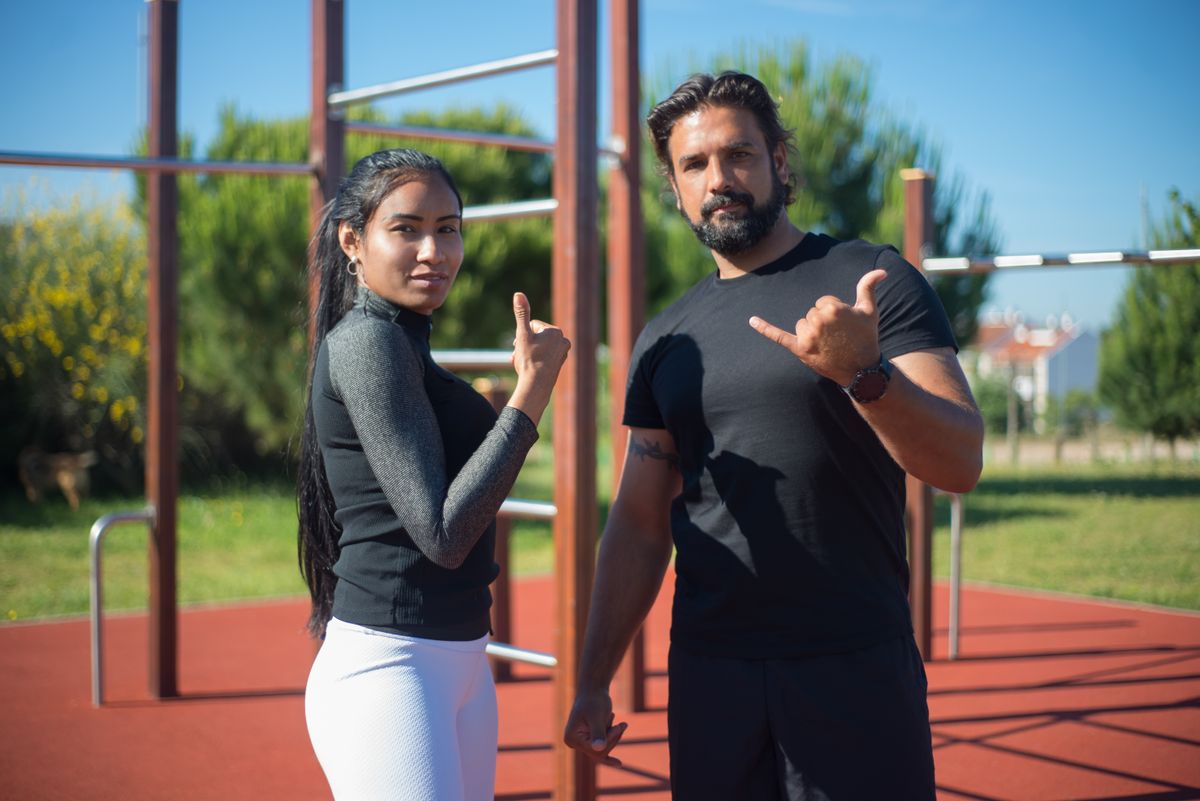 Active couple in sportswear exercising together at an outdoor fitness park
Recovery: The Non-Negotiable for Over-40 HIIT
Recovery isn't optional — it's where the adaptations happen. And after 40, recovery demands more attention than the workout itself.
Sleep is the single most important factor. During deep sleep, growth hormone secretion peaks, protein synthesis accelerates, and cortisol drops to its daily minimum. Aim for 7–9 hours per night. Research shows that morning HIIT sessions improve sleep quality, while evening sessions can elevate cortisol and disrupt sleep onset.
Nutrition matters more than you think. Post-HIIT, consume 20–30g of protein within 60 minutes and prioritise carbohydrate intake of at least 1.2 g/kg/hr in the first 4–6 hours to replenish glycogen stores. Chronic energy deficiency amplifies cortisol and cytokine responses — a direct driver of overtraining.
Active recovery on rest days — walking, gentle yoga, foam rolling — promotes blood flow without adding training stress. A study using the Tabata protocol found that foam rolling reduced muscle soreness by 50% compared to a control group.
Monitor these warning signs that your recovery is inadequate:
- Resting heart rate elevated by 5+ bpm above your baseline
- Performance declining despite consistent training
- Persistent fatigue that doesn't improve with sleep
- Increased frequency of minor injuries or illness
- Feeling wired but exhausted — agitated at rest, flat during workouts
If any of these appear, take an extra rest day. Your body is telling you something — listen to it.
Track Your Over-40 HIIT Progress With Hiitify
Starting HIIT after 40 requires more structure, not less — and that's exactly what Hiitify provides. Build custom workouts with the extended rest intervals your body needs, follow audio cues so you can focus on form instead of watching a timer, and track your training streak to keep your weekly frequency in the research-backed sweet spot of two to three sessions. As your fitness improves, adjust your work-to-rest ratios right in the app and watch your progression over weeks and months.
Free on iOS
TRAIN SMARTER
Build custom HIIT, Tabata, AMRAP, EMOM and Circuit workouts. Precision timer, streak tracking and analytics — free on iOS.
Sources & Further Reading
Research
-
Parra-Soto, S. et al. (2025). Enhancing active aging through exercise: a comparative study of high-intensity interval training and continuous aerobic training benefits. Frontiers in Aging. View on PMC
-
Li, F. et al. (2024). Effects of High-Intensity Interval Training on the Parameters Related to Physical Fitness and Health of Older Adults: A Systematic Review and Meta-Analysis. Sports Medicine — Open. View on SpringerOpen
-
Marriott, C.F.S. et al. (2021). The Effects of High-Intensity Interval Training (HIIT) on Fall Risk Factors in Healthy Older Adults: A Systematic Review. International Journal of Environmental Research and Public Health. View on PMC
-
Fleg, J.L. et al. (2005). Accelerated Longitudinal Decline of Aerobic Capacity in Healthy Older Adults. Circulation. View on AHA Journals
-
Coswig, V.S. et al. (2024). Effects of High-Intensity Interval Training on Muscle Strength for the Prevention and Treatment of Sarcopenia in Older Adults: A Systematic Review. PMC. View on PMC
-
Hurst, C. et al. (2020). The time course of physiological adaptations to high-intensity interval training in older adults. Experimental Gerontology. View on PMC
-
Maffiuletti, N.A. et al. (2022). Clinical and Biological Adaptations in Obese Older Adults Following 12-Weeks of High-Intensity Interval Training or Moderate-Intensity Continuous Training. Journal of Clinical Medicine. View on PMC
Further Reading
- HIIT Workouts for Older Adults — Harvard Health
- Anti-aging Benefits of HIIT — Human Kinetics
- How Can HIIT Be Safely Modified for Older Adults? — B-One Training
Image Credits
- Cover: Elderly couple jogging together — Pexels
- Elderly man doing push-ups at home — Pexels
- Couple in sportswear at exercise park — Pexels
All images free to use under the Pexels License.