HIIT is often marketed as the ultimate fat-burning workout — and the internet is full of claims about torching calories and melting belly fat in minutes. But what does the HIIT for weight loss research actually show? The answer is more nuanced than most fitness sites admit — and in some ways, more useful.
Here's what the peer-reviewed evidence says about HIIT, fat loss, and body composition.
HIIT vs Steady-State Cardio: The Head-to-Head Data
This is the question everyone asks first: does HIIT burn more fat than regular cardio?
The most comprehensive answer comes from a 2023 meta-analysis published in the International Journal of Environmental Research and Public Health, which pooled data from 29 randomised controlled trials and 807 participants. The findings: both HIIT and moderate-intensity continuous training (MICT) produced significant improvements in body composition. Between-group comparisons showed HIIT delivered significant additional benefits to waist circumference, body fat percentage, and VO₂peak — but the absolute differences were small.
A 2025 meta-analysis covering RCTs from 2000–2024 confirmed the pattern: HIIT and MICT both reduce body fat and improve cardiopulmonary fitness in adults, with HIIT showing a modest edge in certain metrics.
The honest conclusion? HIIT doesn't dramatically out-burn steady-state cardio for fat loss. What it does is achieve comparable results in roughly 40% less exercise time. For people with limited schedules, that time efficiency is the real advantage.
| HIIT | Moderate-Intensity Cardio | |
|---|---|---|
| Fat loss | Significant | Significant |
| Waist circumference | Slight advantage | Baseline |
| Time per session | 15–25 min | 30–60 min |
| Weekly time commitment | ~60 min | ~120–180 min |
| VO₂max improvement | Greater | Moderate |
| Afterburn (EPOC) | Higher | Lower |
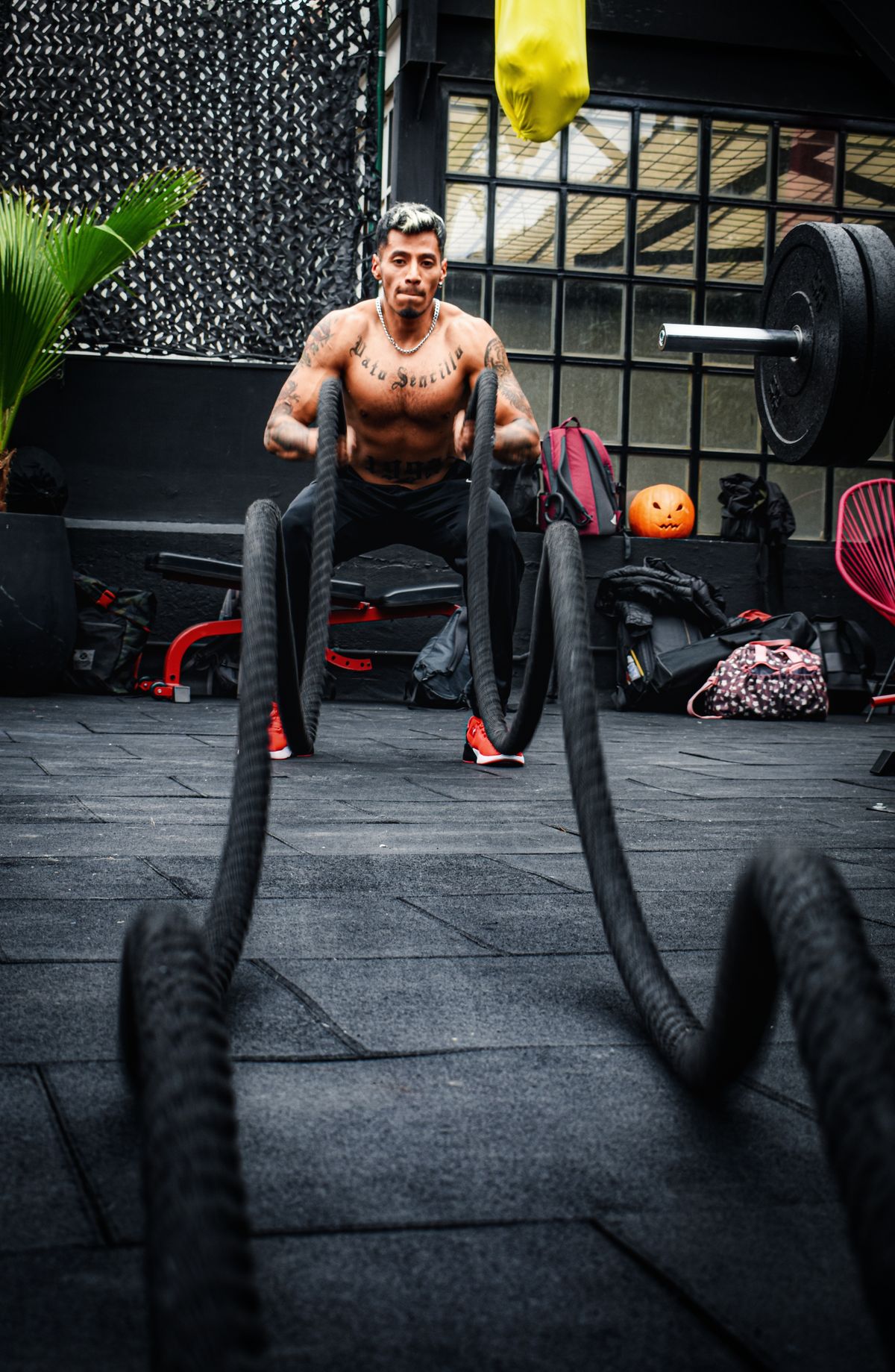 Man working out with battle ropes during an intense training session at the gym
The Afterburn Effect: Real, but Modest
The afterburn effect — technically EPOC (Excess Post-Exercise Oxygen Consumption) — is HIIT's most hyped benefit. After intense exercise, your body continues burning calories at an elevated rate as it restores itself to its resting state.
A 2024 study published in PubMed Central directly compared HIIT and MICT in 21 untrained men with obesity, using energy-matched treadmill protocols at 90% vs 60% VO₂max. The results:
- EPOC was higher after HIIT (66.20 ± 14.36 kcal) compared to MICT (53.91 ± 12.63 kcal, p = 0.045)
- Lipid oxidation (fat burning) was significantly greater after HIIT (1.01 vs 0.76 mg/kg/min, p = 0.003)
- The effect was most pronounced in the first 10 minutes post-exercise
These numbers are real — but they're not transformative. Most studies show EPOC adds an extra 6–15% of calories on top of the workout itself. If you burn 300 calories during a HIIT session, EPOC might add 30–50 more. Over weeks and months, that adds up. Over a single session, it's not the game-changer that marketing suggests.
The takeaway: the afterburn effect is a genuine bonus, not a magic bullet. The majority of your fat loss from HIIT comes from the workout itself, not what happens after.
HIIT and Visceral Fat: Where the Science Gets Interesting
This is where HIIT's weight loss story gets genuinely compelling. Visceral fat — the deep abdominal fat surrounding your organs — is the most metabolically dangerous type of body fat, linked to heart disease, type 2 diabetes, and metabolic syndrome.
Free on iOS
TRAIN SMARTER
Build custom HIIT, Tabata, AMRAP, EMOM and Circuit workouts. Precision timer, streak tracking and analytics — free on iOS.
A landmark 2018 meta-analysis by Maillard et al. in Sports Medicine analysed 39 studies involving 617 participants and found that HIIT significantly reduced:
- Total fat mass (p = 0.003)
- Abdominal fat mass (p = 0.007)
- Visceral fat mass (p = 0.018)
The researchers also discovered that running-based HIIT was more effective than cycling-based protocols for reducing total and visceral fat, and that training at above 90% of peak heart rate produced the greatest reductions in whole-body adiposity.
Why is HIIT particularly effective against visceral fat? The mechanism involves catecholamines — adrenaline and noradrenaline. High-intensity exercise triggers a surge of these hormones, which preferentially stimulate lipolysis (fat breakdown) in visceral adipose tissue. Visceral fat has a higher density of catecholamine receptors than subcutaneous fat, making it more responsive to the hormonal signals that HIIT generates.
HIIT and Appetite: The Hunger Hormone Effect
One of the less-discussed advantages of HIIT for weight management is its effect on appetite-regulating hormones.
Research shows that high-intensity exercise suppresses ghrelin (the hunger hormone) while increasing satiety hormones like CCK, GLP-1, and PYY. One study found that total ghrelin concentrations declined significantly after high-intensity sprinting and remained lower 30 minutes into recovery compared to pre-exercise levels.
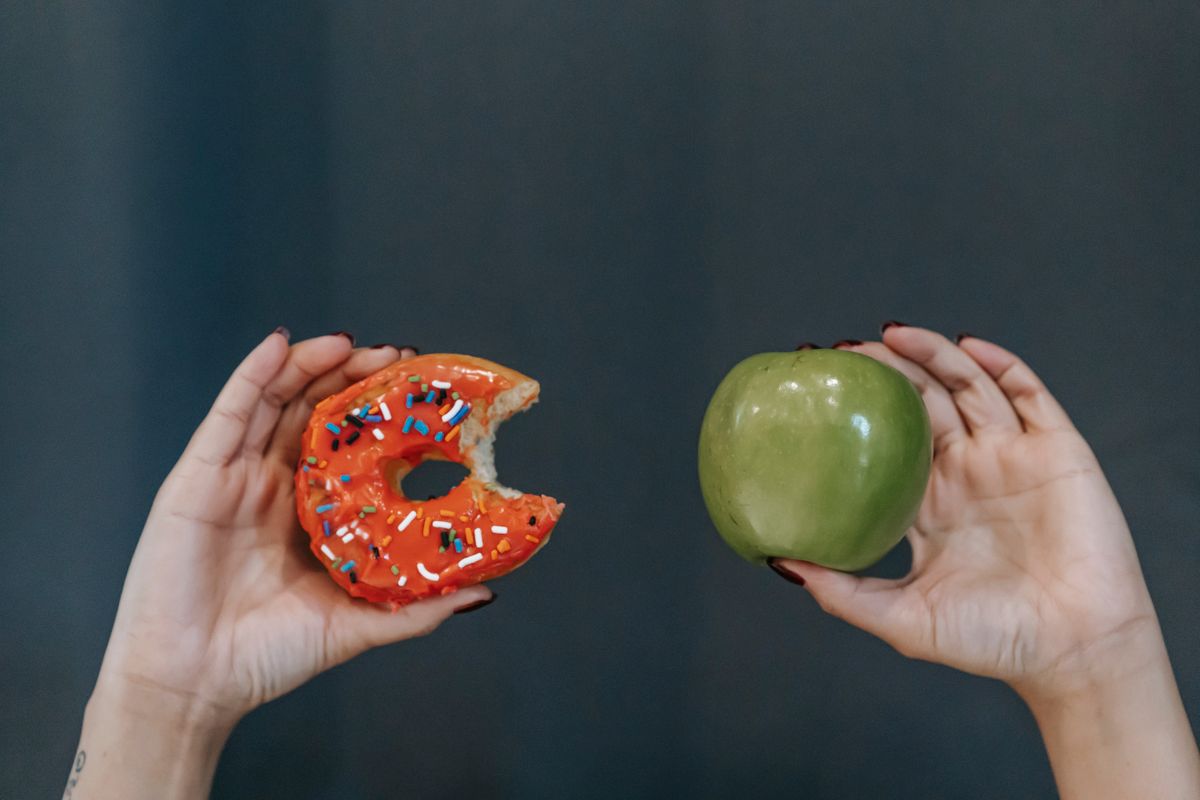 Woman holding a fresh apple and a doughnut, representing the choice between healthy and unhealthy eating
HIIT also appears to improve leptin signalling. Leptin is the hormone that tells your brain you're full — but in overweight individuals, leptin resistance can blunt this signal. A study on inactive overweight men found that a HIIT programme reduced plasma leptin concentrations, while a moderate-intensity continuous programme over the same period did not.
The practical implication: HIIT may help you eat less without feeling deprived. If your appetite is more regulated after training, you're less likely to undo your calorie deficit at the dinner table.
What Actually Drives Fat Loss: The Bigger Picture
Here's what the research consistently shows when you step back from any single mechanism:
1. Calorie deficit is still king. No amount of HIIT will overcome a poor diet. The most rigorous meta-analyses show that exercise alone — whether HIIT or steady-state — produces modest fat loss without dietary changes. A 2023 systematic review found HIIT combined with dietary intervention produced significantly better outcomes than exercise alone.
2. Consistency beats intensity. The best workout for weight loss is the one you actually do. HIIT's time efficiency makes it easier to fit into a busy schedule, which improves adherence — and adherence is the strongest predictor of long-term results.
3. Muscle preservation matters. HIIT has been shown to preserve lean body mass better than prolonged steady-state cardio during a caloric deficit. More muscle means a higher resting metabolic rate, which compounds over time.
4. Two to three sessions per week is enough. Multiple studies confirm that HIIT performed just 2–3 times weekly produces significant improvements in body composition, cardiovascular fitness, and metabolic markers. More isn't better — recovery is where adaptation happens.
A Simple HIIT-for-Fat-Loss Weekly Plan
| Day | Session | Duration |
|---|---|---|
| Monday | HIIT (30s work / 15s rest, 4 rounds) | 20 min |
| Tuesday | Strength training (full body) | 30 min |
| Wednesday | Rest or light walk | — |
| Thursday | HIIT (Tabata or EMOM) | 20 min |
| Friday | Strength training (full body) | 30 min |
| Saturday | HIIT (AMRAP or circuit) | 20 min |
| Sunday | Rest | — |
This structure gives you three HIIT sessions, two strength sessions, and two recovery days — hitting the evidence-based sweet spot for fat loss, muscle preservation, and sustainable adherence.
Track Your Weight Loss Workouts With Hiitify
Building a fat-loss training plan is one thing — executing it consistently is another. Hiitify lets you build and save custom HIIT workouts with precise work and rest intervals, track your training streak to stay accountable, and switch between Tabata, EMOM, AMRAP, and classic interval formats in seconds. Set up your Monday sprint session and your Thursday Tabata — then let the app handle the clock while you focus on the effort.
Free on iOS
TRAIN SMARTER
Build custom HIIT, Tabata, AMRAP, EMOM and Circuit workouts. Precision timer, streak tracking and analytics — free on iOS.
Sources & Further Reading
Research
-
Viana, R.B. et al. (2023). Effect of High-Intensity Interval Training vs. Moderate-Intensity Continuous Training on Fat Loss and Cardiorespiratory Fitness in the Young and Middle-Aged: A Systematic Review and Meta-Analysis. Int. J. Environ. Res. Public Health. View on PMC
-
PMC (2025). The effects of HIIT and MICT on body fat composition and cardiopulmonary fitness in adults: a meta-analysis of randomized controlled trials. View on PMC
-
Maillard, F. et al. (2018). Effect of High-Intensity Interval Training on Total, Abdominal and Visceral Fat Mass: A Meta-Analysis. Sports Medicine. View on PubMed
-
Li, H. et al. (2024). Acute interval running induces greater excess post-exercise oxygen consumption and lipid oxidation than isocaloric continuous running in men with obesity. View on PMC
-
Frühbeck, G. et al. (2025). Interactions between exercise, environmental factors, and diet in modulating appetite-regulating hormones: implications for athletes and physically active individuals. View on PMC
-
Zhang, H. et al. (2017). Comparable Effects of High-Intensity Interval Training and Prolonged Continuous Exercise Training on Abdominal Visceral Fat Reduction in Obese Young Women. View on PMC
Further Reading
- HIIT Afterburn for Fat Loss: 29 Trials Measured — FitChef
- HIIT Workouts for Belly Fat: What Science Really Says — Yahoo
- The Afterburn Effect: Tips, Workouts and Recovery — U.S. News
Image Credits
- Cover: Woman measuring waist with tape in gym — Pexels
- Man working out using battle ropes — Pexels
- Woman showing apple and doughnut — Pexels
All images free to use under the Pexels License.