HIIT vs weight training is one of the most common debates in fitness — and one of the most misunderstood. Both challenge your muscles, both burn calories, and both improve body composition. But they do it through fundamentally different mechanisms, and the research is clear on which one builds more muscle.
How Each Modality Builds Muscle
Weight training builds muscle through progressive mechanical overload — gradually increasing the load your muscles must resist over time. This creates the mechanical tension and metabolic stress that drive muscle protein synthesis and fiber hypertrophy. You control the weight, the tempo, and the volume, which makes it uniquely suited for targeted muscle growth.
HIIT builds fitness through repeated bouts of near-maximal effort followed by rest. While HIIT recruits fast-twitch (Type II) muscle fibers — the same fibers responsible for strength and power — it does so under cardiovascular stress rather than sustained mechanical load. A 2025 review in Life found that HIIT promotes shifts toward Type IIa hybrid fibers and improves motor unit recruitment and synchronization, but it lacks the progressive overload required for maximal hypertrophy.
The distinction matters: HIIT can make your existing muscles work harder and more efficiently, but weight training makes them bigger and stronger.
What the Research Says About Muscle Growth
A 2025 systematic review and meta-analysis published in Sports examined 54 studies (N = 1,136) on HIIT's effects on muscle strength, mass, and endurance. The findings were clear:
| Outcome | HIIT vs Control | HIIT vs Resistance Training |
|---|---|---|
| Fat-free mass | Small, non-significant gain (ES = 0.07) | RT likely superior |
| Leg press strength | — | RT favored (SMD = −0.82) |
| Muscle endurance | Small improvement | Comparable |
HIIT produced a pre–post effect size of just 0.07 for fat-free mass across 463 participants — essentially negligible. Meanwhile, resistance training consistently produced larger strength gains, particularly for lower-body exercises like the leg press.
The bottom line: if your goal is muscle hypertrophy, weight training is the superior tool by a wide margin.
 Woman using earphones during an intense cardio workout in the gym
Free on iOS
TRAIN SMARTER
Build custom HIIT, Tabata, AMRAP, EMOM and Circuit workouts. Precision timer, streak tracking and analytics — free on iOS.
The Interference Effect: Is It Real?
For years, the "interference effect" — the idea that cardio blunts muscle gains — kept lifters away from HIIT. The original 1980 study by Robert Hickson found that concurrent endurance and strength training led to smaller strength gains than resistance training alone. But the picture has changed dramatically.
A 2026 study in the Journal of Applied Physiology provided the clearest molecular evidence yet. Researchers tracked muscle protein synthesis, satellite cell dynamics, and fiber hypertrophy over 16 weeks in concurrent trainees versus resistance-only trainees. The result: concurrent HIIT and resistance training did not impair muscle protein synthesis or hypertrophy. The interference effect, where it exists, operates through neural mechanisms that suppress maximal strength development — not through the biological pathways that build muscle tissue.
A separate meta-analysis found that combining HIIT with resistance training produced similar hypertrophy outcomes and similar upper-body strength gains compared to resistance training alone. Lower-body strength showed a small interference effect (ES = −0.248, p = 0.049), but the practical significance was modest.
What modality you choose for HIIT matters
Not all HIIT is equal when paired with lifting. Cycling-based HIIT causes less eccentric muscle damage and neuromuscular fatigue than running, making it more compatible with lower-body strength sessions. Running-induced delayed-onset muscle soreness (DOMS) can compromise squat and deadlift form for days.
Body Composition: Where the Two Diverge
Both HIIT and weight training improve body composition, but through different pathways:
| Factor | HIIT | Weight Training | Combined |
|---|---|---|---|
| Fat loss | Strong (via EPOC and calorie burn) | Moderate (via metabolic rate) | Best results |
| Muscle mass | Minimal gain | Significant gain | Best results |
| VO₂max improvement | 5–15% in 8–12 weeks | 2–5% | 8–15% |
| Metabolic rate | Temporary increase (EPOC) | Sustained increase (more muscle) | Sustained + acute boost |
A 2024 randomized controlled trial in Frontiers in Endocrinology compared HIIT alone versus combined HIIT and resistance training in young women with overweight. Both groups improved body weight, BMI, and body fat. But muscle mass increased only in the combined group — a 2.75% greater improvement compared to HIIT alone.
During caloric restriction, the difference is even more pronounced. A study on overweight adults found that HIIT preserves muscle mass during a hypocaloric diet, but resistance training is superior for preventing the lean mass loss that typically accompanies weight loss.
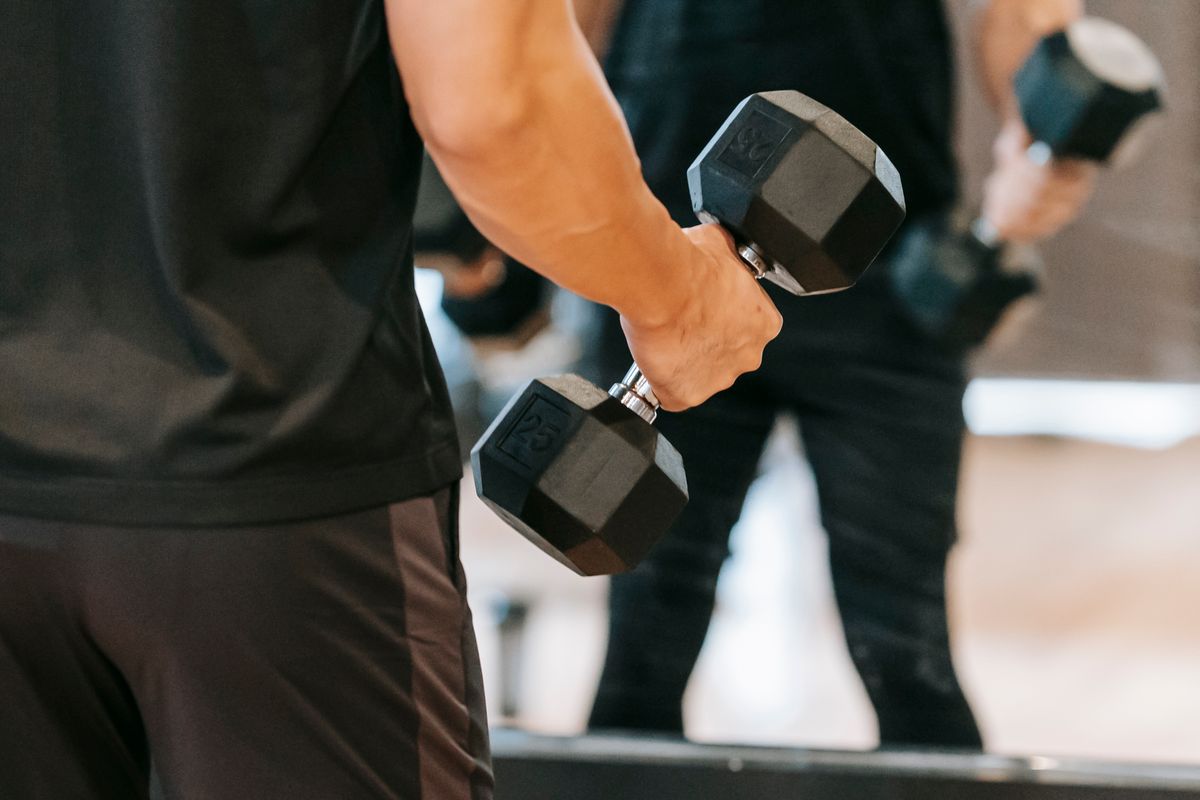 Man working out with heavy dumbbells in front of a gym mirror
How to Combine Both for Best Results
The research points to a clear conclusion: combining HIIT and weight training produces better results than either alone — more muscle, less fat, and superior cardiovascular fitness. Here is how to structure it.
A Research-Backed Weekly Template
| Day | Workout | Focus |
|---|---|---|
| Monday | Strength (Upper Body) | Hypertrophy |
| Tuesday | HIIT (Bike/Rower, 20 min) | Cardiovascular |
| Wednesday | Strength (Lower Body) | Hypertrophy |
| Thursday | Active Recovery | Mobility/Walking |
| Friday | Strength (Full Body) | Strength |
| Saturday | HIIT (Bike/Rower, 20 min) | Cardiovascular |
| Sunday | Rest | Recovery |
Key programming principles
- Prioritize weights if muscle is the goal. Three to four resistance sessions per week, two HIIT sessions.
- Separate sessions when possible. If you must combine, lift first, then do HIIT.
- Choose low-impact HIIT modalities. Cycling and rowing cause less muscle damage than running.
- Allow 48-hour recovery windows between intense lower-body lifting and HIIT.
- Keep HIIT sessions short. 20–30 minutes is the research-supported sweet spot.
 Woman doing exercise at gym during a CrossFit-style session
Track Your Strength and HIIT With Hiitify
Hiitify lets you build custom interval timers for both HIIT sessions and resistance training rest periods. Track your workout streaks, monitor session consistency, and build the combined training habit that the research says delivers the best results — all from one app.
Free on iOS
TRAIN SMARTER
Build custom HIIT, Tabata, AMRAP, EMOM and Circuit workouts. Precision timer, streak tracking and analytics — free on iOS.
Sources & Further Reading
Research
- Bauer, P. et al. (2025). Does High-Intensity Interval Training Increase Muscle Strength, Muscle Mass, and Muscle Endurance? A Systematic Review and Meta-Analysis. Sports, 13(9), 293. View on PMC
- Sabag, A. et al. (2018). The compatibility of concurrent high intensity interval training and resistance training for muscular strength and hypertrophy: a systematic review and meta-analysis. Journal of Sports Sciences. View on ResearchGate
- Tsirigkakis, S. et al. (2025). The Role of High-Intensity Interval Training (HIIT) in Neuromuscular Adaptations: Implications for Strength and Power Development — A Review. Life, 15(4), 657. View on PMC
- (2026). Concurrent training with long-interval HIIT does not impair skeletal muscle protein synthesis or hypertrophy. Journal of Applied Physiology. View on APS
- Sterczala, A. et al. (2024). Skeletal muscle adaptations to high-intensity, low-volume concurrent resistance and interval training. Physiological Reports. View on Wiley
- Zhang, H. et al. (2024). Combined high-intensity interval and resistance training improves cardiorespiratory fitness more than HIIT alone. Frontiers in Endocrinology. View on PMC
- Viana, R. et al. (2019). Is interval training the magic bullet for fat loss? A systematic review and meta-analysis. British Journal of Sports Medicine. View on PubMed
Further Reading
- The interference effect is getting less scary by the day — Stronger by Science
- Concurrent HIIT and Resistance Training for Musculoskeletal Function — MDPI Life
Image Credits
- Cover: Person Lifting Barbell Indoors — Pexels
- Woman Using Earphones During Gym Workout — Pexels
- Man with Dumbbell in Gym — Pexels
- Woman Doing Exercise at Gym — Pexels
All images free to use under the Pexels License.