Bad knees don't mean the end of high-intensity interval training. The mistake most people make is confusing intensity with impact — they assume HIIT means jumping, pounding, and landing hard. It doesn't. You can push your heart rate to 85% of its max with both feet planted firmly on the ground. This low-impact HIIT workout for bad knees proves it: no jumping, no jarring landings, and every exercise chosen to protect your joints while delivering real results.
Why Low-Impact HIIT Works for Knee Pain
The science is clear: high-intensity interval training benefits people with knee problems — as long as the exercises are chosen carefully.
A 2022 meta-analysis by Cuenca-Martínez et al. published in Diagnostics reviewed 13 randomised controlled trials and found that HIIT reduced pain intensity with a moderate clinical effect (SMD = −0.73) compared to control groups. The same study found a strong inverse relationship between cardiovascular fitness and pain — meaning the fitter you get, the less pain you experience (R² = 82.99%, p = 0.003).
A 2025 meta-analysis by Zhai et al. in Frontiers in Physiology analysed 9 RCTs involving 1,540 patients with knee osteoarthritis and found that high-intensity training significantly improved knee flexion strength (SMD = 0.39, p = 0.01), leg press strength (SMD = 0.47, p = 0.0001), and quality of life (SMD = 0.29, p = 0.0005).
Meanwhile, a 2023 review by Singjie et al. in the Orthopaedic Journal of Sports Medicine concluded that HIIT was more efficient than moderate-intensity continuous training for improving fitness, reducing visceral fat, and managing symptoms in people with symptomatic knee osteoarthritis.
The takeaway: the muscles around your knee — your quads, hamstrings, and glutes — act as shock absorbers. Strengthening them with structured HIIT reduces the load on the joint itself.
High Intensity vs High Impact: The Key Difference
This distinction changes everything for people with knee pain:
| Factor | High Intensity | High Impact |
|---|---|---|
| Definition | Working at 80–90% of max heart rate | Both feet leaving the ground simultaneously |
| Examples | Fast standing marches, battle ropes, cycling sprints | Jump squats, box jumps, burpees |
| Joint stress | Low to moderate (controlled movements) | High (2–5x bodyweight on landing) |
| Knee-friendly? | Yes, with proper exercise selection | Generally not for bad knees |
| Calorie burn | High | High |
| Cardiovascular benefit | Significant | Significant |
You can be at 90% of your max heart rate during a standing boxing combination or a fast glute bridge series — no jump required. Intensity is about effort and heart rate, not about how high you leave the floor.
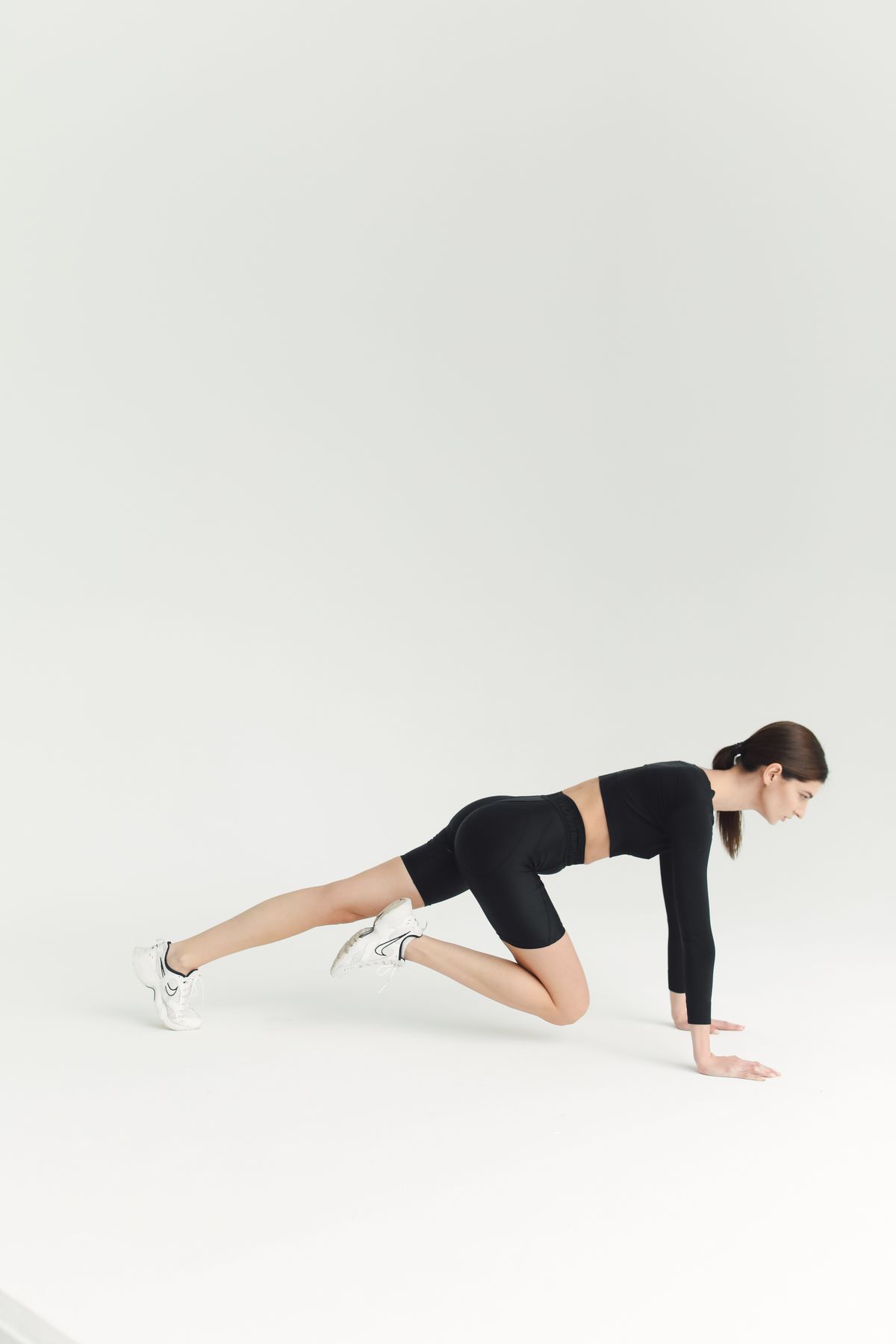 Woman doing a push-up on an exercise mat at home
Free on iOS
TRAIN SMARTER
Build custom HIIT, Tabata, AMRAP, EMOM and Circuit workouts. Precision timer, streak tracking and analytics — free on iOS.
The 20-Minute Low-Impact HIIT Workout
This routine uses a 30 seconds work / 15 seconds rest structure across three rounds of five exercises each. You get a 60-second rest between rounds. Total time: approximately 20 minutes.
Every exercise keeps at least one foot on the ground at all times. No jumping. No deep knee bends past 90 degrees.
Round 1 — Lower Body Focus
| Exercise | Work | Rest |
|---|---|---|
| Standing marches (high knees, no hop) | 30s | 15s |
| Glute bridges | 30s | 15s |
| Lateral step-outs | 30s | 15s |
| Wall sit | 30s | 15s |
| Standing calf raises | 30s | 15s |
Rest 60 seconds
Round 2 — Upper Body and Core
| Exercise | Work | Rest |
|---|---|---|
| Incline push-ups (hands on bench or wall) | 30s | 15s |
| Standing boxing punches | 30s | 15s |
| Bird dogs | 30s | 15s |
| Dead bugs | 30s | 15s |
| Standing torso rotations | 30s | 15s |
Rest 60 seconds
Round 3 — Full Body Finisher
| Exercise | Work | Rest |
|---|---|---|
| Standing knee drives (alternating) | 30s | 15s |
| Glute bridge marches | 30s | 15s |
| Standing side kicks | 30s | 15s |
| Modified push-ups | 30s | 15s |
| Standing marches (fast) | 30s | 15s |
Exercise Breakdowns
Standing marches: Stand tall with your core braced. Drive one knee up toward hip height, then lower it with control. Alternate legs at a pace that elevates your heart rate — think fast and rhythmic, not stomping. Swing your arms naturally for extra intensity.
Glute bridges: Lie face up with your knees bent and feet flat on the floor. Press through your heels to lift your hips until your body forms a straight line from shoulders to knees. Squeeze your glutes at the top for a full second, then lower with control. This strengthens the posterior chain without any knee compression.
Lateral step-outs: Stand with feet together. Step your right foot wide to the right, bend both knees slightly, then step your right foot back in. Repeat on the left. Keep your chest up and move at a brisk pace — this targets your hip abductors, which stabilise the knee joint during movement.
Standing boxing punches: Stand in a staggered stance. Throw alternating jabs, crosses, hooks, and uppercuts at speed. Keep your core tight and your feet planted. This is one of the highest calorie-burning low-impact exercises because it engages your entire upper body and core simultaneously.
Bird dogs: Start on all fours. Extend your right arm forward and left leg back simultaneously, keeping your hips level. Hold for one second, return, and switch sides. This exercise trains anti-rotation — a critical skill for knee stability during everyday movement.
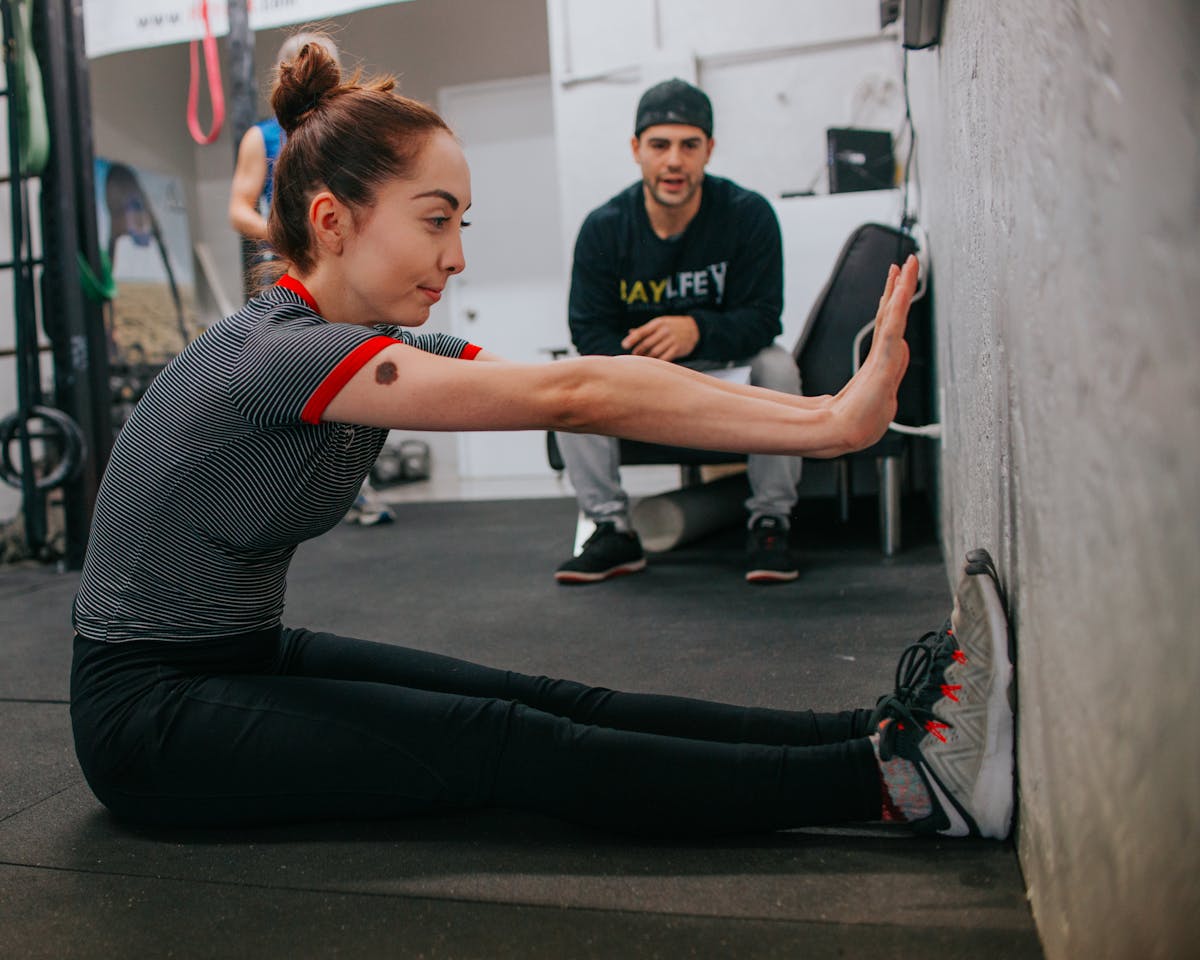 Woman doing a stretching exercise in a gym setting
Exercises to Avoid with Bad Knees
Not every HIIT movement belongs in a knee-friendly routine. Here are the ones to skip and what to do instead:
| Skip This | Why It Hurts | Do This Instead |
|---|---|---|
| Jump squats | 2–5x bodyweight force on landing | Glute bridges or wall sits |
| Box jumps | High landing impact on knee joint | Standing step-ups (low step) |
| Burpees with jump | Repeated impact plus deep knee flexion | Incline push-ups to standing march |
| Deep lunges | Excessive knee flexion under load | Lateral step-outs |
| High-impact mountain climbers | Fast knee flexion with bodyweight | Dead bugs or bird dogs |
| Tuck jumps | Maximum knee compression on landing | Standing knee drives |
The rule is simple: if an exercise causes sharp pain, increased swelling, or a grinding sensation in your knee, stop immediately. Mild discomfort during the first few reps that fades as you warm up is generally acceptable. Pain that gets worse with each rep is not.
How to Progress Without Adding Impact
Once this workout starts feeling comfortable, progress through intensity — not impact:
- Increase work intervals — move from 30 seconds on / 15 seconds rest to 40 seconds on / 15 seconds rest
- Add resistance — hold light dumbbells during standing marches and boxing punches
- Reduce rest between rounds — drop from 60 seconds to 30 seconds
- Add a fourth round — repeat Round 3 as a second finisher
- Slow down the eccentric phase — take 3 seconds to lower during glute bridges and push-ups
The 2022 Diagnostics review found that improvements in VO₂ max were strongly correlated with reductions in pain intensity. So getting fitter isn't just about performance — it directly reduces how much your knees hurt.
Track Your Low-Impact HIIT With Hiitify
Hiitify lets you build custom interval timers for this exact routine — set your 30/15 work-rest intervals, programme all three rounds with 60-second breaks, and track your sessions over time. Monitor your training frequency to ensure you're hitting 2–3 sessions per week without overdoing it.
Free on iOS
TRAIN SMARTER
Build custom HIIT, Tabata, AMRAP, EMOM and Circuit workouts. Precision timer, streak tracking and analytics — free on iOS.
Sources & Further Reading
Research
- Cuenca-Martínez, F. et al. (2022). Effects of High-Intensity Interval Training (HIIT) on Patients with Musculoskeletal Disorders: A Systematic Review and Meta-Analysis. Diagnostics. View on PMC
- Zhai, Y. et al. (2025). Effect of high-intensity training on improving knee flexion strength and quality of life in patients with knee osteoarthritis. Frontiers in Physiology. View on Frontiers
- Singjie, L. C. et al. (2023). The Effectiveness of High-Intensity Interval Training as a Treatment Option in Symptomatic Knee Osteoarthritis. Orthopaedic Journal of Sports Medicine. View on PMC
Further Reading
- 12-Minute Low-Impact HIIT Workout for Bad Knees — Get Healthy U
- 10 Low Impact HIIT Exercises and Workouts — PureGym
- 5 Best Low Impact Cardio Exercises for People with Bad Knees — NM Orthopaedic Associates
Image Credits
- Cover: Sportswoman doing stretching exercise on mat — Pexels
- Woman doing a push-up — Pexels
- Woman doing exercise — Pexels
All images free to use under the Pexels License.