Exercise after 40 is not a lesser version of exercise before 40 — it is a different game with different rules. Your body still builds muscle, burns fat, and improves cardiovascular fitness. But the rate of adaptation changes, recovery windows widen, and the margin for error shrinks. A 2024 review in Experimental Gerontology confirmed that resistance training promotes muscle growth in older adults at the whole-muscle and fiber level — the machinery still works. The question is whether your programming has caught up with your physiology.
The Five Shifts That Change Everything
After 40, five interconnected physiological changes alter how your body responds to exercise. None of them are deal-breakers, but ignoring any of them leads to stalled progress, chronic fatigue, or injury.
| Change | What Happens | Rate of Decline |
|---|---|---|
| Muscle mass | Sarcopenia accelerates | 0.5–1.2% per year |
| Muscle strength | Declines faster than mass | ~3% per year |
| VO2 max | Aerobic capacity drops | ~10% per decade |
| Hormonal output | Testosterone and growth hormone fall | 1–2% per year |
| Connective tissue | Collagen production slows | Progressive stiffening |
Understanding these shifts is the first step toward training around them instead of through them.
Muscle Still Grows — But the Signal Needs to Be Stronger
The most important change after 40 is sarcopenia — the progressive loss of skeletal muscle mass, strength, and function. A quantitative review in Frontiers in Physiology found that adults lose 3 to 5 percent of muscle mass per decade after age 30, with the rate accelerating to approximately 8 percent per decade after 40. Strength declines even faster, and muscular power — the ability to produce force quickly — begins dropping after age 35.
But the muscle-building response does not disappear. A 2020 systematic review and meta-analysis of exercise programs for adults with sarcopenia found that resistance training significantly improved muscle mass, strength, and physical performance. The difference is that the anabolic threshold rises — your muscles need a stronger stimulus and more protein to trigger the same growth response.
What this means in practice: lighter, high-rep "toning" routines become less effective. Compound movements with challenging loads — squats, deadlifts, rows, presses — deliver the mechanical tension that aging muscles need to adapt.
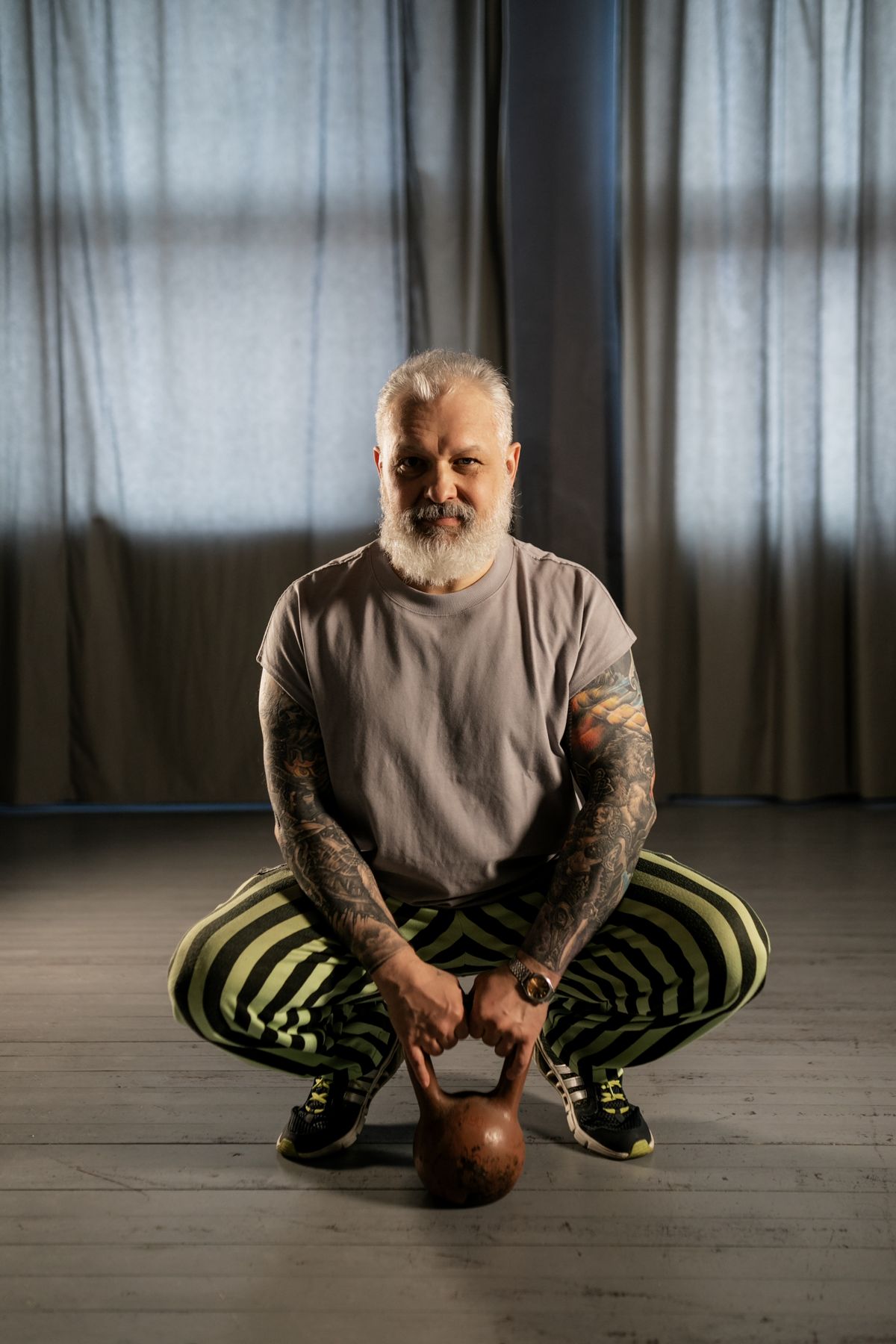 Elderly man holding a kettlebell during a strength training workout
Your Aerobic Engine Loses Capacity — But Training Fights Back
VO2 max — the gold-standard measure of cardiovascular fitness — declines at roughly 10 percent per decade in sedentary adults after age 25. By 65, aerobic capacity is 30 to 40 percent lower than young adult values, according to a 2023 cross-sectional and longitudinal review published in PMC.
The mechanisms are multiple: maximum heart rate decreases by roughly one beat per year, stroke volume drops, arterial walls stiffen, and peripheral oxygen extraction becomes less efficient. The result is that the same effort produces less output.
The good news: training dramatically slows this decline. A landmark study tracking master athletes and sedentary men found that while both groups lost aerobic capacity over time, the rate of decline was significantly smaller in those who maintained consistent training. A separate meta-analysis of endurance training in older adults found that structured exercise programs improved VO2 max by an average of 16.3 percent — a meaningful reversal of years of decline.
HIIT is particularly effective here. A 2024 systematic review confirmed that HIIT significantly improved cardiorespiratory fitness in older adults compared to both moderate continuous training and non-exercise controls. The key is adjusting the intensity: 1:2 or 1:3 work-to-rest ratios instead of the 1:1 common in younger programs.
Free on iOS
TRAIN SMARTER
Build custom HIIT, Tabata, AMRAP, EMOM and Circuit workouts. Precision timer, streak tracking and analytics — free on iOS.
Recovery Is No Longer Optional — It Is the Training
After 40, recovery shifts from something that happens passively to something that must be programmed deliberately. Three factors drive this change.
Hormonal decline. Testosterone drops at approximately 1 to 2 percent per year in men after 40, and women experience parallel declines in estrogen and progesterone. Both hormones play direct roles in muscle protein synthesis and tissue repair. Lower levels mean the repair window after training is longer.
Blunted protein synthesis. The muscle protein synthesis response to resistance training becomes less efficient with age. Research shows that adults over 40 require 1.6 to 2.0 grams of protein per kilogram of bodyweight per day to achieve the same anabolic response that younger adults get from 1.2 to 1.6 grams.
Sleep quality changes. Deep sleep — the phase where growth hormone peaks — naturally decreases with age. Since the majority of muscle repair happens during sleep, poor sleep quality compounds the recovery deficit. Prioritizing 7 to 9 hours and improving sleep hygiene becomes a genuine training variable.
For most adults over 40, training three to four days per week with 48 to 72 hours between high-intensity sessions allows for full recovery and sustained progress.
Your Joints Need a Different Strategy
Collagen production decreases with age, making tendons, ligaments, and cartilage progressively stiffer and more prone to irritation. This does not mean avoiding movement — it means preparing for it differently.
A 2022 study published in PMC found that supervised flexibility training significantly improved range of motion in older adults, with dynamic stretching combined with static stretching producing a 22.96 percent increase in flexibility over 12 weeks. A 2025 systematic review in the Journal of Strength and Conditioning Research confirmed that resistance training itself improves joint flexibility — so strength work and mobility work are not opposing goals.
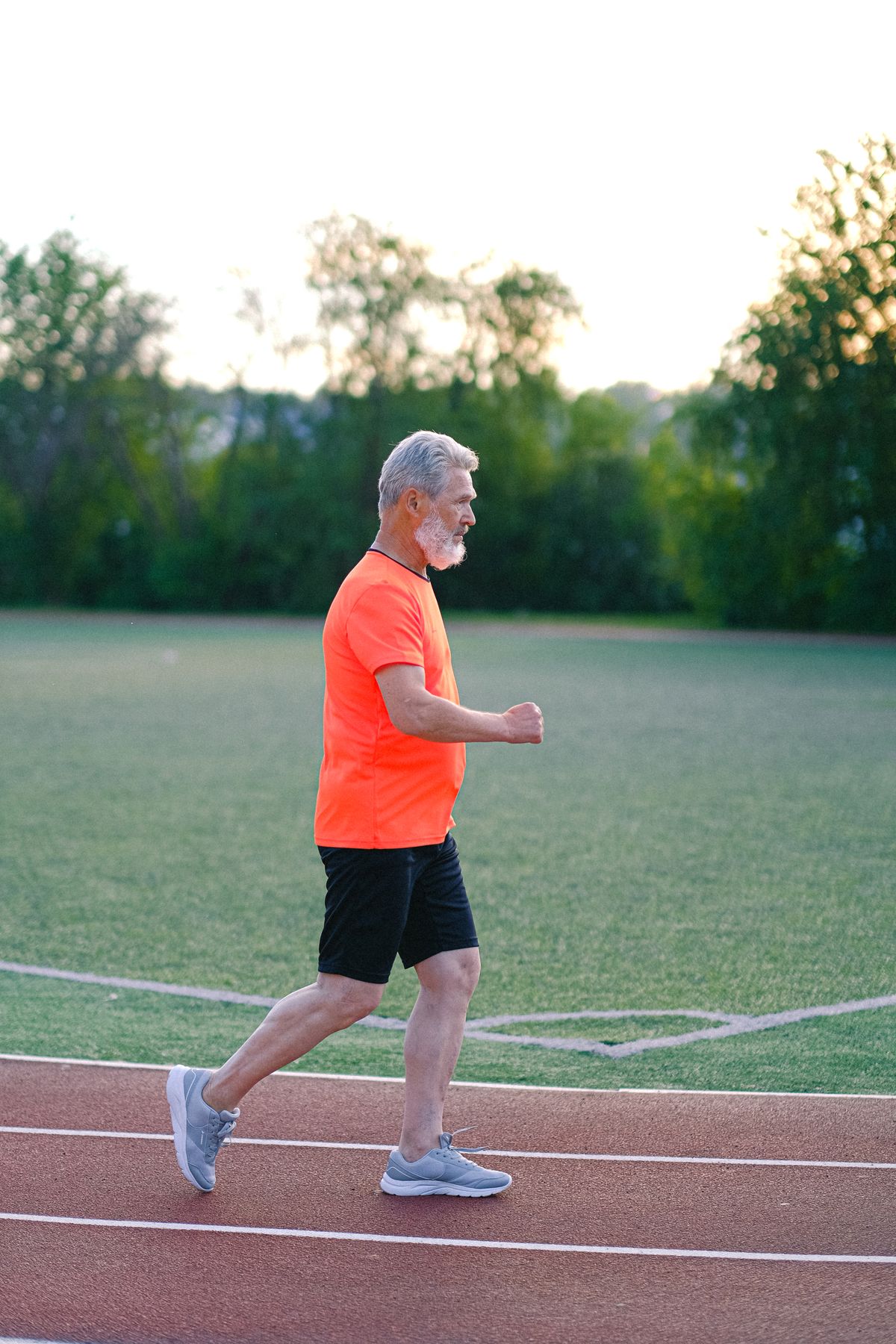 Aged gray-haired man running on a stadium track
The Practical Mobility Minimum
Spend 5 to 10 minutes before every session on targeted mobility. Focus on the areas that tighten most with age:
- Hips — 90/90 switches, hip flexor stretches, deep bodyweight squats
- Thoracic spine — cat-cow, foam roller extensions, thread the needle
- Ankles — wall ankle mobilizations, calf stretches with a bent knee
- Shoulders — band pull-aparts, wall slides, arm circles
How to Adapt: Before 40 vs After 40
The changes are not dramatic — but they are non-negotiable. Here is how smart training looks on both sides of 40.
| Training Variable | Before 40 | After 40 |
|---|---|---|
| Weekly frequency | 4–6 sessions | 3–4 sessions |
| Recovery between hard sessions | 24–48 hours | 48–72 hours |
| Work-to-rest ratio (HIIT) | 1:1 | 1:2 or 1:3 |
| Protein intake | 1.2–1.6 g/kg/day | 1.6–2.0 g/kg/day |
| Mobility work | Optional warm-up | 5–10 min every session |
| Training priority | Performance, aesthetics | Strength, longevity, joint health |
| Impact level | Any | Low to moderate preferred |
The goal is not to do less. It is to do the right things with better precision.
Track Your Over-40 Training With Hiitify
Hiitify lets you build custom interval timers with the adjusted work-to-rest ratios that research recommends for training after 40 — set 1:2 or 1:3 ratios in seconds and save them for every session. Track your workout consistency with streaks, monitor your weekly training volume, and build a sustainable habit that matches your body's recovery timeline.
Free on iOS
TRAIN SMARTER
Build custom HIIT, Tabata, AMRAP, EMOM and Circuit workouts. Precision timer, streak tracking and analytics — free on iOS.
Sources & Further Reading
Research
- Mitchell, W.K. et al. (2012). Sarcopenia, Dynapenia, and the Impact of Advancing Age on Human Skeletal Muscle Size and Strength; a Quantitative Review. Frontiers in Physiology. View on PMC
- Liao, C.D. et al. (2020). Exercise Programs for Muscle Mass, Muscle Strength and Physical Performance in Older Adults with Sarcopenia: A Systematic Review and Meta-Analysis. Aging Clinical and Experimental Research. View on PMC
- Marriott, C.F.S. et al. (2021). High-Intensity Interval Training in Older Adults: a Scoping Review. Sports Medicine — Open. View on Springer
- Valenzuela, P.L. et al. (2023). Age-related decline in peak oxygen uptake: Cross-sectional vs. longitudinal findings. A review. PMC. View on PMC
- Liu, J. et al. (2024). Effects of High-Intensity Interval Training on the Parameters Related to Physical Fitness and Health of Older Adults: A Systematic Review and Meta-Analysis. Sports Medicine — Open. View on Springer
- (2024). Resistance training promotes muscle growth in older adults at both the whole-muscle and individual muscle fiber levels. Experimental Gerontology. View on ScienceDirect
- Huang, G. et al. (2005). Controlled Endurance Exercise Training and VO2max Changes in Older Adults: A Meta-Analysis. Preventive Cardiology. View on Wiley
- Marcucci, L. & Reggiani, C. (2020). Decline in VO2max with aging in master athletes and sedentary men. Journal of Applied Physiology. View on PubMed
- (2022). Acute and Chronic Effects of Supervised Flexibility Training in Older Adults. PMC. View on PMC
- (2025). The Influence of Resistance Training on Joint Flexibility in Healthy Adults: A Systematic Review, Meta-analysis, and Meta-regression. Journal of Strength and Conditioning Research. View on PMC
Further Reading
- Five essential fitness adaptations for your body after 40 — Rolling Out
- Can I Get Fit In My 40s? Science-Based Answers — North Ave Immediate Care
- Recovery After 40: Why Your Body Needs More Time — Hive Fitness Bristol
- Why VO2 max Declines with Age, and What to Do about It — Physiologically Speaking
Image Credits
- Cover: Serious mature man stretching on stadium — Pexels
- An Elderly Man Holding a Kettlebell — Pexels
- Aged gray haired man running on stadium — Pexels
All images free to use under the Pexels License.