The most common question people ask about HIIT calorie burn is deceptively simple: how many calories does it actually burn? The answer depends on your body weight, the intensity you sustain, the exercises you choose, and how long you work. But the research gives us concrete numbers — and they're more useful than the vague "up to 500 calories!" claims you'll find on most fitness sites.
Here's what the science actually shows.
The Per-Minute Calorie Burn
The reason HIIT is so time-efficient comes down to one metric: calories burned per minute. And by this measure, HIIT consistently outperforms every other common cardio format.
A 2024 study published in Frontiers in Endocrinology directly compared three exercise protocols in male university students with overweight/obesity and measured energy expenditure rates precisely:
| Protocol | Format | Energy Expenditure Rate |
|---|---|---|
| Tabata | 20s on / 10s off, 8 rounds | 5.76 kcal/min |
| HIIT | 3 min at 80% VO₂max / 2 min at 20% | 4.81 kcal/min |
| MICT | 30 min at 50% VO₂max | 3.45 kcal/min |
Tabata burned 67% more calories per minute than moderate-intensity cardio. Standard HIIT burned 39% more. Both differences were statistically significant (p<0.001).
Research from Auburn University at Montgomery found even higher rates during true maximal-effort Tabata: participants burned 13.5 calories per minute during 20-second all-out bouts followed by 10 seconds of rest.
These numbers matter because they explain HIIT's core advantage: you don't need to train for an hour to get meaningful calorie expenditure. A 20-minute HIIT session can match the calorie burn of a 35–40 minute moderate jog — with a larger afterburn effect on top.
 Strong man running on treadmill during an intense cardio workout in the gym
How Many Calories You'll Actually Burn (By Duration)
The honest answer is: it depends on your body weight and how hard you push. But here are realistic ranges based on the research, calculated for a 70 kg (155 lb) person at vigorous intensity:
| Duration | Estimated Calorie Burn | With Afterburn (EPOC) |
|---|---|---|
| 10 minutes | 110–140 kcal | 120–155 kcal |
| 15 minutes | 165–210 kcal | 180–235 kcal |
| 20 minutes | 220–280 kcal | 240–310 kcal |
| 30 minutes | 330–400 kcal | 360–440 kcal |
These estimates use a MET range of 7–11 (moderate to vigorous HIIT), which reflects real-world training where you're alternating between hard work intervals and active recovery — not sustaining maximal effort for the entire session.
Free on iOS
TRAIN SMARTER
Build custom HIIT, Tabata, AMRAP, EMOM and Circuit workouts. Precision timer, streak tracking and analytics — free on iOS.
The Variables That Actually Matter
Not all HIIT sessions burn the same number of calories. Four factors explain most of the variation:
1. Body Weight
Body weight is the single strongest predictor of calorie expenditure during any exercise. The physics are straightforward: moving a heavier body requires more mechanical work and more energy.
A 100 kg person burns approximately 43% more calories than a 70 kg person performing the exact same workout at the same intensity and duration. The standard MET formula scales directly with body mass:
Calories = MET × weight (kg) × duration (hours)
This is why calorie burn ranges are always wide — a 60 kg beginner and a 90 kg athlete will have dramatically different numbers from the same 20-minute session.
2. Exercise Intensity
Intensity is the second-largest driver — and its relationship with calorie burn is exponential, not linear. Research by LaForgia, Withers & Gore (2006) confirmed that doubling exercise intensity more than doubles calorie expenditure and EPOC.
The MET values tell the story:
| Intensity Level | MET Value | Calories/20 min (70 kg) |
|---|---|---|
| Moderate HIIT | 7.0 | ~163 kcal |
| Vigorous HIIT | 11.0 | ~257 kcal |
| Sprint intervals | 14.0 | ~327 kcal |
The gap between moderate and sprint-level HIIT is 100% more calories for the same duration. Intensity matters more than any other controllable variable.
3. Exercise Selection
Compound, full-body movements burn significantly more calories than isolated exercises. Burpees, thrusters, squat jumps, and sprints recruit more muscle mass and demand more oxygen than bicep curls or calf raises.
4. Work-to-Rest Ratio
The ratio of effort to recovery directly controls your average energy expenditure. A 1:1 ratio (30 seconds work, 30 seconds rest) keeps calorie burn elevated. A 1:3 ratio (20 seconds work, 60 seconds rest) is easier to sustain but burns less per minute. For calorie maximisation, 1:1 or 2:1 ratios produce the highest per-minute expenditure.
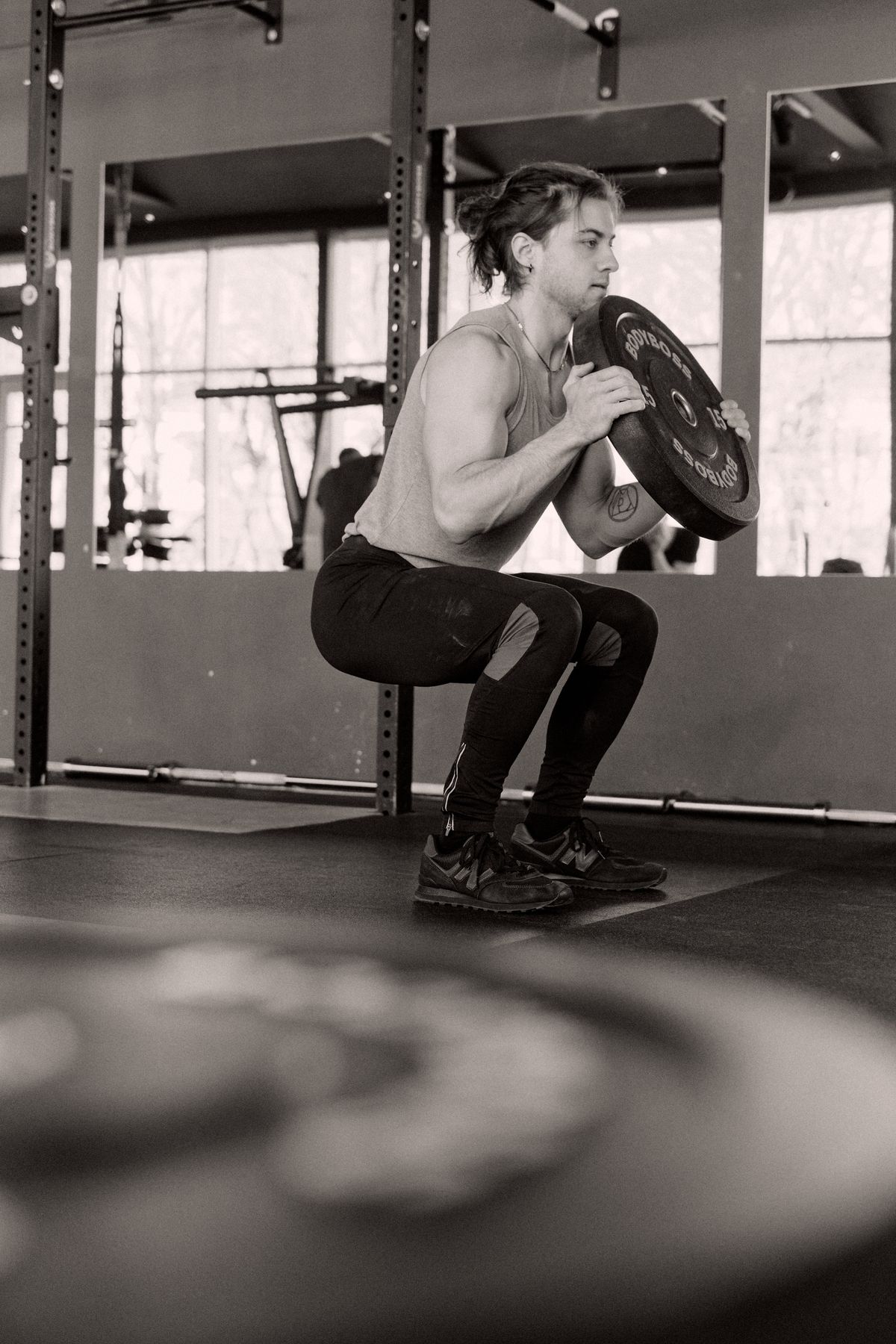 Man doing squats with heavy weights at the gym
HIIT vs Other Exercise: A Calorie Comparison
One of the most useful ways to contextualise HIIT calorie burn is to compare it against other common exercise formats. These estimates are for a 70 kg (155 lb) person over 30 minutes:
| Exercise | Calories / 30 min | Notes |
|---|---|---|
| HIIT (vigorous) | 330–400 | Highest per-minute burn + afterburn |
| Running (6 mph) | 300–350 | High burn, weight-bearing |
| Jump rope | 280–340 | Very high intensity, skill-dependent |
| Cycling (moderate) | 240–280 | Lower impact, sustainable longer |
| Swimming (laps) | 220–300 | Full-body, intensity-dependent |
| Walking (brisk) | 130–160 | Low intensity, highly accessible |
The key insight: HIIT burns more calories per minute than any other format, but steady-state exercise sessions often last longer. A 45-minute run may burn more total calories than a 20-minute HIIT session — but HIIT achieves more per unit of time. A 2015 study in the Journal of Strength and Conditioning Research found HIIT burned 25–30% more calories than steady-state exercise over the same duration.
The Afterburn Bonus: How Much Does EPOC Really Add?
After every HIIT session, your body continues burning calories at an elevated rate — a phenomenon called EPOC (Excess Post-Exercise Oxygen Consumption). But the actual numbers are more modest than marketing claims suggest.
A 2024 study by Li et al. measured EPOC precisely after energy-matched HIIT and moderate-intensity sessions in men with obesity:
- HIIT EPOC: 66.20 kcal (at 90% VO₂max)
- MICT EPOC: 53.91 kcal (at 60% VO₂max)
- Most of the difference occurred in the first 10 minutes post-exercise
Across the broader literature, EPOC typically adds 6–15% of exercise calories on top of the session. If you burn 300 calories during a HIIT workout, expect an extra 20–45 calories from the afterburn — not hundreds. The effect is real, but the workout itself accounts for 85–94% of your total calorie expenditure.
The Bigger Picture: Calories Are Just One Metric
Calorie burn matters, but fixating on it misses the broader picture. HIIT's real advantages go beyond the session-level numbers:
1. Time efficiency. Burning 300 calories in 20 minutes instead of 45 means you're more likely to actually do the workout. Adherence is the strongest predictor of long-term results.
2. Metabolic adaptations. Regular HIIT training increases VO₂max, improves insulin sensitivity, and enhances mitochondrial density — all of which raise your resting metabolic rate over time.
3. Muscle preservation. Unlike prolonged steady-state cardio, HIIT preserves lean body mass during a caloric deficit. More muscle means a higher baseline calorie burn, 24 hours a day.
4. Appetite regulation. Research shows HIIT suppresses ghrelin (the hunger hormone) and increases satiety hormones, making it easier to maintain a calorie deficit without feeling deprived.
The most effective fat-loss strategy isn't about finding the workout that burns the most calories — it's about finding one you'll do consistently, at an intensity that drives adaptation, combined with sensible nutrition.
Track Your HIIT Calorie Burn With Hiitify
Knowing the numbers is one thing — structuring your workouts to maximise them is another. Hiitify lets you build custom HIIT workouts with precise work and rest intervals, choose between Tabata, EMOM, AMRAP, and classic interval formats, and track your training streak to stay consistent. Set your work-to-rest ratio, pick your round count, and let the app handle the timing while you focus on pushing intensity.
Free on iOS
TRAIN SMARTER
Build custom HIIT, Tabata, AMRAP, EMOM and Circuit workouts. Precision timer, streak tracking and analytics — free on iOS.
Sources & Further Reading
Research
-
Wang, Y. et al. (2024). A comparative analysis of energy expenditure and substrate metabolism in male university students with overweight/obesity: Tabata vs HIIT and MICT. Frontiers in Endocrinology. View on PMC
-
Li, H. et al. (2024). Acute interval running induces greater excess post-exercise oxygen consumption and lipid oxidation than isocaloric continuous running in men with obesity. BMC Sports Science, Medicine and Rehabilitation. View on PMC
-
LaForgia, J., Withers, R.T. & Gore, C.J. (2006). Effects of exercise intensity and duration on the excess post-exercise oxygen consumption. Journal of Sports Sciences, 24(12), 1247–1264. View on PubMed
-
Falcone, P.H. et al. (2015). Caloric Expenditure of Aerobic, Resistance, or Combined High-Intensity Interval Training Using a Hydraulic Resistance System in Healthy Men. Journal of Strength and Conditioning Research, 29(3), 779–785. View on PubMed
-
Børsheim, E. & Bahr, R. (2003). Effect of Exercise Intensity, Duration and Mode on Post-Exercise Oxygen Consumption. Sports Medicine, 33(14), 1037–1060. View on PubMed
Further Reading
- How Many Calories Does HIIT Burn? The Real Answer — Armour Body
- HIIT vs. Traditional Cardio: Which Burns More & Why — Brookswood Bootcamp
- How Many Calories Does a HIIT Workout Burn? — CrossTown Fitness
Image Credits
- Cover: Photo of women exercising — Pexels
- Strong sportsman using treadmill for cardio workout in gym — Pexels
- Man doing squats at the gym — Pexels
All images free to use under the Pexels License.