More HIIT should mean more results — right? Not exactly. Research shows there's a clear ceiling on how often you should do HIIT, and pushing past it doesn't just stall your progress. It reverses it. The science points to a surprisingly narrow sweet spot, and most people who feel stuck are probably already past it.
The Research: 2–3 Sessions Per Week Is the Sweet Spot
The most consistent finding across the exercise science literature is that 2–3 HIIT sessions per week delivers optimal results for the vast majority of people.
A 2025 study published in Physiological Reports by researchers at the University of Würzburg put this directly to the test. Twenty-six recreationally active participants (VO₂max: 51.3 ± 7.1 mL/kg/min) were assigned to perform 4×4-minute HIIT at 90–95% of maximum heart rate either once, twice, or three times per week for six weeks. The results were clear: two weekly sessions produced significant improvements in VO₂max and time to exhaustion, with no additional benefit from increasing to three sessions. The researchers concluded that twice-weekly HIIT is "a practical and time-efficient training strategy."
A separate study on recreational runners (n=26) over six weeks confirmed the pattern. Two to three weekly HIIT sessions produced peak gains in aerobic capacity. Going from three to four sessions showed zero additional improvement — only increased fatigue and injury risk.
And there's a hard number behind the frequency guideline. Research from Jinger Gottschall at Pennsylvania State University found that the weekly ceiling for time spent above 90% of maximum heart rate is roughly 30–40 minutes. A typical 30-minute HIIT class keeps you in that zone for about 10–15 minutes, which means two to three sessions per week lands you squarely in the optimal range.
| Weekly HIIT Sessions | VO₂max Gains | Overtraining Risk | Recovery |
|---|---|---|---|
| 1 session | Modest | Very low | Full recovery |
| 2 sessions | Significant | Low | Adequate |
| 3 sessions | Peak (marginal over 2) | Moderate | Requires good habits |
| 4+ sessions | Diminishing or negative | High | Likely incomplete |
 Muscular sportsman resting between sets at the gym
What Happens When You Do Too Much HIIT
The most compelling evidence for HIIT's upper limit comes from a landmark 2021 study in Cell Metabolism by Flockhart et al. at the Swedish School of Sport and Health Sciences. The researchers progressively increased participants' HIIT volume over four weeks, closely monitoring mitochondrial function, glucose tolerance, and performance.
During the first two weeks — moderate HIIT volume — participants saw the expected improvements: enhanced mitochondrial respiratory capacity and better glucose regulation. But in the heaviest training week, when participants were performing 152 minutes of high-intensity exercise, everything reversed:
- Mitochondrial function declined — intrinsic respiration dropped and hydrogen peroxide production increased
- Glucose tolerance was impaired — insulin secretion became disrupted
- Performance gains stalled then deteriorated
The study demonstrated what the researchers described as a bell-shaped dose-response curve: moderate HIIT improves mitochondrial health; excessive HIIT damages the very cellular machinery that produces energy. The good news is the effects were reversible — once training volume returned to normal, mitochondrial function recovered.
This isn't just a cellular-level problem. Excessive HIIT drives chronically elevated cortisol. Research published in Scandinavian Journal of Medicine & Science in Sports found that testosterone and cortisol serve as sensitive biomarkers for monitoring the anabolic-catabolic balance during HIIT. When cortisol stays elevated because you never give it time to drop, the downstream effects cascade: systemic inflammation, disrupted sleep, mood instability, and accumulation of abdominal fat — the opposite of what most people are training for.
Free on iOS
TRAIN SMARTER
Build custom HIIT, Tabata, AMRAP, EMOM and Circuit workouts. Precision timer, streak tracking and analytics — free on iOS.
The Warning Signs of HIIT Overtraining
Overtraining syndrome sits at the end of a continuum. It starts with functional overreaching (temporary performance dip that resolves with rest), progresses to non-functional overreaching (extended fatigue and stagnation), and culminates in full overtraining syndrome — which can take weeks or months to recover from.
A 2017 systematic review in BMC Sports Science, Medicine and Rehabilitation examined the hormonal aspects of overtraining across 38 studies. The researchers found that while resting hormone levels are often normal in overtrained athletes, the body's ability to respond to stress becomes blunted — a key sign that the hormonal system is overwhelmed.
Here are the signs that you're doing too much HIIT:
- Declining performance despite consistent training — your times, reps, or power output are getting worse
- Persistent fatigue that doesn't improve with a good night's sleep
- Elevated resting heart rate — 5+ bpm above your normal baseline
- Sleep disruption — feeling "wired but tired," unable to fall asleep despite exhaustion
- Mood changes — irritability, low motivation, and dreading workouts you used to enjoy
- Frequent illness — excessive high-intensity work temporarily suppresses immune function
- Chronic soreness — muscle soreness lasting beyond 72 hours is more than normal DOMS
If you recognise three or more of these signs, it's time to cut back to two HIIT sessions per week — or take a full deload week with only light activity.
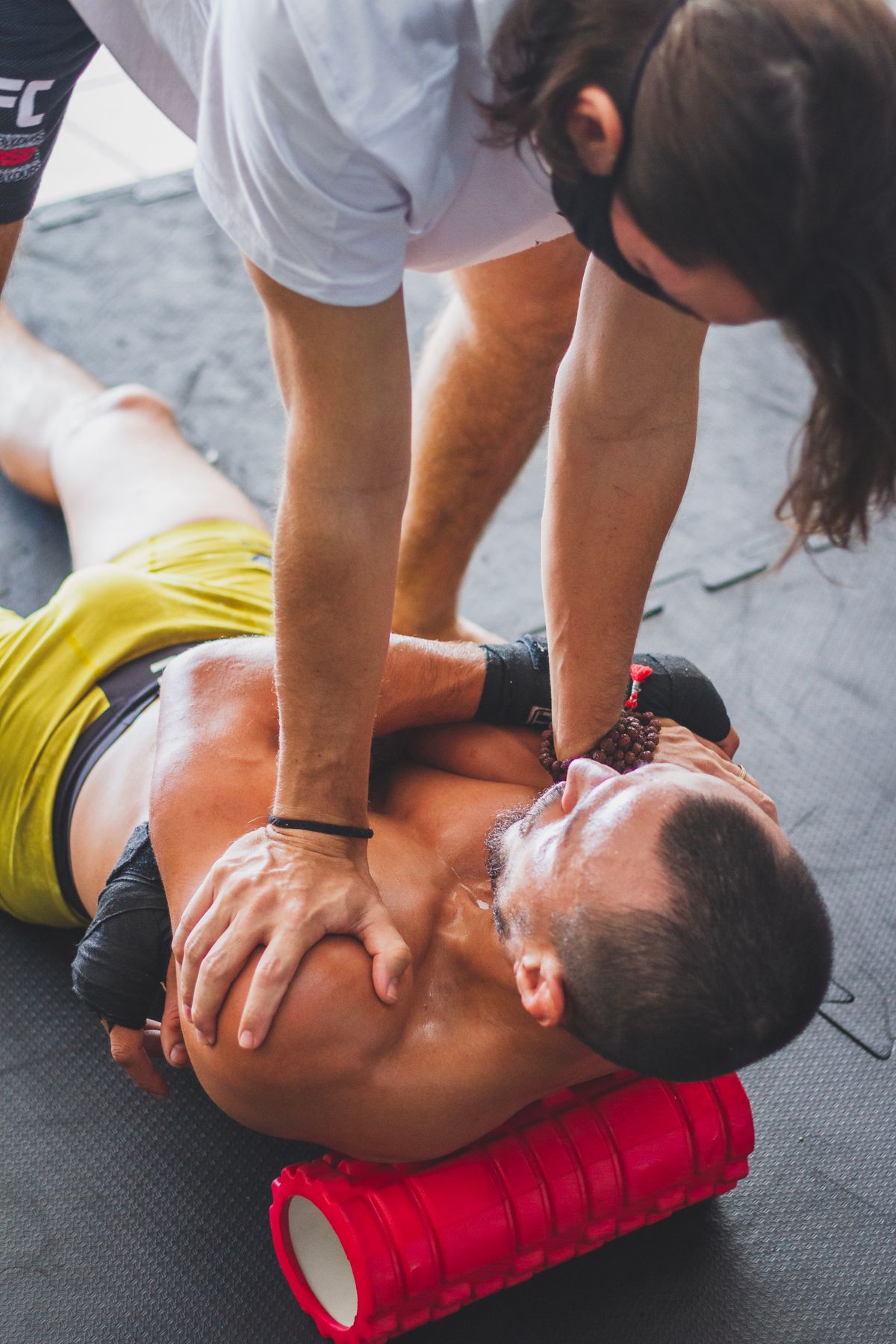 Trainer helping an athlete with foam roller recovery and stretching
How to Structure Your Week
The optimal HIIT week isn't about maximising the number of high-intensity sessions — it's about placing them strategically so your body can fully recover and adapt.
The Evidence-Based Template
| Day | Training Type | Intensity |
|---|---|---|
| Monday | HIIT session | High |
| Tuesday | Walking, yoga, or mobility | Low |
| Wednesday | Strength training | Moderate |
| Thursday | Rest or light activity | Low |
| Friday | HIIT session | High |
| Saturday | Active recovery or strength | Low–Moderate |
| Sunday | Full rest | None |
This template ensures at least 48 hours between HIIT sessions — the minimum recovery window supported by research. A study on trained rowers found that heart rate variability takes 16–29 hours to return to baseline after HIIT depending on the protocol, with some individuals needing up to 41 hours. The 48-hour buffer accounts for individual variation.
Adjustments by Experience Level
Beginners (0–3 months of HIIT): Start with two sessions per week separated by at least 72 hours. Your cardiovascular system and connective tissues need time to adapt to the intensity.
Intermediate (3–12 months): Move to two to three sessions per week with 48 hours between them. Monitor your resting heart rate and perceived fatigue.
Advanced (12+ months): You can sustain three sessions per week, but the total time above 90% max heart rate should stay under 40 minutes weekly. Consider using HRV monitoring to decide when you're ready for your next session.
Over 40 or returning from a break: Research on older adults (mean age ~61) found benefits from HIIT performed as infrequently as once every five days. Start conservatively and extend rest periods to 72 hours if recovery feels incomplete.
Quality Over Quantity: The Real Key
Here's a perspective shift that changes how most people think about HIIT frequency: if your body is too fatigued to perform with genuine high intensity, your HIIT session isn't really high intensity. You're just doing hard cardio with diminishing returns.
Research from Martin Buchheit, a leading sports scientist, demonstrates that exceeding optimal HIIT volumes leads to diminishing returns and increased injury risk in elite athletes — and recreational exercisers have even less capacity to absorb high-intensity stress.
The practical takeaway: two or three genuinely high-quality HIIT sessions will always outperform five mediocre ones. If you want to train more frequently, fill the remaining days with strength training, walking, yoga, or mobility work — activities that complement HIIT without competing with its recovery demands.
Track Your HIIT Frequency With Hiitify
Staying in the 2–3 session sweet spot is easy when you can see your training week at a glance. Hiitify logs every HIIT session with precise work and rest intervals, tracks your weekly frequency, and helps you build a sustainable training streak. Create custom timers for your favourite protocols and keep your high-intensity volume in the evidence-based range — so every session counts.
Free on iOS
TRAIN SMARTER
Build custom HIIT, Tabata, AMRAP, EMOM and Circuit workouts. Precision timer, streak tracking and analytics — free on iOS.
Sources & Further Reading
Research
-
Flockhart, M. et al. (2021). Excessive exercise training causes mitochondrial functional impairment and decreases glucose tolerance in healthy volunteers. Cell Metabolism. View on Cell Metabolism
-
Lenk, S. et al. (2025). Impact of weekly frequency of high-intensity interval training on cardiorespiratory, metabolic, and performance measures in recreational runners. Physiological Reports. View on PMC
-
Cadegiani, F.A. & Kater, C.E. (2017). Hormonal aspects of overtraining syndrome: a systematic review. BMC Sports Science, Medicine and Rehabilitation. View on PMC
-
Moreira, A. et al. (2022). Acute effect of HIIT on testosterone and cortisol levels in healthy individuals: A systematic review and meta-analysis. Scandinavian Journal of Medicine & Science in Sports. View on Wiley
-
Cadegiani, F.A. & Kater, C.E. (2021). Effects of Overtraining Status on the Cortisol Awakening Response. Sports Medicine — Open. View on PubMed
-
Álvarez, C. et al. (2018). High-Intensity Interval Training Frequency: Cardiometabolic Effects and Quality of Life. International Journal of Sports Medicine. View on PubMed
Further Reading
- The Cortisol Creep: Is HIIT Backfiring? — Healthline
- Too Many HIIT Workouts Could Be Bad for You — T3
- How Often Should You Do HIIT? Weekly Limits & Recovery — Fitryte
Image Credits
- Cover: Man sitting on flat bench in gym — Pexels
- Muscular sportsman resting after workout in gym — Pexels
- Trainer helping athlete with stretching on foam roller — Pexels
All images free to use under the Pexels License.