Following someone else's HIIT workout is fine when you are starting out. But eventually, the cookie-cutter routine stops fitting. Your goals change, your fitness improves, or the exercises do not match what you have available. The solution is not to find another pre-built plan — it is to learn how to build a custom HIIT workout from scratch. Once you understand the five variables that define every interval session, you can design workouts that match your goals, your fitness level, and the time you actually have.
The Five Variables Behind Every HIIT Workout
Every HIIT session is built from five decisions. Change any one of them and you change the stimulus your body receives.
| Variable | What It Controls | Example |
|---|---|---|
| Exercises | Which muscles you target and how much coordination is required | Burpees vs. marching in place |
| Work duration | How long each high-intensity interval lasts | 20s, 30s, 40s, or 60s |
| Rest duration | How much recovery you get between efforts | 10s, 20s, 30s, or 40s |
| Rounds | How many times you cycle through the exercises | 3, 4, or 5 rounds |
| Intensity | How hard you push during work intervals | 80–95% of max heart rate |
Research supports this framework. A 2019 meta-analysis by Wen et al. in the British Journal of Sports Medicine reviewed 77 studies and found that all five variables — particularly interval duration and intensity — independently influence cardiovascular and metabolic outcomes. The specific combination you choose determines whether your workout targets fat loss, aerobic capacity, anaerobic power, or muscular endurance.
Step 1: Set Your Time Budget
Start with how much time you have. This anchors every other decision.
- 10–15 minutes — choose 3–4 exercises, 3–4 rounds, shorter intervals (20–30s work)
- 15–20 minutes — choose 4–5 exercises, 3–4 rounds, moderate intervals (30–40s work)
- 20–30 minutes — choose 5–6 exercises, 3–5 rounds, longer intervals (30–60s work)
A 2015 meta-analysis by Milanović et al. in Sports Medicine found that HIIT sessions as short as 10 minutes of total high-intensity work significantly improved VO₂ max — by an average of 5.5 ml/kg/min. You do not need an hour. You need enough work intervals at the right intensity.
 Woman performing a plank on a yoga mat at home
Step 2: Choose Your Work-to-Rest Ratio
Your work-to-rest ratio controls the difficulty. Here is how to match it to your level:
| Level | Ratio | Example | Why It Works |
|---|---|---|---|
| Beginner | 1:2 | 20s work / 40s rest | Longer rest allows full recovery, keeps form clean |
| Intermediate | 1:1 | 30s work / 30s rest | Balanced stimulus — builds both aerobic and anaerobic fitness |
| Advanced | 2:1 | 40s work / 20s rest | Shorter rest increases metabolic demand and lactate accumulation |
A 2024 study in the Journal of Exercise Science & Fitness examined the effects of different work-to-rest ratios on college athletes and found that both 1:1 and 2:1 ratios produced significant improvements in aerobic capacity, with no significant difference between them. The key factor was consistent intensity during work intervals, not the specific ratio. Start conservative and tighten the rest as your fitness improves.
Free on iOS
TRAIN SMARTER
Build custom HIIT, Tabata, AMRAP, EMOM and Circuit workouts. Precision timer, streak tracking and analytics — free on iOS.
Step 3: Pick Your Exercises
The best HIIT exercises are compound movements that use multiple joints and large muscle groups. They elevate your heart rate quickly and keep it high throughout the interval. Here is an exercise menu organised by movement pattern:
| Movement Pattern | Beginner | Intermediate | Advanced |
|---|---|---|---|
| Lower body push | Bodyweight squat | Jump squat | Squat jump to tuck |
| Lower body pull | Glute bridge | Reverse lunge | Bulgarian split squat jump |
| Upper body push | Incline push-up | Push-up | Explosive push-up |
| Upper body pull | Superman hold | Renegade row | Pull-up |
| Core | Dead bug | Mountain climber | Burpee |
| Cardio | March in place | High knees | Tuck jumps |
The principle: pick one exercise from each row that matches your level, and you have a balanced full-body HIIT workout. Aim for 4–6 exercises total. If you are short on time, choose four. If you have 25 minutes, go with five or six.
For joint-friendly options, swap any plyometric movement for its low-impact alternative — step-back lunges instead of jump lunges, fast marching instead of high knees. The ACSM confirms that bodyweight HIIT produces equivalent cardiovascular improvements regardless of whether exercises include jumping.
Step 4: Structure Your Rounds
Now assemble everything. Here is the formula:
Total workout time = (work + rest) × exercises × rounds + rest between rounds
For example, a 20-minute beginner workout:
- Ratio: 20s work / 40s rest (1:2)
- Exercises: 5 (bodyweight squat, incline push-up, glute bridge, dead bug, march in place)
- Rounds: 4
- Rest between rounds: 60s
- Total: (20 + 40) × 5 × 4 + (60 × 3) = 1,200 + 180 = 1,380 seconds (23 minutes)
Add a 5-minute warm-up of dynamic stretches and light cardio, and a 3-minute cool-down of static stretches, and you have a complete session under 31 minutes.
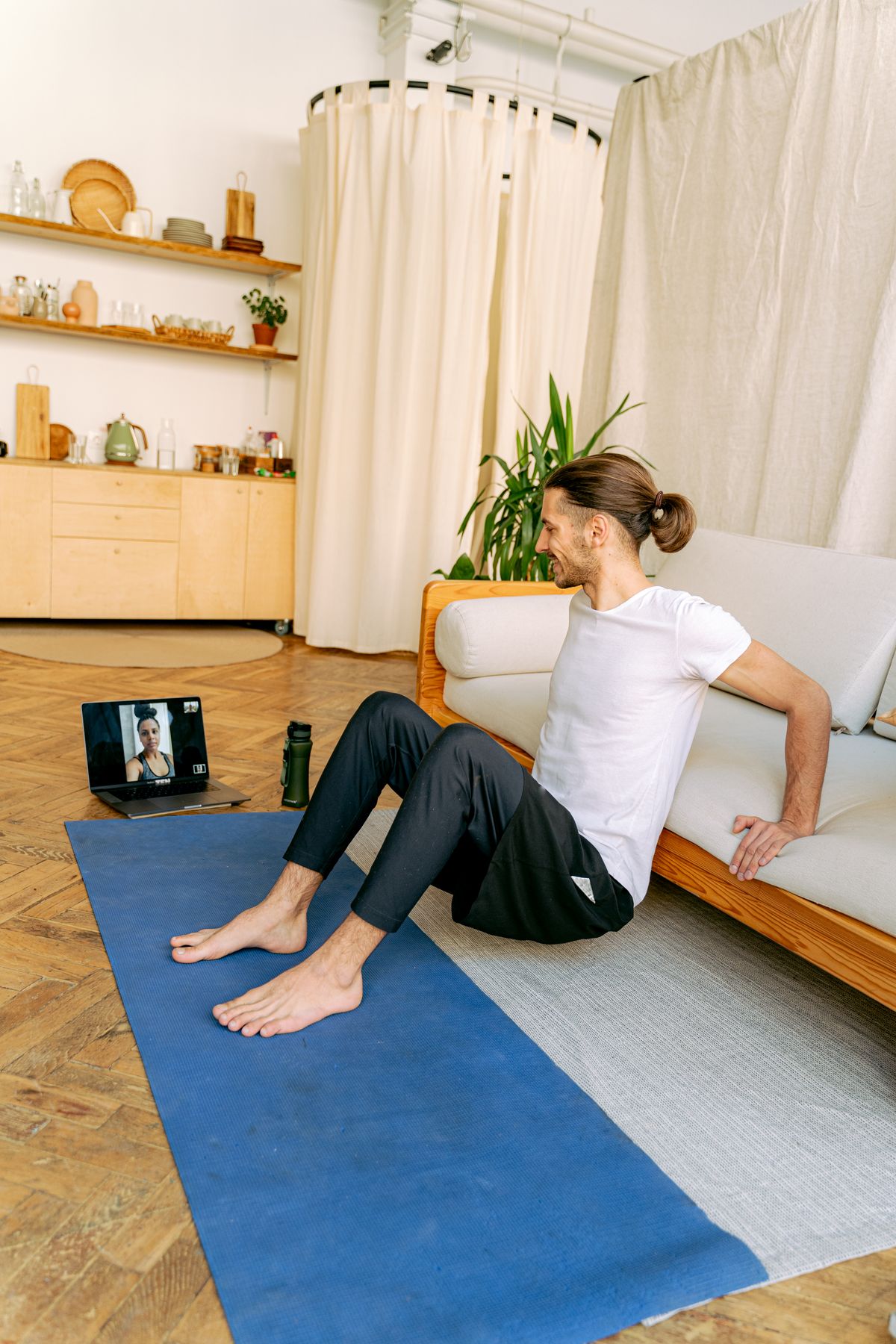 Man doing a workout exercise at home during a video call
Three Sample Custom Workouts
Fat Loss Focus (Intermediate, 18 min)
Ratio: 30s work / 30s rest | Rounds: 3 | Rest between rounds: 60s
- Jump squats
- Push-ups
- Mountain climbers
- Reverse lunges (alternating)
- Burpees
Endurance Builder (Beginner, 20 min)
Ratio: 20s work / 40s rest | Rounds: 4 | Rest between rounds: 60s
- Bodyweight squats
- Incline push-ups
- High knees (or fast marching)
- Glute bridges
Power and Speed (Advanced, 22 min)
Ratio: 40s work / 20s rest | Rounds: 4 | Rest between rounds: 45s
- Tuck jumps
- Explosive push-ups
- Bulgarian split squat jumps
- Renegade rows
- Burpees
Common Design Mistakes
Too many exercises. More than six exercises per circuit means you spend more time remembering what is next than actually training. Keep it simple — four to six movements is the sweet spot.
Skipping warm-up. A 2018 systematic review in Sports Medicine found that dynamic warm-ups reduce acute injury risk and improve power output during high-intensity efforts. Five minutes of arm circles, leg swings, and light jogging is non-negotiable.
Same workout every session. Your body adapts. Change at least one variable — exercises, ratio, or rounds — every 2–3 weeks. A 2019 review by Wen et al. found that progressive overload through these variables drives continued adaptation across 4–12 week training cycles.
Going too hard too soon. If you are a beginner using a 2:1 work-to-rest ratio, your form will break down before your cardiovascular system gets the stimulus. Start at 1:2 and earn the harder ratios over weeks.
Track Your Custom HIIT Workouts With Hiitify
Hiitify makes building custom HIIT workouts effortless. Set your exact work and rest intervals, choose your round count, and start training — the timer handles the structure so you can focus on effort. Save your favourite workout templates and track your sessions over time. The built-in streak tracker keeps you consistent, and you can adjust your intervals as you progress from beginner to advanced ratios.
Free on iOS
TRAIN SMARTER
Build custom HIIT, Tabata, AMRAP, EMOM and Circuit workouts. Precision timer, streak tracking and analytics — free on iOS.
Sources & Further Reading
Research
- Milanović, Z. et al. (2015). Effectiveness of High-Intensity Interval Training (HIT) and Continuous Endurance Training for VO₂max Improvements: A Systematic Review and Meta-Analysis. Sports Medicine. View on PubMed
- Wen, D. et al. (2019). Effects of different protocols of high intensity interval training for VO₂max improvements in adults: A meta-analysis of randomised controlled trials. British Journal of Sports Medicine. View on PubMed
- Chen, Y. et al. (2024). Effects of different work-to-rest ratios of high-intensity interval training on physical performance and physiological responses in male college judo athletes. Journal of Exercise Science & Fitness. View on ScienceDirect
- Falkenberg, E. et al. (2025). Impact of weekly frequency of high-intensity interval training on cardiorespiratory, metabolic, and performance measures in recreational runners. European Journal of Applied Physiology. View on PubMed
Further Reading
- High-Intensity Interval Training: For Fitness, for Health or Both? — ACSM
- Coaching HIIT: A Practical Approach to Programming — ACSM
- How to Build Your Own HIIT Workout — TRAINFITNESS
Image Credits
- Cover: Man working out at a gym — Pexels
- Woman planking on a yoga mat — Pexels
- Man doing exercise at home — Pexels
All images free to use under the Pexels License.