You have been doing HIIT for a few weeks. The workouts that once left you gasping now feel manageable. That is a good sign — it means your body is adapting. But the question most people get wrong is what to do next. Push too hard too fast and you end up injured or overtrained. Stay at the same level and you plateau. Learning how to progress your HIIT workouts safely is the difference between long-term gains and a setback that costs you weeks.
The Principle Behind Safe Progression
Every fitness improvement follows the same rule: progressive overload. You gradually increase the stress placed on your body so it adapts and grows stronger. In strength training, this usually means adding weight. In HIIT, the variables are different — and there are more of them.
The key principle is to change only one variable at a time. Your body can adapt to a single new stressor per training cycle. Stack multiple changes together — harder exercises, shorter rest, longer sessions — and you overwhelm your recovery capacity, which is when injuries happen.
The Five Variables You Can Progress
There are five ways to make a HIIT workout harder. Each one targets a different aspect of fitness, and the order matters.
| Variable | How to Progress | What It Improves | Injury Risk |
|---|---|---|---|
| Work duration | Add 5–10 seconds per interval | Muscular endurance | Low |
| Rest duration | Remove 5–10 seconds of rest | Cardiovascular recovery | Low–Moderate |
| Rounds/sets | Add 1 extra round | Total volume and stamina | Low |
| Exercise complexity | Swap to a harder variation | Power, coordination | Moderate–High |
| Frequency | Add a session per week | Overall training load | High |
Start at the top and work down. Increasing work duration or adding a round is far safer than jumping straight to plyometric variations or extra training days. Save frequency increases for last — research consistently shows that going beyond 3 HIIT sessions per week increases overreaching risk without proportional fitness gains.
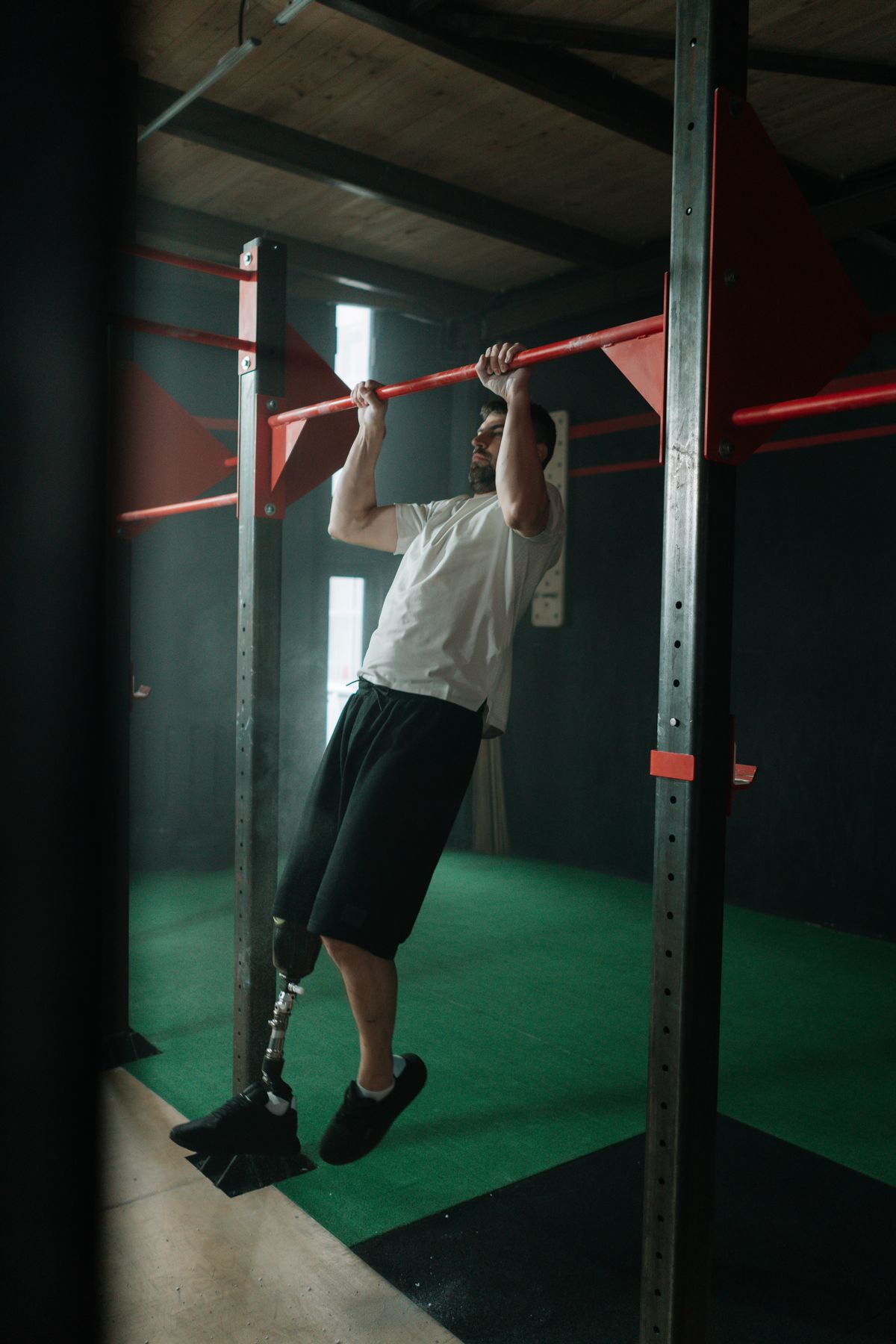 Man doing pull ups in a gym demonstrating progressive bodyweight exercise
What the Science Says About Doing Too Much
A landmark 2021 study by Flockhart et al., published in Cell Metabolism, demonstrated what happens when you push HIIT progression too aggressively. Researchers put healthy volunteers through a 4-week programme with progressively increasing HIIT loads. By week three, participants showed markedly decreased mitochondrial function — the energy-producing capacity of their cells actually declined. This coincided with impaired glucose tolerance and reduced insulin sensitivity, meaning their metabolic health got worse, not better.
The critical finding: a single recovery week only partly restored mitochondrial function. Full recovery required extended deloading. The takeaway is clear — progression without planned recovery does not just slow your gains, it reverses them.
Separately, a 2023 systematic review by Leite et al. in the International Journal of Environmental Research and Public Health analysed 15 studies on exercise-induced muscle damage after HIIT sessions. They found that creatine kinase and myoglobin levels — markers of muscle damage — peaked within 24 hours of a HIIT session and took 48–72 hours to return to baseline. Sprint-based HIIT protocols caused significantly more muscle damage than longer-interval formats. Well-trained individuals showed smaller damage responses than beginners, reinforcing why gradual progression matters.
Free on iOS
TRAIN SMARTER
Build custom HIIT, Tabata, AMRAP, EMOM and Circuit workouts. Precision timer, streak tracking and analytics — free on iOS.
A 12-Week Progression Framework
Here is a practical framework for progressing a HIIT workout over 12 weeks. This example uses a 20-minute session with bodyweight exercises:
| Weeks | Work : Rest | Rounds | Exercise Level | Total Work |
|---|---|---|---|---|
| 1–3 | 20s : 40s | 4 | Beginner (squats, modified push-ups) | ~5 min |
| 4–6 | 25s : 35s | 5 | Beginner+ (full push-ups, lunges) | ~8 min |
| 7–9 | 30s : 30s | 5 | Intermediate (jump squats, burpees) | ~10 min |
| 10–12 | 30s : 20s | 6 | Intermediate+ (tuck jumps, plyo push-ups) | ~12 min |
Week 4 and week 8 should be deload weeks — drop back to the previous block's settings and reduce total rounds by one. This gives your body the recovery window the Flockhart study identified as essential.
Notice that the framework changes only one or two variables per block: weeks 4–6 increase work duration and add a round. Weeks 7–9 shift the ratio and introduce harder exercises. Never jump from week 3 settings straight to week 10.
How to Know You Are Ready to Progress
Tracking objective markers removes the guesswork:
- Heart rate recovery: If your heart rate drops below 120 bpm within 60 seconds of finishing a work interval, you are recovering well enough to handle more stress.
- RPE consistency: When the same workout feels like a 6 out of 10 or lower for two consecutive sessions, it is time to move up.
- Resting heart rate: Track your morning resting heart rate. A sustained increase of 5–10 bpm above your baseline signals incomplete recovery — hold off on progression.
- Completion quality: If you cannot finish the final round with the same form as the first, you are not ready to add load.
 Woman in white tank top stretching at the gym to improve mobility and prevent injury
Strength Training as Injury Insurance
One of the most effective ways to prevent HIIT injuries has nothing to do with HIIT itself. A systematic review and meta-analysis of 26 randomised controlled trials found that strength training reduced overuse injuries by 50% and acute injuries by 30%. Stronger muscles, tendons, and connective tissue absorb the forces generated by explosive HIIT movements — jump squats, burpees, and high knees — without breaking down.
Adding two strength sessions per week that target the glutes, quads, hamstrings, shoulders, and core builds the structural foundation to handle progressive overload safely. These sessions do not need to be long — 20–30 minutes of compound movements like goblet squats, Romanian deadlifts, push-ups, and planks is enough.
Common Progression Mistakes
Skipping the deload
Many people feel guilty about an easy week. But the Flockhart data is clear: without planned recovery, mitochondrial function declines and metabolic health suffers. Deloading is not optional — it is part of the programme.
Chasing soreness
Muscle soreness is not a reliable indicator of workout quality. The Leite review showed that muscle damage markers peak at 24 hours regardless of whether you feel sore. Training through persistent soreness (>72 hours) increases injury risk with no additional fitness benefit.
Progressing too many variables at once
Shortening rest and adding harder exercises and extending the session in the same week is a recipe for overuse injuries. Change one thing, adapt for 2–3 weeks, then change the next.
Track Your HIIT Progression With Hiitify
Hiitify lets you build custom interval timers that evolve with your fitness — adjust work and rest durations as you progress, add rounds when you are ready, and track every session in your training log. The built-in streak tracker helps you stay consistent through each training block, and you can see exactly when it is time to push harder or pull back for a deload week.
Free on iOS
TRAIN SMARTER
Build custom HIIT, Tabata, AMRAP, EMOM and Circuit workouts. Precision timer, streak tracking and analytics — free on iOS.
Sources & Further Reading
Research
- Flockhart, M. et al. (2021). Excessive exercise training causes mitochondrial functional impairment and decreases glucose tolerance in healthy volunteers. Cell Metabolism. View on Cell Press
- Leite, C. et al. (2023). Exercise-Induced Muscle Damage after a High-Intensity Interval Exercise Session: Systematic Review. International Journal of Environmental Research and Public Health. View on PMC
- Lauersen, J. B. et al. (2014). The effectiveness of exercise interventions to prevent sports injuries: a systematic review and meta-analysis of randomised controlled trials. British Journal of Sports Medicine. View on PubMed
- Stensvold, D. et al. (2020). Effect of exercise training for five years on all cause mortality in older adults. BMJ. View on PubMed
- Wiewelhove, T. et al. (2016). Markers of exercise-induced muscle damage and their relationship with physiological recovery. Frontiers in Physiology. View on PMC
Further Reading
- Progressive Overload: What It Is, Examples, and Tips — Healthline
- Evidence-Based Effects of High-Intensity Interval Training on Exercise Capacity and Health — PMC
- The Role of HIIT in Neuromuscular Adaptations — MDPI
Image Credits
- Cover: Fit woman in CrossFit apparel ready for workout — Pexels
- Man doing pull ups in a gym — Pexels
- Woman in white tank top stretching at the gym — Pexels
All images free to use under the Pexels License.