Nearly 60% of people resolve to exercise more each year. Fewer than one in ten follow through. The problem is rarely a lack of motivation — it is that most fitness goals are built to fail from the start. They are too vague, too ambitious, or focused entirely on outcomes that take months to materialise.
The science of goal setting offers a better path. Decades of research — from Locke and Latham's foundational theory to recent exercise-specific trials — show that how you frame a goal matters as much as what the goal is. This guide breaks down what the evidence actually says and gives you a practical framework for setting fitness goals you will reach.
Why Most Fitness Goals Fail Before February
The statistics are sobering. Around 80% of fitness-related resolutions fail before January ends, and 43% of people abandon their goal within the first month. The average fitness resolution lasts just 3.74 months.
The biggest culprit is not laziness — it is unrealistic goal setting. People attempt workout routines that are too advanced for their current fitness level, set targets with no clear action plan, and treat one missed session as proof that the whole effort is pointless.
A 2023 study on New Year exercise resolutions found that people who pursued approach goals — goals focused on doing something positive, like "exercise three times per week" — maintained significantly better wellbeing and adherence than those who pursued avoidance goals like "stop being sedentary." The framing of the goal itself shapes whether you persist or quit.
What Goal-Setting Research Actually Shows
Goal-setting theory, developed by Edwin Locke and Gary Latham in 1990, is one of the most validated frameworks in behavioural science. Their core finding: difficult, specific goals produce better performance than easy or vague goals — provided the person accepts the goal and receives feedback on their progress.
A meta-analysis of goal-setting interventions for physical activity found a medium effect size (d = 0.55) for increasing exercise behaviour. That is a meaningful, reliable boost — but only when certain conditions are met.
The research identifies four critical moderators:
| Factor | Why It Matters | What to Do |
|---|---|---|
| Commitment | Goals only work if you genuinely accept them | Choose goals that align with your values, not someone else's expectations |
| Feedback | Without tracking, you cannot adjust | Log sessions and review weekly |
| Task complexity | Complex tasks need flexible goals | Start with learning goals, not performance targets |
| Ability | Goals beyond your current skill level backfire | Match the goal to your fitness level today |
One surprising finding from a 2025 expert statement by Exercise and Sports Science Australia (ESSA) is that specific goals were no more effective than open goals like "be more active" for people who are new to exercise. For beginners, rigid targets can actually increase anxiety and reduce enjoyment. The recommendation is to start with flexible goals and add specificity as competence grows.
 A planner with writing materials on a desk for goal planning
Free on iOS
TRAIN SMARTER
Build custom HIIT, Tabata, AMRAP, EMOM and Circuit workouts. Precision timer, streak tracking and analytics — free on iOS.
Process Goals vs Outcome Goals
This is where the research gets particularly useful. There are three types of goals in exercise science:
- Outcome goals: the end result you want (lose 5kg, run a 25-minute 5K)
- Performance goals: personal benchmarks you control (improve your plank time by 15 seconds)
- Process goals: the daily actions that drive progress (complete three workouts per week, warm up before every session)
A landmark study by Wilson and Brookfield (2009) assigned 60 recreational exercisers to three groups: process goals, outcome goals, or no goals. After six weeks, the process goal group had significantly greater adherence, higher interest and enjoyment, and more perceived choice than both other groups. The outcome goal group reported higher pressure and tension with no adherence advantage over the control.
The most striking finding: six months after the study ended, the process goal group still had significantly greater adherence — despite receiving no further instruction to set process goals. The behaviour had become self-sustaining.
Earlier work by Kingston and Wilson (2008) confirmed similar benefits: process goals reduced anxiety, enhanced self-efficacy, and improved focus compared to outcome goals.
Why Process Goals Work
Process goals succeed because they satisfy the psychological needs identified by self-determination theory: autonomy (you choose the action), competence (you can achieve it today), and relatedness (you can share your progress). Outcome goals, by contrast, depend on factors partly outside your control — genetics, metabolism, life circumstances — which creates pressure without a clear path forward.
A Practical Framework for Setting Fitness Goals
Based on the research, here is a framework that combines what actually works:
Step 1 — Start with your why
Write down why you want to train. Research shows that intrinsic motivation (exercising because it improves your mood, energy, or confidence) predicts long-term adherence far better than extrinsic motivation (exercising solely to change your appearance).
Step 2 — Set one outcome goal as a compass
Pick a single outcome goal that gives your training direction: "I want to be able to do 10 full push-ups" or "I want to run 5K without stopping." This is your compass, not your daily target.
Step 3 — Build process goals around it
Break that outcome into weekly behaviours you fully control:
| Outcome Goal | Process Goals |
|---|---|
| Run 5K without stopping | Run three times per week, adding 2 minutes each week |
| Do 10 full push-ups | Do three bodyweight sessions per week with push-up progressions |
| Feel stronger and more energetic | Complete three 20-minute HIIT sessions per week |
| Improve flexibility | Stretch for 10 minutes after every workout |
Step 4 — Write an implementation intention
Specify exactly when and where you will train. Research by Milne, Orbell, and Sheeran (2002) found that 91% of people who wrote a when-and-where plan exercised at least once per week, compared with just 35% in the control group. The format is simple:
"When [cue], I will [action] at [location]."
Step 5 — Track and adjust
Goal-setting theory is clear: goals without feedback do not work. Log every session, review your progress weekly, and adjust your process goals based on what you are learning. If a goal feels too easy after two weeks, increase the challenge. If you are missing sessions, reduce the barrier.
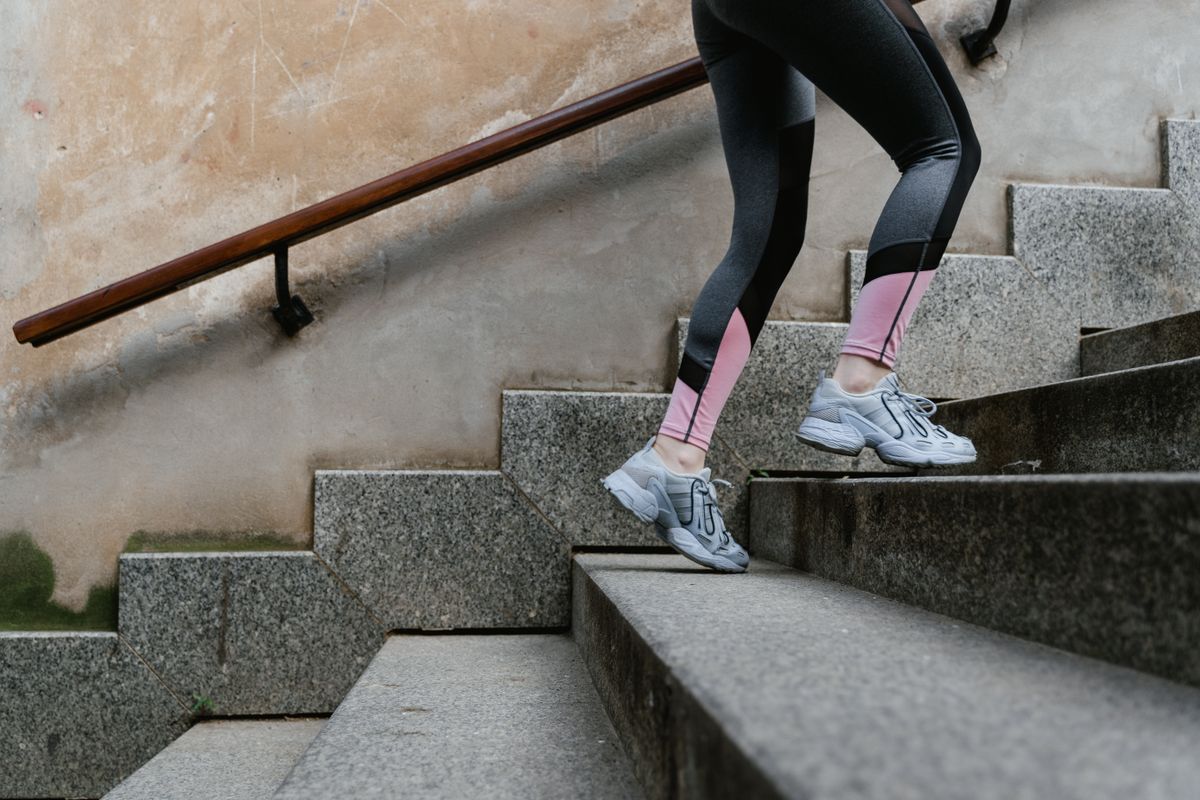 A person in activewear climbing concrete stairs outdoors
Five Goal-Setting Mistakes That Kill Progress
The ESSA expert statement identifies several risks that derail even well-intentioned goals:
-
All-or-nothing framing. Setting a goal of "exercise every day" means that one missed day feels like failure — even if you trained six times that week. Use range goals ("three to five sessions per week") to build in flexibility.
-
Outcome-only goals. Without a process goal underneath, an outcome goal is a wish. You cannot control how fast you lose weight, but you can control how often you train.
-
Ignoring your starting point. A goal that is appropriate for someone who has been training for a year may be counterproductive for a beginner. Match the difficulty to your current ability and increase gradually.
-
No feedback loop. People who wrote down their goals, outlined steps, and reported progress were 33% more successful than those without a tracking system, according to research from Michigan State University.
-
Never revising. Goals are not permanent. If your circumstances change — injury, travel, a new schedule — update your process goals rather than abandoning the whole plan.
Track Your Fitness Goals With Hiitify
Hiitify turns goal-setting science into daily practice. Log every session to build a visible feedback loop — the tracking that goal-setting theory identifies as essential. Use structured interval timers to make your process goals concrete: set a session length, pick your exercises, and press start. Watch your workout streaks grow as proof that your system is working, not just your willpower.
Free on iOS
TRAIN SMARTER
Build custom HIIT, Tabata, AMRAP, EMOM and Circuit workouts. Precision timer, streak tracking and analytics — free on iOS.
Sources & Further Reading
Research
- Locke, E.A. & Latham, G.P. (1990). A Theory of Goal Setting and Task Performance. Prentice-Hall. View on APA PsycNet
- Wilson, K. & Brookfield, D. (2009). Effect of Goal Setting on Motivation and Adherence in a Six-Week Exercise Program. International Journal of Sport and Exercise Psychology. View on ResearchGate
- Bird, S.R. et al. (2025). Goal Setting in Exercise and Physical Activity: An Expert Statement on Behalf of Exercise and Sports Science Australia. Sports Medicine. View on PMC
- Milne, S., Orbell, S. & Sheeran, P. (2002). Combining motivational and volitional interventions to promote exercise participation. British Journal of Health Psychology. View on Wiley
- Lally, P. et al. (2010). How are habits formed: Modelling habit formation in the real world. European Journal of Social Psychology. View on Wiley
- Oscarsson, M. et al. (2023). Adaptive Goal Processes and Underlying Motives That Sustain Mental Wellbeing and New Year Exercise Resolutions. International Journal of Environmental Research and Public Health. View on PMC
- McEwan, D. et al. (2016). The Effectiveness of Multi-Component Goal Setting Interventions for Changing Physical Activity Behaviour: A Systematic Review and Meta-Analysis. Health Psychology Review. View on Taylor & Francis
Further Reading
- The (Over)Use of SMART Goals for Physical Activity Promotion — Health Psychology Review
- Updating Goal-Setting Theory in Physical Activity Promotion — Health Psychology Review
- SMART Ways to Set Core Exercise Goals — Harvard Health
Image Credits
- Cover: Anonymous sportswoman checking smart watch and sitting on mat — Pexels
- Photo of planner and writing materials — Pexels
- Person in active wear going up stairs — Pexels
All images free to use under the Pexels License.