Starting a workout routine when you have never exercised before can feel overwhelming. The gym seems intimidating, the advice online is contradictory, and every programme assumes you already know what a "superset" is. Here is the truth: how to start working out is simpler than the fitness industry makes it look — and the science is clear that even small amounts of movement deliver real, measurable benefits from week one.
Why Starting Is the Hardest Part
The biggest barrier to exercise is not fitness — it is psychology. A 2020 study published in the European Journal of Sport Science tracked fitness club members over 12 months and found that 28.3% had dropped out entirely by the end of the year. The primary reasons were not injuries or lack of results — they were competing priorities, low self-confidence, and fear of judgement.
For people who have never exercised, these barriers are even higher. Research on exercise adherence consistently shows that beginners face elevated dropout risk due to unrealistic expectations, doing too much too soon, and not seeing instant results.
The good news: the same research shows that early consistency is the single strongest predictor of long-term adherence. If you can build a simple routine in the first 4–6 weeks, the odds of sticking with it long-term increase dramatically.
How Much Exercise Do You Actually Need?
Less than you think.
The World Health Organization and American College of Sports Medicine recommend 150 minutes of moderate-intensity aerobic activity per week — about 30 minutes, five days a week. But that is a target, not a starting line.
A 2024 article in The Conversation, citing large-scale epidemiological data, found that just two hours of exercise per week — even leisurely cycling or brisk walking — reduced cardiovascular disease mortality risk by up to 20% in previously sedentary adults. The greatest health leap comes from going from zero activity to some activity, not from moderate to intense.
For a complete beginner, the practical minimum looks like this:
| Week | Sessions | Duration | Intensity |
|---|---|---|---|
| 1–2 | 3 days | 10–15 min | Light (can talk easily) |
| 3–4 | 3–4 days | 15–20 min | Light to moderate |
| 5–6 | 4 days | 20–30 min | Moderate (can talk, slightly breathless) |
| 7–8 | 4–5 days | 30 min | Moderate |
The key principle: increase only one variable at a time — either frequency, duration, or intensity. Never all three at once. The ACSM calls this the principle of progressive overload, and it is the safest way to build fitness without injury.
 Woman doing yoga in her living room with natural lighting
Free on iOS
TRAIN SMARTER
Build custom HIIT, Tabata, AMRAP, EMOM and Circuit workouts. Precision timer, streak tracking and analytics — free on iOS.
A Beginner Workout You Can Do Today
You do not need a gym, equipment, or experience. This 15-minute bodyweight routine covers all the basics — and every exercise can be modified.
| Exercise | Duration | Modification |
|---|---|---|
| March in place (warm-up) | 2 min | Swing arms for extra movement |
| Wall push-ups | 30s on / 30s rest x 2 | Step closer to wall to make it easier |
| Bodyweight squats | 30s on / 30s rest x 2 | Squat to a chair if needed |
| Standing calf raises | 30s on / 30s rest x 2 | Hold a wall for balance |
| Plank (knees down) | 20s hold x 2 | Rest 40s between holds |
| Step-ups (stair or low step) | 30s on / 30s rest x 2 | Alternate legs each rep |
| Gentle stretch cool-down | 2 min | Hold each stretch 15–20s |
Why this works: every exercise targets major muscle groups using compound movements, which is exactly what the ACSM recommends for beginners — strength training that covers all major muscle groups, performed 2–3 days per week. A 2020 study in BMC Public Health confirmed that untrained adults using bodyweight-only programmes achieved significant increases in muscle size and strength over 12 weeks.
What Happens to Your Body When You Start
The benefits of starting to exercise arrive faster than most people expect — even before visible changes appear.
Week 1–2: Mood and Energy
Exercise triggers the release of endorphins, serotonin, and brain-derived neurotrophic factor (BDNF). Most beginners report improved mood and energy within the first few sessions. A 2023 meta-analysis in the British Journal of Sports Medicine found that physical activity reduced symptoms of depression, anxiety, and psychological distress — with effects comparable to psychotherapy for mild to moderate depression.
Week 3–4: Cardiovascular Fitness
Your heart begins adapting. Resting heart rate starts to drop, and the same walk that left you breathless in week one feels easier. A 12-week study on sedentary older adults found that just three 60-minute supervised aerobic sessions per week produced measurable improvements in VO2 max and memory performance.
Week 6–12: Strength and Body Composition
Muscle fibres recruited during bodyweight exercises become more efficient. Strength gains of 7–27% have been documented in untrained adults performing daily 6-minute bodyweight circuits over just four weeks, according to a 2018 study by Sperlich et al. in Frontiers in Physiology.
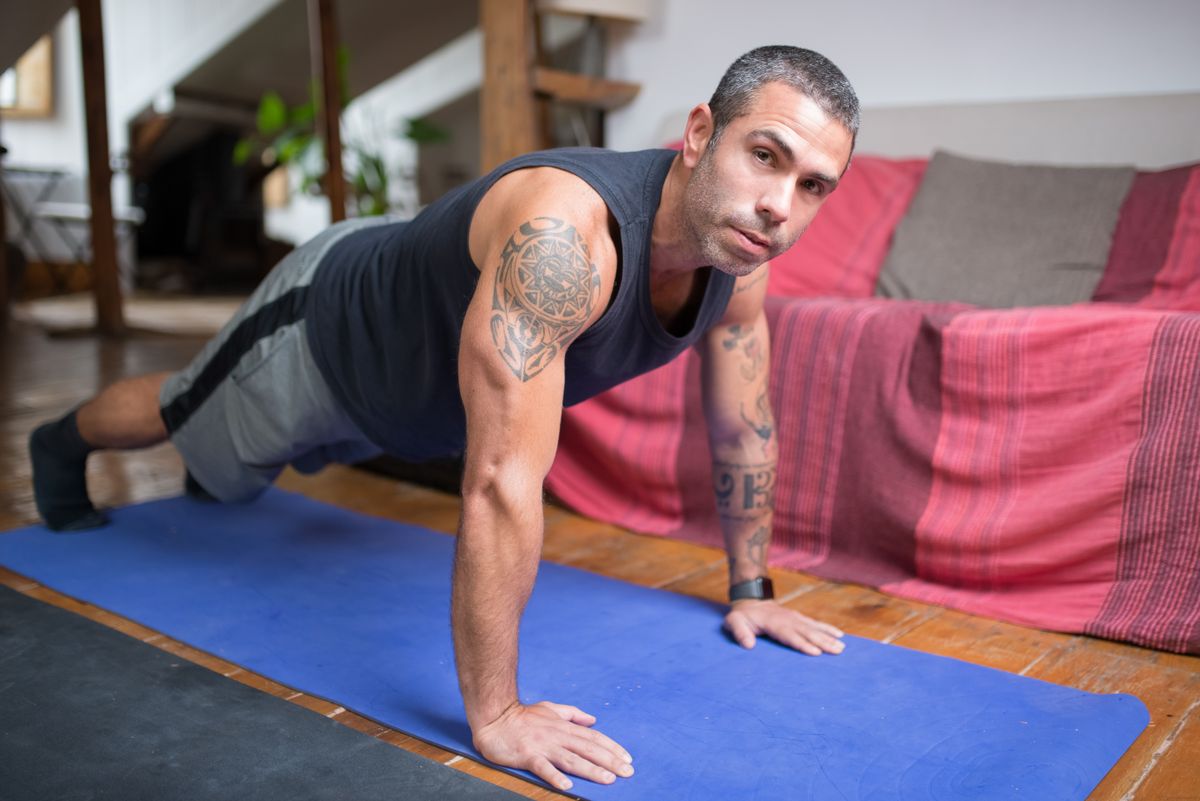 Man doing push-ups on a yoga mat at home
How to Make It Stick: The Science of Habit Formation
The "21 days to form a habit" claim is a myth — it comes from a misinterpretation of a 1960s observation about cosmetic surgery patients. The real number is higher.
A landmark 2009 study by Phillippa Lally at University College London tracked 96 participants forming new daily habits. The findings:
- Median time to automaticity: 66 days (range: 18–254 days)
- Exercise habits specifically took a median of 91 days
- Missing a single day did not reset the process — consistency over perfection mattered most
A 2015 follow-up study found that new gym-goers needed to train at least four times per week for six weeks to develop a stable exercise habit.
Here is what the research suggests for beginners:
1. Anchor it to something you already do. Lally's research showed that habits form fastest when tied to an existing cue — "after I make my morning coffee, I do 10 minutes of movement."
2. Start embarrassingly small. If 15 minutes feels like too much, do 5. The goal in the first two weeks is not fitness — it is showing up. A 2016 study by Gillen et al. demonstrated that even 1 minute of intense exercise within a 10-minute session produced meaningful cardiovascular improvements.
3. Track every session. The act of recording a workout reinforces the behaviour loop. Research on exercise adherence consistently shows that self-monitoring is one of the most effective behaviour-change strategies.
4. Do not wait for motivation. Motivation follows action, not the other way around. On low-motivation days, commit to just the warm-up. Most of the time, once you start moving, you will finish the session.
Common Beginner Mistakes to Avoid
Doing too much, too soon. The ACSM identifies this as the number one cause of beginner injuries — muscle strains, joint pain, and tendonitis. Start lighter and shorter than you think you need to.
Comparing yourself to others. Fitness influencers have been training for years. Your starting point is your starting point. The only comparison that matters is you versus last week.
Skipping rest days. Recovery is when adaptation happens. Three well-executed sessions per week will produce better results than seven half-hearted ones.
Waiting for the perfect plan. The best workout programme is the one you actually do. A basic bodyweight routine done consistently will outperform an "optimal" plan you never start.
Track Your First Workouts With Hiitify
Hiitify makes starting simple. Set up a custom interval timer for your beginner routine — work periods, rest periods, and rounds are all adjustable. Log every session to build your workout streak, and watch the consistency that research says matters most. When you are ready to progress, adjust your intervals and add new exercises without needing a new app.
Free on iOS
TRAIN SMARTER
Build custom HIIT, Tabata, AMRAP, EMOM and Circuit workouts. Precision timer, streak tracking and analytics — free on iOS.
Sources & Further Reading
Research
- Lally, P. et al. (2010). How are habits formed: Modelling habit formation in the real world. European Journal of Social Psychology. View on Wiley
- Sperlich, B. et al. (2018). A 4-Week Intervention Involving Mobile-Based Daily 6-Minute Micro-Sessions of Functional High-Intensity Circuit Training Improves Strength and Quality of Life. Frontiers in Physiology. View on PMC
- Gillen, J.B. et al. (2016). Twelve Weeks of Sprint Interval Training Improves Indices of Cardiometabolic Health Similar to Traditional Endurance Training despite a Five-Fold Lower Exercise Volume and Time Commitment. PLoS ONE. View on PubMed
- Kinnafick, F. et al. (2020). Motives and barriers to initiation and sustained exercise adherence in a fitness club setting — A one‐year follow‐up study. European Journal of Sport Science. View on PMC
- Garber, C.E. et al. (2011). Quantity and Quality of Exercise for Developing and Maintaining Cardiorespiratory, Musculoskeletal, and Neuromotor Fitness in Apparently Healthy Adults. Medicine & Science in Sports & Exercise (ACSM Position Stand). View on PubMed
- Singh, B. et al. (2023). Effectiveness of physical activity interventions for improving depression, anxiety and distress: an overview of systematic reviews. British Journal of Sports Medicine. View on PubMed
Further Reading
- Physical Activity Guidelines — ACSM
- Just two hours of exercise a week can bring you huge cardiovascular health benefits — The Conversation
- The Safest Way for Beginners to Start Exercising, According to Science — News Medical
Image Credits
- Cover: Woman lacing up running shoes — Pexels
- Woman doing yoga in her living room — Pexels
- Man doing push-ups on a yoga mat — Pexels
All images free to use under the Pexels License.