Working from home has clear advantages — no commute, flexible hours, and zero dress code. But it comes with a hidden cost: you move far less than you think. A 2025 meta-analysis published in BMC Public Health found that remote workdays accumulate 44 minutes more sedentary time and 2,500 fewer steps than office days. Without the walk to the train, the stairwell, or even the trip to a colleague's desk, your body stays locked in one position for hours. The good news is that staying active at home doesn't require a gym membership or an hour-long workout. It requires a system.
The Sedentary Trap of Remote Work
The data on remote work and inactivity is striking. A study in the Journal of Occupational and Environmental Medicine found that office workers burn an average of 426 calories during the workday (including their commute), while remote workers burn just 228 calories — a gap of nearly 200 calories per day.
That difference compounds. Research from the Korean Journal of Family Medicine (2024) showed that sitting beyond 7 hours per day leads to a 5% increase in all-cause mortality for each additional hour spent seated. For remote workers who routinely log 8 to 10 hours at a desk without the natural interruptions of office life, the risk adds up quietly.
The health consequences are well-documented:
| Risk Factor | Finding | Source |
|---|---|---|
| Cardiovascular disease | Sedentary time >8 hrs/day linked to elevated blood pressure and LDL | PMC (2025) |
| Mental health | +34% risk of moderate-to-severe mental health issues | PMC meta-analysis |
| Daily calorie gap | Remote workers burn ~200 fewer calories/day | JOEM (2024) |
| Step count reduction | ~2,500 fewer steps on remote days | BMC Public Health (2025) |
| All-cause mortality | +5% per hour of sitting beyond 7 hrs/day | Korean J. Family Med. (2024) |
The problem isn't remote work itself — it's the absence of incidental movement that office life provides without you noticing.
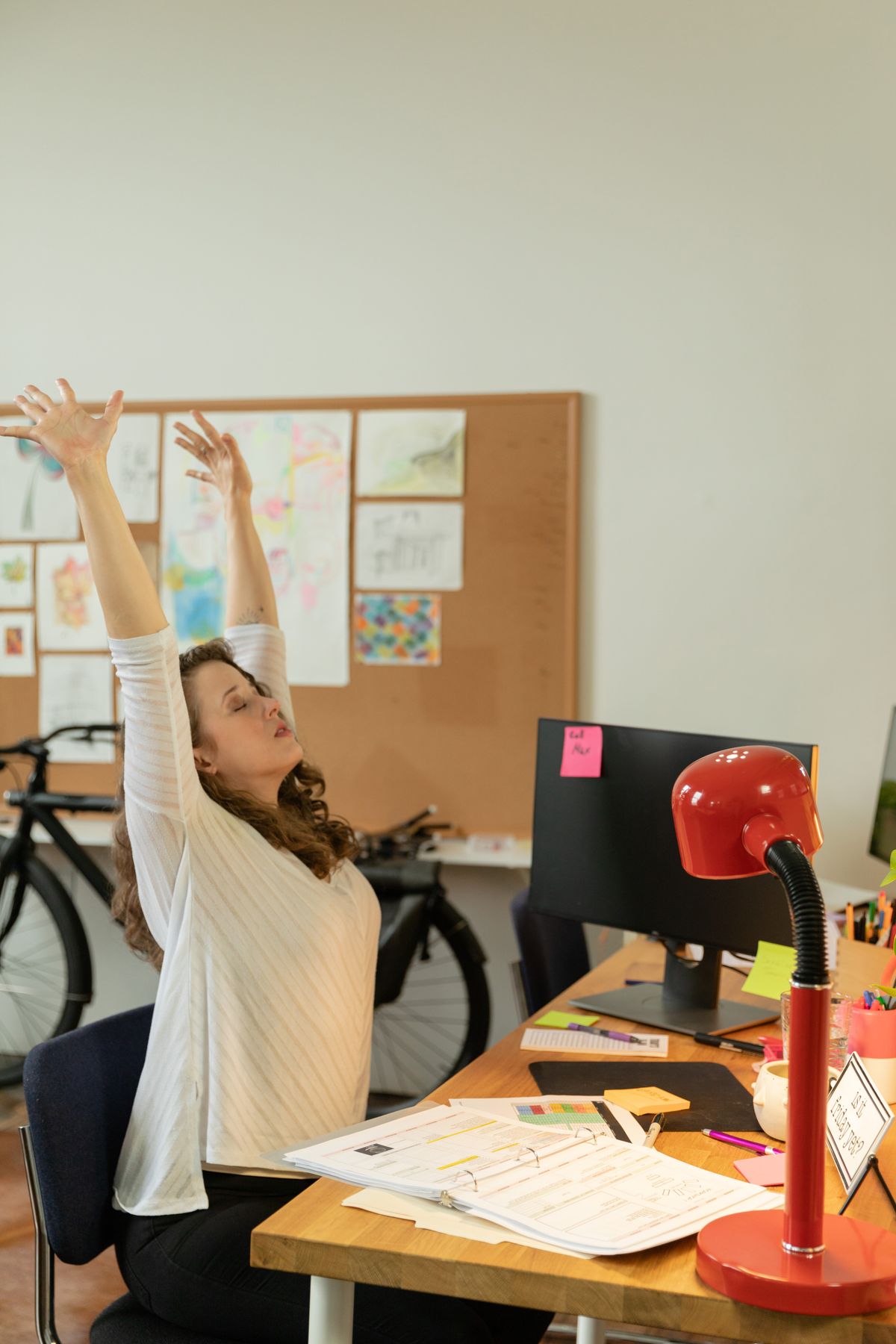 Woman stretching her body while sitting at her desk
Free on iOS
TRAIN SMARTER
Build custom HIIT, Tabata, AMRAP, EMOM and Circuit workouts. Precision timer, streak tracking and analytics — free on iOS.
Movement Snacks: The Simplest Fix
The most effective strategy for staying active at home isn't a single workout — it's movement snacks. These are brief bursts of activity lasting 30 seconds to 5 minutes, scattered throughout your day.
The concept is backed by serious research. A scoping review published in Sports Medicine (Islam et al., 2024) confirmed that exercise accumulated in short bouts has similar effects on aerobic fitness and weight management as one continuous session. And a landmark study on vigorous intermittent lifestyle physical activity (VILPA) from the University of Sydney found that just three bouts of 1 to 2 minutes of vigorous activity per day reduced cardiovascular mortality risk by 48 to 49 percent in non-exercisers.
Here are movement snacks you can do between meetings or during breaks:
- 10 bodyweight squats every time you stand up from your chair
- Push-ups against your kitchen counter while waiting for coffee
- 60-second plank before your first meeting of the day
- Calf raises during any standing phone call
- A quick walk around the block between deep-work sessions
- Lunges down the hallway on bathroom breaks
The key is frequency, not intensity. Six 2-minute movement snacks per day add up to 12 minutes of activity — enough to meaningfully reduce your health risk and boost your energy.
Build an Active Break System
A 2024 study by Batista-Ferreira et al. found that a structured active-break protocol over 25 weeks produced remarkable results among office workers:
- Sedentary time exceeding 10 hours per day dropped from 31% to 14%
- Perceived stress decreased by 29%
- Pain and discomfort fell by 37%
- Post-lunch sleepiness declined by 13%
- The share of non-exercisers dropped from 43% to 26%
The most important finding: 64% of participants were still taking active breaks after the study ended, up from 36% at baseline. Structure creates habits.
A Simple Daily Framework
| Time | Action | Duration |
|---|---|---|
| Before work | Bodyweight circuit (squats, push-ups, lunges) | 5–10 min |
| Mid-morning | Desk stretches or a short walk | 2–5 min |
| Lunch break | Walk outside or home workout | 10–20 min |
| Mid-afternoon | Movement snack (planks, calf raises, squats) | 2–5 min |
| End of day | Cool-down stretches or yoga flow | 5–10 min |
Set a recurring timer on your phone or use a Pomodoro app. The trigger matters more than the exercise choice — what gets scheduled gets done.
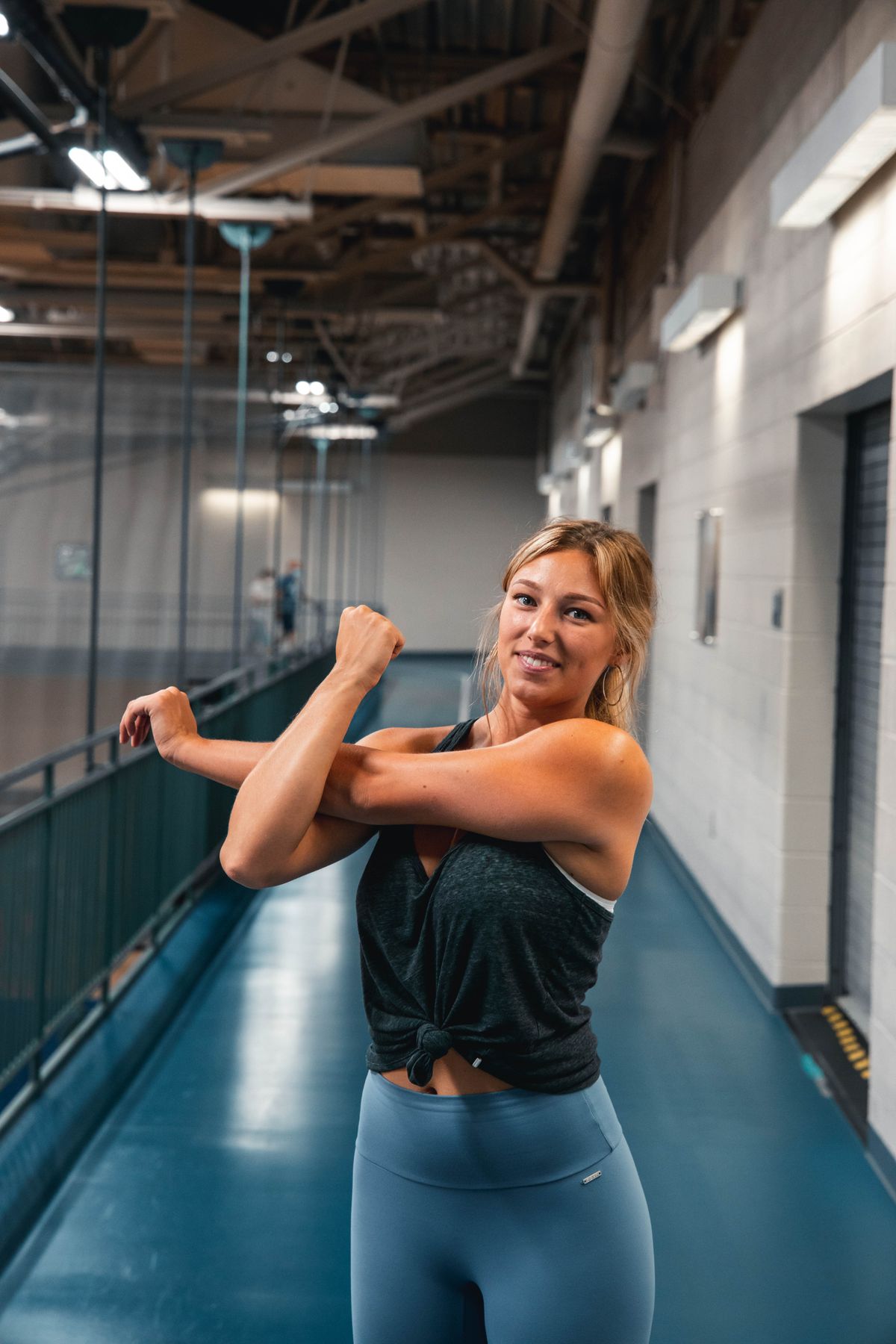 Smiling woman doing arm stretching exercise at home
The Micro Workout Approach
If movement snacks are appetizers, micro workouts are the main course. A micro workout is a focused 5 to 15-minute session designed to deliver real training stimulus — not just break up sitting.
Research from Tsoukas et al. (2024) published in PMC found that 10-minute physical activity breaks improved attention and executive function in healthcare workers. For remote workers, this means a short workout between tasks doesn't just benefit your body — it sharpens your focus for the next block of work.
Three Micro Workouts for Your Home Office Day
Morning Kickstart (5 min)
- 40 seconds squats, 20 seconds rest
- 40 seconds push-ups, 20 seconds rest
- 40 seconds mountain climbers, 20 seconds rest
- 40 seconds reverse lunges, 20 seconds rest
- 40 seconds burpees, 20 seconds rest
Lunchtime EMOM (10 min) At the top of every minute, complete 8 bodyweight squats + 5 push-ups. Rest for the remainder of the minute. Repeat for 10 rounds.
Afternoon Reset (5 min)
- 60-second plank
- 60 seconds of glute bridges
- 60 seconds of bird-dogs (alternating)
- 60 seconds of dead bugs
- 60 seconds of cat-cow stretches
Make Your Environment Work for You
Your home setup can either encourage or discourage movement. Small changes make a big difference:
Stand more. A standing desk or a stack of books under your laptop creates natural opportunities to shift your weight, pace, and move. You don't need to stand all day — alternating every 30 to 60 minutes between sitting and standing is enough.
Keep equipment visible. A resistance band draped over your chair, a yoga mat rolled out next to your desk, or a pair of dumbbells by the door serve as constant visual cues. Out of sight means out of mind.
Use transition moments. Every time you refill your water, finish a meeting, or close a browser tab, that's a trigger for a movement snack. Pair the new habit with something you already do.
Walk your calls. Any meeting where you don't need to share your screen is a walking meeting. Take your phone, put in earbuds, and pace your hallway or walk outside. You'll be surprised how many meetings work better this way.
Track Your Active Work-From-Home Habits With Hiitify
Hiitify makes it easy to build movement into your remote workday. Set up custom interval timers for micro workouts you can squeeze between meetings — Tabata, EMOM, or your own circuit. Track your workout streaks to build consistency day after day, and watch your daily active minutes grow from a few scattered stretches into a real fitness habit. No gym required.
Free on iOS
TRAIN SMARTER
Build custom HIIT, Tabata, AMRAP, EMOM and Circuit workouts. Precision timer, streak tracking and analytics — free on iOS.
Sources & Further Reading
Research
- Chastin, S. et al. (2025). The impact of working from home on sedentary behaviour and physical activity compared to onsite work in the working population: a systematic review and meta-analysis. BMC Public Health. View on Springer
- Batista-Ferreira, C. et al. (2024). Impact of active breaks on sedentary behavior and perception of productivity in office workers. Revista Brasileira de Medicina do Trabalho. View on PMC
- Tsoukas, D. et al. (2024). Ten-Minute Physical Activity Breaks Improve Attention and Executive Functions in Healthcare Workers. PMC. View on PMC
- Stamatakis, E. et al. (2022). Association of wearable device-measured vigorous intermittent lifestyle physical activity with mortality. Nature Medicine. View on Nature
- Islam, H. et al. (2024). Exercise Snacks and Other Forms of Intermittent Physical Activity for Improving Health in Adults and Older Adults: A Scoping Review. Sports Medicine. View on PubMed
- PMC (2025). Analytical study on cardiovascular implications of remote work, sedentary behavior and stress. View on PMC
Further Reading
- 6 Easy Ways to Move More While Working from Home — TIME
- Exercise Snacks Guide 2026: With Examples — Exercise Snacks Blog
- Remote Workers and the Sedentary Trap — WorldHealth.net
Image Credits
- Cover: Woman Working At Home Using Her Laptop — Pexels
- Woman Stretching Her Body While Sitting — Pexels
- Smiling Woman Making Arm Stretching Exercise — Pexels
All images free to use under the Pexels License.