You set your alarm for 5:30 AM, lace up in the dark, and push through a HIIT session before the world wakes up. Or you wait until after work, when your body feels loose and your energy is high. Both feel right — but is one actually better? The science of morning vs evening HIIT comes down to what your body does differently at each end of the day, and what you are trying to get out of your training.
Your Body Runs on a Clock
Every cell in your body follows a circadian rhythm — a roughly 24-hour internal cycle that regulates hormones, body temperature, metabolism, and muscle function. This clock is why you feel alert at certain times and sluggish at others, and it directly affects how you perform during HIIT.
Here is what happens across the day:
| Time of Day | Body Temperature | Cortisol | Testosterone | Muscular Power | Fat Oxidation |
|---|---|---|---|---|---|
| 6–8 AM | Low (rising) | Peak | Peak | Lower | Higher (fasted) |
| 12–2 PM | Moderate | Declining | Moderate | Moderate | Moderate |
| 4–7 PM | Peak | Low | Declining | Peak | Lower |
| 9–11 PM | Declining | Lowest | Low | Declining | Low |
Cortisol and testosterone are both highest in the early morning. Core body temperature — one of the strongest predictors of physical performance — does not peak until late afternoon. This split is at the heart of the morning vs evening debate.
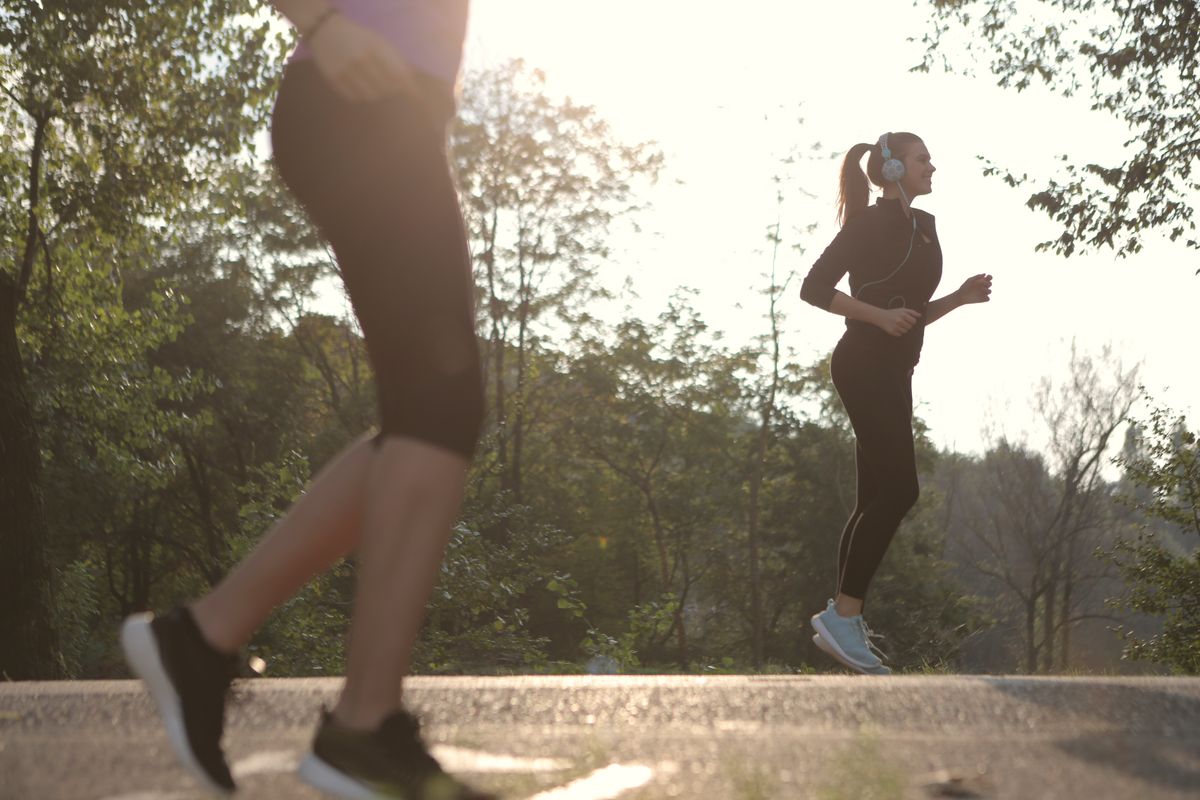 Two women jogging in a sunny park during a morning workout
The Case for Morning HIIT
You burn more fat
A 2025 study by Lan et al. published in Frontiers in Physiology tested five exercise timing conditions in 18 healthy young men using a randomised crossover design. The result: exercise before breakfast produced significantly higher fat oxidation than exercise after breakfast, before dinner, or after dinner (p < 0.01). Morning fasted exercise also sustained elevated fat utilisation for up to 4 hours post-workout.
You lose more abdominal fat
Arciero et al. (2022) published a 12-week trial in Frontiers in Physiology with 47 participants. Women who exercised in the morning lost 2.6 kg of abdominal fat compared to just 0.9 kg in the evening group. Morning exercisers also saw systolic blood pressure drop by 12.5 mmHg versus a slight increase in the evening group.
You sleep better
A 2025 randomised controlled trial published in Scientific Reports found that morning exercisers (6–8 AM) experienced improvements in sleep-wake cycle regularity and showed faster body fat reduction and lower plasma cholesterol compared to evening exercisers.
You build the habit faster
From a practical standpoint, morning workouts have fewer scheduling conflicts. No late meetings, social events, or end-of-day fatigue to compete with. Research on exercise adherence consistently shows that people who train in the morning are more consistent over time.
Free on iOS
TRAIN SMARTER
Build custom HIIT, Tabata, AMRAP, EMOM and Circuit workouts. Precision timer, streak tracking and analytics — free on iOS.
The Case for Evening HIIT
You perform better
Your body is physically primed for peak output in the late afternoon and early evening. A 2020 study published in Scientific Reports by Blazquez et al. found that short-duration maximal exercise performance peaks in the evening, driven by higher core body temperature, faster nerve conduction velocity, and improved muscle contractile properties.
The practical difference is real. Research shows 3–5% higher strength and power output in the evening compared to early morning — enough to mean an extra rep, a faster sprint, or a heavier set.
Your muscles are warmer and more flexible
Core body temperature peaks between 4–7 PM. A review by Chtourou and Souissi in Sports Medicine confirmed that this passive warming improves joint mobility, glucose metabolism, and muscular blood flow. Warmer muscles contract more forcefully and are less prone to injury — an important factor for explosive HIIT movements.
You build more upper body strength
The Arciero et al. (2022) study found that women who trained in the evening gained significantly more upper body power — bench throw power improved by 45 watts in the evening group versus just 10 watts in the morning group. For men, evening exercise produced greater blood pressure reductions (-14.9 mmHg systolic vs -3.5 mmHg in the morning group).
 Silhouette of a jogger running through a park at sunset
Morning vs Evening: A Side-by-Side Comparison
| Factor | Morning HIIT | Evening HIIT |
|---|---|---|
| Fat oxidation | Higher (especially fasted) | Lower during session |
| Abdominal fat loss | Greater in women | Moderate |
| Peak muscular power | 3–5% lower | Peak performance |
| Injury risk | Slightly higher (cold muscles) | Lower (warm muscles) |
| Blood pressure (women) | Greater reduction | Moderate reduction |
| Upper body strength gains | Moderate | Greater in women |
| Sleep quality | Improved regularity | No negative effect if >2 hrs before bed |
| Consistency/adherence | Fewer scheduling conflicts | More likely to be skipped |
| Hormonal environment | High cortisol + testosterone | Low cortisol, peak body temp |
What the Research Actually Recommends
The honest answer from the science: it depends on your goal.
If your primary goal is fat loss, morning fasted HIIT has a measurable edge. The Lan et al. (2025) data on fat oxidation and the Arciero et al. (2022) findings on abdominal fat reduction both favour the morning.
If your goal is peak athletic performance — hitting faster times, lifting heavier, or maximising power output — the evening is your window. The circadian peak in body temperature and neuromuscular function is well-established across dozens of studies.
If your goal is simply to train consistently and get fitter, the best time is whichever slot you will actually show up for. A 2019 study in the International Journal of Obesity (the Midwest Exercise Trial 2) found that participants who exercised consistently at the same time of day — regardless of whether it was morning or evening — lost significantly more weight than those with inconsistent timing.
Your body also adapts. Research shows that regular training at a specific time of day reduces the morning-evening performance gap within 3–6 weeks. Morning trainers who stick with it eventually perform nearly as well at 6 AM as they would at 6 PM.
Track Your Training Time With Hiitify
Hiitify makes it easy to build morning or evening HIIT sessions with custom interval timers — set your work and rest periods, track completed workouts, and build a streak at whatever time fits your life. Whether you are chasing fat loss with fasted morning sessions or peak performance with evening intervals, having a consistent timer and training log keeps you on track.
Free on iOS
TRAIN SMARTER
Build custom HIIT, Tabata, AMRAP, EMOM and Circuit workouts. Precision timer, streak tracking and analytics — free on iOS.
Sources & Further Reading
Research
- Lan, F. et al. (2025). Morning vs. evening: the role of exercise timing in enhancing fat oxidation in young men. Frontiers in Physiology. View on PMC
- Arciero, P. J. et al. (2022). Morning Exercise Reduces Abdominal Fat and Blood Pressure in Women; Evening Exercise Increases Muscular Performance in Women and Lowers Blood Pressure in Men. Frontiers in Physiology. View on PMC
- Kunorozva, L. et al. (2025). Differential benefits of 12-week morning vs. evening aerobic exercise on sleep and cardiometabolic health: a randomized controlled trial. Scientific Reports. View on PubMed
- Blazquez, A. et al. (2020). Time-of-Day Effects on Short-Duration Maximal Exercise Performance. Scientific Reports. View on Nature
- Morales-Palomo, F. et al. (2024). Efficacy of morning versus afternoon aerobic exercise training on reducing metabolic syndrome components. The Journal of Physiology. View on PMC
- Willis, E. A. et al. (2019). The effects of exercise session timing on weight loss and components of energy balance. International Journal of Obesity. View on Nature
Further Reading
- Best time to exercise? How circadian rhythms affect your workout and your health — NPR
- Circadian Regulation for Optimizing Sport and Exercise Performance — PMC
- Interactions of cortisol, testosterone, and resistance training: influence of circadian rhythms — PubMed
Image Credits
- Cover: Man jogging at sunrise — Pexels
- Woman doing morning exercise — Pexels
- Silhouette of jogger at sunset in park — Pexels
All images free to use under the Pexels License.