You crushed a HIIT session yesterday. Today, getting out of bed feels like a negotiation with your own legs. That deep, stiff ache in your muscles is not a sign that something went wrong — it is your body's predictable response to hard work. Understanding why you're sore after HIIT and what actually helps (and what does not) can save you days of unnecessary discomfort and keep you training consistently.
What Is DOMS — and Why Does HIIT Cause It?
That next-day soreness has a name: delayed onset muscle soreness (DOMS). It typically appears 12–24 hours after exercise, peaks between 24 and 72 hours, and gradually fades over 5–7 days. Unlike the burn you feel mid-set — which is caused by metabolic byproducts like hydrogen ions — DOMS is a structural event.
A landmark review by Cheung et al. (2003) in Sports Medicine examined six proposed mechanisms and concluded that DOMS is best explained as a Type I muscle strain at the microscopic scale: tiny tears in muscle fibres followed by an inflammatory cascade. Your body releases TNF-alpha, interleukin-1 beta, and interleukin-6, while markers of muscle damage like creatine kinase (CK) spike in the bloodstream.
HIIT is especially good at triggering DOMS because of its reliance on eccentric contractions — the lowering phase of movements like squat jumps, burpees, and lunges. During eccentric loading, individual muscle fibres bear more force, creating more micro-damage than concentric (shortening) contractions. Research published in Frontiers in Physiology (2024) also points to the connective tissue and fascia surrounding muscle fibres as a key source of post-exercise pain, not just the muscle itself.
What Actually Helps: Evidence-Based Recovery
Not every recovery method you see on social media is backed by science. A 2018 meta-analysis by Dupuy et al., published in Frontiers in Physiology and covering 99 studies, ranked the most common recovery techniques by their effect on DOMS and fatigue. Here is what the data showed:
| Recovery Method | Effect on DOMS | Evidence Level |
|---|---|---|
| Massage | Large reduction | Strong |
| Cold water immersion | Moderate reduction | Strong |
| Active recovery | Small–moderate reduction | Strong |
| Compression garments | Small reduction | Moderate |
| Contrast water therapy | Small reduction | Moderate |
| Stretching | No significant effect | Strong (negative) |
| Electrostimulation | No significant effect | Weak |
Massage emerged as the single most effective intervention. Cold water immersion (10–15°C for 10–15 minutes) showed meaningful reductions at 24, 48, and 72 hours post-exercise. And a finding that surprises many people: stretching does not reduce DOMS in any measurable way.
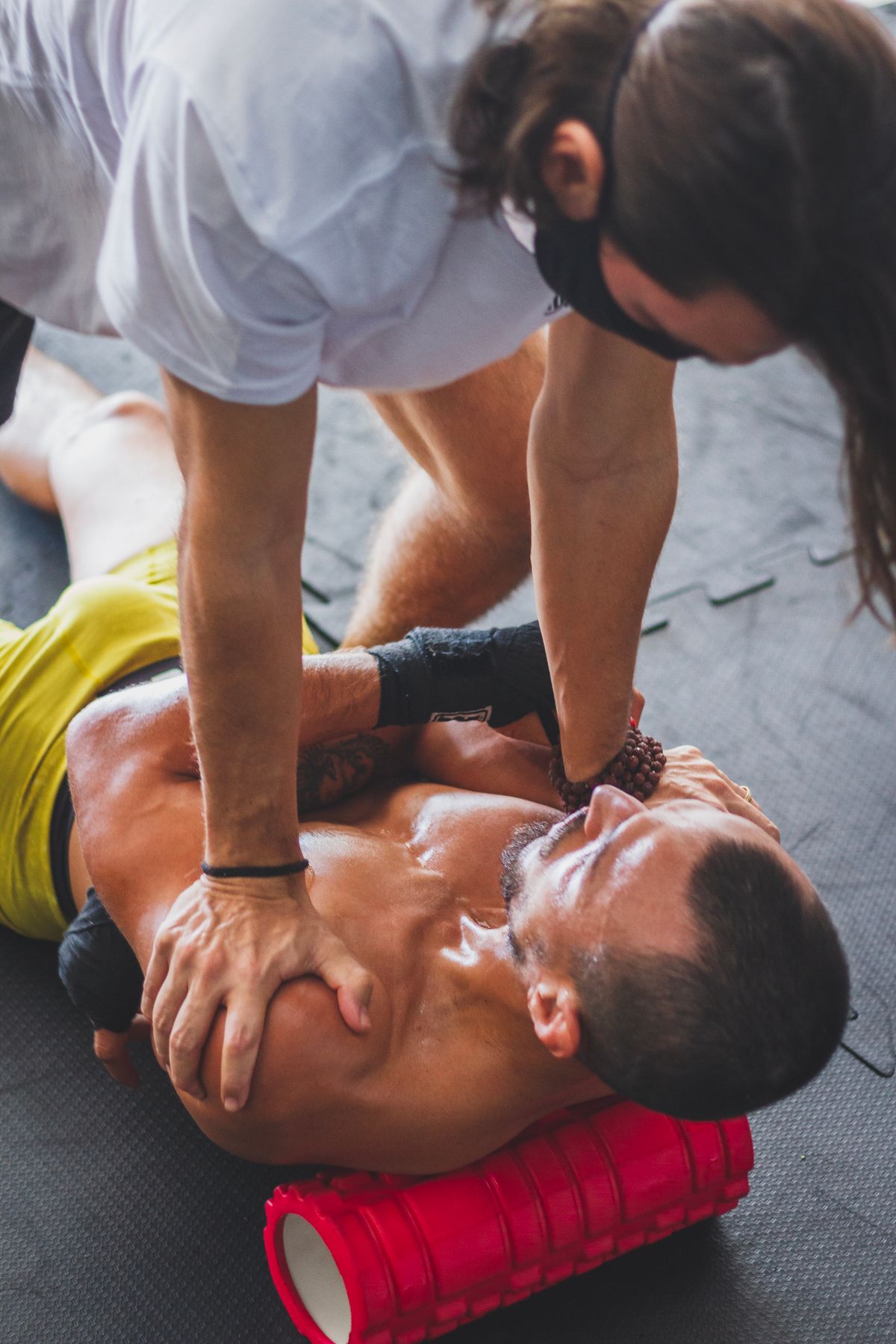 Man receiving recovery massage using a foam roller after training
Free on iOS
TRAIN SMARTER
Build custom HIIT, Tabata, AMRAP, EMOM and Circuit workouts. Precision timer, streak tracking and analytics — free on iOS.
Three Things You Can Do Right Now
You do not need a sports physiotherapist on speed dial. These three strategies are free, evidence-based, and available to everyone.
1. Move Lightly (Active Recovery)
A separate analysis from the Mountain Tactical Institute found that 10–20 minutes of post-training walking was as effective as foam rolling, cold water immersion, and massage at reducing DOMS. Light movement increases blood flow to damaged tissue, which helps clear inflammatory byproducts and deliver nutrients for repair. A gentle walk, an easy bike ride, or a low-intensity swim all qualify.
2. Foam Roll for 10–15 Minutes
A 2019 study published in the Journal of Athletic Training found that self-myofascial release with a foam roller after HIIT improved range of motion and reduced perceived soreness at 24 and 48 hours. Foam rolling works by increasing local blood flow and temporarily reducing muscle stiffness. Focus on the muscle groups you trained — spend 60–90 seconds per area, rolling slowly through any tender spots.
3. Sleep More, Not Less
Sleep is when your body produces the bulk of its growth hormone — a key driver of tissue repair. Research consistently shows that sleep restriction impairs recovery from exercise-induced muscle damage and increases perceived soreness. If you are deep into a HIIT training block, aim for 7–9 hours per night and consider that your recovery needs may be higher than when you are not training.
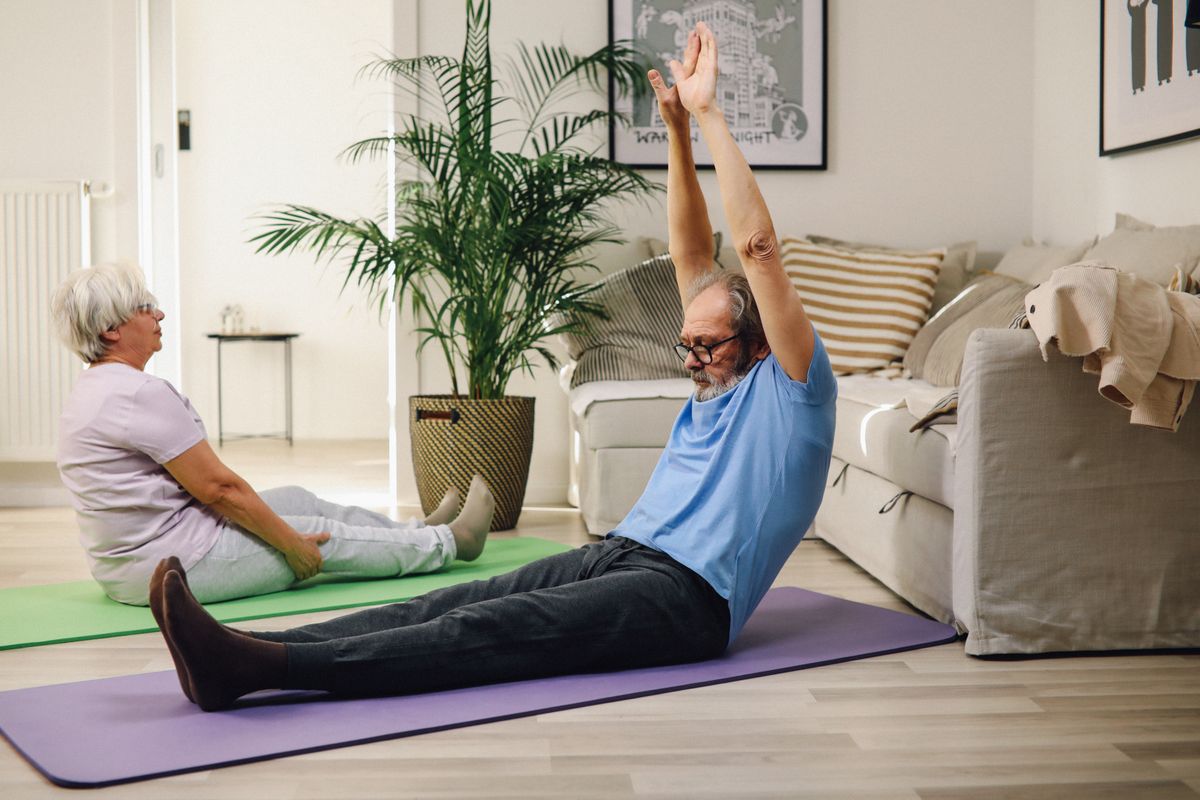 Man and woman stretching on yoga mats as part of an active recovery session
When Soreness Is a Warning Sign
DOMS is uncomfortable but harmless. However, some types of post-workout pain are not normal and should not be ignored:
- Sharp or stabbing pain during or immediately after a movement — this may indicate a strain, sprain, or tendon issue
- Pain localised to a joint rather than a muscle belly — joints do not experience DOMS
- Swelling that does not subside within 48 hours
- Dark or cola-coloured urine after intense exercise — this can be a sign of rhabdomyolysis, a rare but serious condition where muscle breakdown products overwhelm the kidneys
If any of these apply, stop training and consult a medical professional.
The Repeated Bout Effect: Why It Gets Better
Here is the good news: your body adapts fast. A well-documented phenomenon called the repeated bout effect means that performing the same exercise a second time produces significantly less muscle damage and soreness than the first. Studies show that a single bout of eccentric exercise can confer protection for several weeks.
This is why gradual progression matters. If you are new to HIIT — or returning after a break — starting with shorter sessions, fewer rounds, and lower-impact exercises gives your muscles time to build this protective adaptation. The soreness does not disappear entirely, but it becomes manageable within 2–3 weeks of consistent training.
Track Your Recovery With Hiitify
Hiitify helps you manage the balance between training and recovery. Use custom interval timers to control your work-to-rest ratios, track your workout streaks to spot when you are overreaching, and log every session so you can see how your soreness patterns change as your fitness improves.
Free on iOS
TRAIN SMARTER
Build custom HIIT, Tabata, AMRAP, EMOM and Circuit workouts. Precision timer, streak tracking and analytics — free on iOS.
Sources & Further Reading
Research
- Cheung, K. et al. (2003). Delayed Onset Muscle Soreness: Treatment Strategies and Performance Factors. Sports Medicine. View on Springer
- Dupuy, O. et al. (2018). An Evidence-Based Approach for Choosing Post-exercise Recovery Techniques to Reduce Markers of Muscle Damage, Soreness, Fatigue, and Inflammation: A Systematic Review With Meta-Analysis. Frontiers in Physiology. View on PMC
- Romero-Moraleda, B. et al. (2019). Self-Myofascial Release Effect With Foam Rolling on Recovery After High-Intensity Interval Training. Journal of Athletic Training. View on PMC
- Wilke, J. et al. (2021). Is "Delayed Onset Muscle Soreness" a False Friend? The Potential Implication of the Fascial Connective Tissue in Post-Exercise Discomfort. International Journal of Molecular Sciences. View on PMC
- Mizumura, K. & Taguchi, T. (2024). Neurochemical mechanism of muscular pain: Insight from the study on delayed onset muscle soreness. Journal of Physiological Sciences. View on PMC
Further Reading
- The Science of Sore — DOMS Explained — Stronger by Science
- What Is Delayed Onset Muscle Soreness? — Cedars-Sinai
- Delayed Onset Muscle Soreness (DOMS): What It Is and Treatment — Cleveland Clinic
Image Credits
- Cover: Tired muscular male athlete resting after weightlifting workout — Pexels
- Man assisting with massage on a foam roller — Pexels
- Man raising hands and woman stretching in yoga mats — Pexels
All images free to use under the Pexels License.