Staying fit after 40 does not mean choosing between your fitness and your joints. Over 500 million people worldwide live with osteoarthritis, and the risk climbs sharply in midlife — but the solution is not to stop moving. The solution is to move smarter. Research consistently shows that the right kind of exercise protects your joints, while the wrong kind accelerates wear.
What Actually Happens to Your Joints After 40
Your joints are not just wearing out from use — they are changing at a biological level. After 40, several shifts happen simultaneously:
- Cartilage thins and loses elasticity. Articular cartilage — the smooth tissue covering bone ends — has no blood supply. It depends on movement to circulate synovial fluid, the thick liquid that lubricates joints and delivers nutrients. Less movement means less nourishment.
- Collagen production drops. Tendons and ligaments become stiffer and more prone to micro-tears. Recovery from connective tissue injuries takes longer.
- Muscle mass declines. Adults lose 3 to 8 percent of muscle mass per decade after 30, accelerating after 40. Since muscles act as shock absorbers around joints, less muscle means more stress on the joint itself.
- Bone density decreases. After 40, bone mineral density drops roughly 1 percent per year, increasing fracture risk and changing how joints handle load.
These changes do not mean exercise becomes dangerous. They mean the type of exercise you choose matters more than it did at 25.
The Moderate-Intensity Sweet Spot
A 2025 systematic review and meta-analysis published in the Journal of Global Health analyzed 14 studies involving 507,696 participants and found a striking pattern: high physical activity levels increased knee osteoarthritis risk by 26 percent compared to moderate activity (RR = 1.26; 95% CI = 1.17–1.37). But moderate activity showed no increased risk at all.
The takeaway is clear — moderate, consistent training protects your joints. Excessive intensity damages them.
This does not mean avoiding challenge. It means structuring your training so that intensity is deliberate and recovery is respected. The people who stay fit for decades after 40 are not the ones who train the hardest — they are the ones who train the smartest.
| Activity Level | Knee OA Risk vs. Moderate | Takeaway |
|---|---|---|
| Low | No significant difference | Moving is better than not moving |
| Moderate | Baseline | The protective sweet spot |
| High | 26% increased risk | More is not always better |
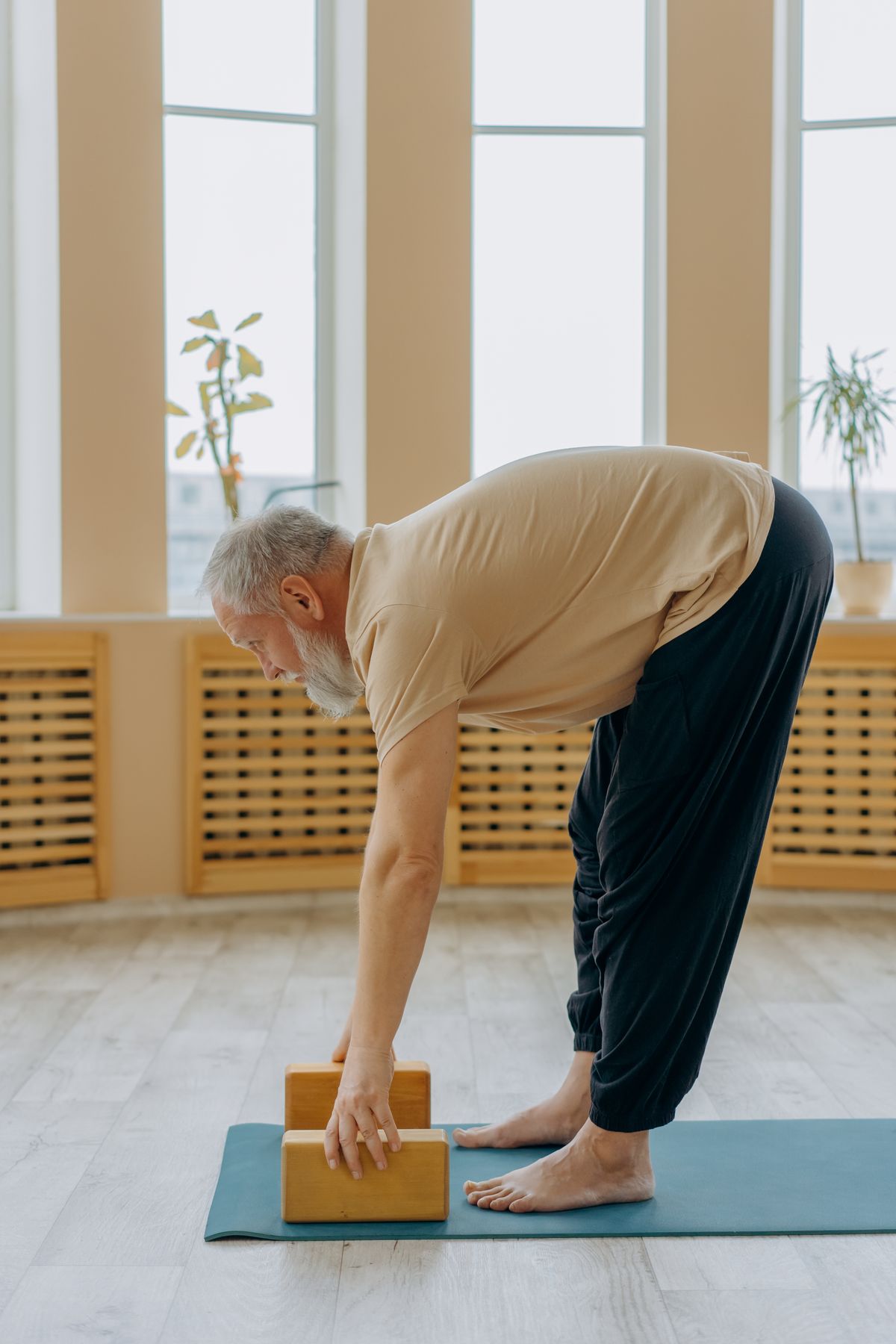 Elderly man doing yoga exercise on a mat indoors
Free on iOS
TRAIN SMARTER
Build custom HIIT, Tabata, AMRAP, EMOM and Circuit workouts. Precision timer, streak tracking and analytics — free on iOS.
The Five Pillars of Joint-Friendly Fitness After 40
1. Low-Impact Cardio
Get your heart rate up without hammering your joints. The best options:
- Swimming and water aerobics — water supports up to 90 percent of your body weight, making it the lowest-impact cardio available while still providing resistance
- Cycling — eliminates ground-impact forces entirely and is particularly beneficial for knee joint health
- Rowing — distributes effort across the full body with minimal joint compression
- Elliptical training — mimics running mechanics without the impact
- Walking on varied terrain — grass, trails, and gravel challenge proprioception and strengthen stabilizer muscles around ankles and knees
2. Strength Training (With Modifications)
Strong muscles are the single best protection for aging joints. A Cochrane review found that targeting the quadriceps is particularly effective at reducing knee joint pain — stronger quads absorb more shock before it reaches the joint.
Key modifications after 40:
- Favor compound movements — squats, hinges, rows, and presses build functional strength across multiple joints
- Use controlled tempos — slow the eccentric (lowering) phase to 3–4 seconds to reduce peak joint forces
- Choose dumbbells and cables over heavy barbells — they allow natural joint paths and reduce compressive loading
- Progress load by 5 to 10 percent per week, not per session — tendons adapt 3 to 5 times slower than muscles
3. Mobility Work
After 40, mobility is not optional — it is foundational. Spend 5 to 10 minutes daily on:
- Hip circles and 90/90 stretches — maintain hip internal and external rotation
- Ankle rotations and calf raises — strong ankles absorb impact and reduce strain traveling up into knees and hips
- Thoracic spine rotations — prevent the upper-back stiffness that cascades into shoulder and neck problems
- Controlled deep squats — maintain full range of motion at the knee, hip, and ankle simultaneously
4. Balance and Proprioception
Falls are the leading cause of injury-related death in adults over 65, and balance begins declining well before that. A 2026 study published in Scientific Reports confirmed that unstable surface training significantly improves postural control in older adults. Research shows balance-challenging exercises reduce fall rates by 23 percent.
Start simple:
- Single-leg stands — 30 seconds per leg
- Walking on uneven surfaces — grass, gravel, sand
- Tai chi — a randomized controlled trial published in Annals of Internal Medicine found tai chi was as effective as physical therapy for knee osteoarthritis
5. Strategic Recovery
Your connective tissues need more recovery time after 40. Build it into your program:
- 48 to 72 hours between intense sessions targeting the same joints
- One to two full rest days per week — active recovery (walking, gentle yoga) counts
- Sleep 7 to 9 hours — collagen synthesis peaks during deep sleep
- Adequate protein — aim for 1.2 to 1.6 grams per kilogram of bodyweight daily to support tendon and muscle repair
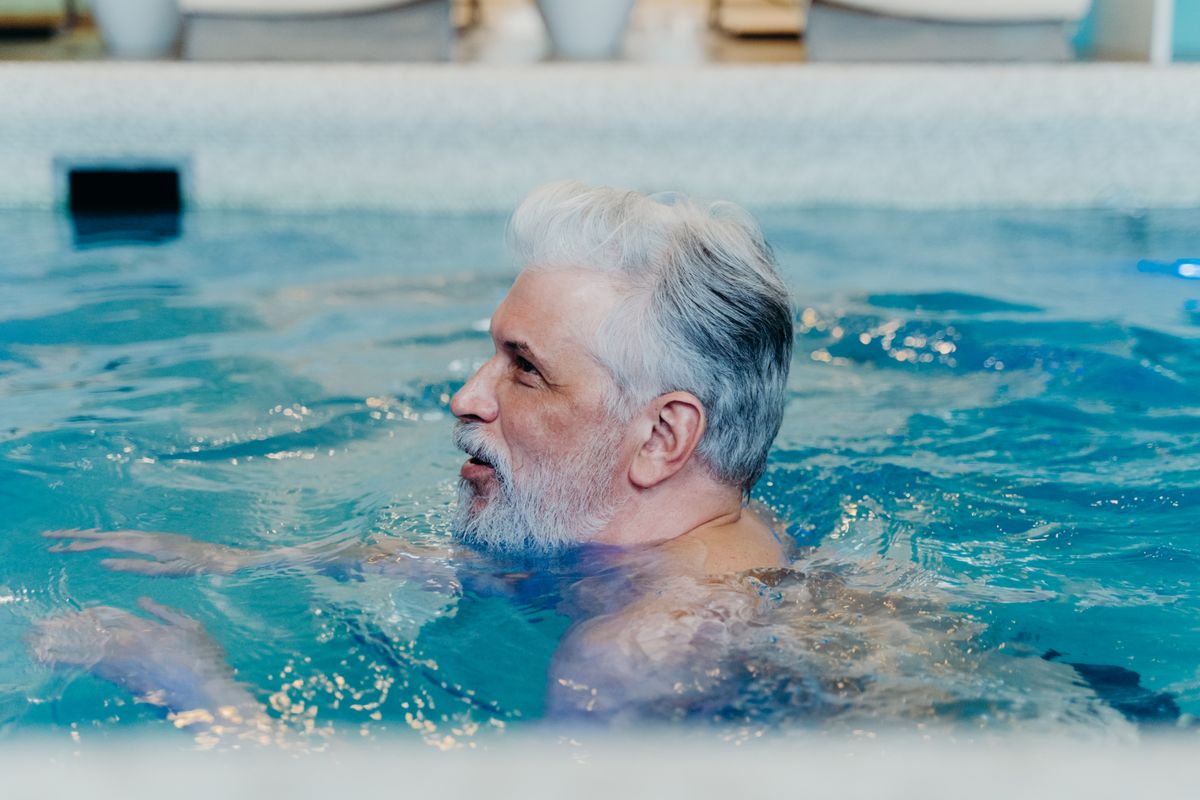 Bearded older man exercising in a swimming pool
A Sample Joint-Friendly Weekly Plan
This structure balances training stimulus with joint recovery:
| Day | Session | Focus |
|---|---|---|
| Monday | Strength (lower body) | Goblet squats, lunges, RDLs, calf raises |
| Tuesday | Low-impact cardio | 30–40 min cycling or swimming |
| Wednesday | Mobility + balance | 20 min yoga or tai chi flow |
| Thursday | Strength (upper body) | Rows, presses, band pull-aparts, farmer's carries |
| Friday | Low-impact cardio | 30–40 min rowing or elliptical |
| Saturday | Active recovery | Walk on varied terrain, light stretching |
| Sunday | Rest | Full recovery day |
Every session starts with 5 to 10 minutes of joint-specific warm-up — arm circles, leg swings, bodyweight squats, and ankle rotations. Every session ends with 5 minutes of mobility work targeting the joints you trained.
Common Mistakes That Accelerate Joint Wear
Skipping the warm-up. Cold connective tissue is stiff and vulnerable. Five minutes of movement prep reduces injury risk significantly, especially after 40.
Training through joint pain. Muscle soreness is normal. Joint pain — sharp, located in or around the joint, or accompanied by swelling — is a signal to modify or stop. Ignoring it turns minor irritation into chronic damage.
Only doing cardio. Running or cycling without strength training leaves the muscles around your joints weak. Weak muscles mean your joints absorb more impact directly.
Ignoring mobility. Strength without mobility creates stiffness that increases joint stress. A joint that cannot move through its full range compensates elsewhere — and compensation patterns are where injuries happen.
Progressing too fast. Muscles adapt in days to weeks. Tendons and ligaments take weeks to months. If you increase volume or intensity faster than your connective tissue can adapt, your joints pay the price.
Track Your Joint-Friendly Training With Hiitify
Hiitify lets you build custom interval workouts with adjustable work and rest periods — perfect for designing low-impact training sessions that respect your joints. Set longer rest intervals, track your consistency with workout streaks, and follow a sustainable training rhythm that keeps you moving for decades, not just weeks.
Free on iOS
TRAIN SMARTER
Build custom HIIT, Tabata, AMRAP, EMOM and Circuit workouts. Precision timer, streak tracking and analytics — free on iOS.
Sources & Further Reading
Research
- Waddington, G. (2026). What exercises will keep my ageing joints healthy? The Conversation. View Article
- (2025). Association between physical activity and knee osteoarthritis: a comprehensive systematic review and meta-analysis. Journal of Global Health. View Study
- Fransen, M. et al. (2015). Exercise for osteoarthritis of the knee. Cochrane Database of Systematic Reviews. View on Cochrane
- Wang, C. et al. (2016). Tai Chi Is Equally Effective as Physical Therapy for Knee Osteoarthritis. Annals of Internal Medicine. View Study
- (2026). Unstable surface training significantly improves postural control in older adults. Scientific Reports. View Study
- (2026). Effectiveness of exercise therapy for osteoarthritis: an overview of systematic reviews and randomised controlled trials. PMC. View on PubMed
Further Reading
- Exercise Can Protect Your Joints — ScienceAlert
- Scientists Reveal the Best Exercises for Aging Joints — SciTechDaily
- Joint-Friendly Exercises After 40 — BoxLife Magazine
Image Credits
- Cover: Aged Man Doing Resistance Band Exercise on Stadium — Pexels
- Elderly Man Doing Yoga Exercise — Pexels
- Bearded Man in the Swimming Pool — Pexels
All images free to use under the Pexels License.