Strength training for beginners over 50 is not about becoming a bodybuilder — it is about building the muscle, bone density, and functional strength your body is actively losing. After 50, adults lose muscle at roughly 8 percent per decade, and strength declines even faster. But the research is unambiguous: it is never too late to start, and the benefits go far beyond looking fit.
Why Strength Training Matters More After 50
The biggest threat to health after 50 is not heart disease or weight gain — it is sarcopenia, the progressive loss of skeletal muscle mass and strength. A 2025 systematic review published in Aging Clinical and Experimental Research confirmed that resistance training significantly improves muscle strength, physical function, and gait speed in older adults diagnosed with sarcopenia.
The consequences of muscle loss are serious:
- Falls become more likely. Falls are the leading cause of injury-related death in adults over 65, and reduced muscle strength is a primary risk factor.
- Metabolism slows. Muscle tissue burns more calories at rest than fat. Losing muscle means your body burns fewer calories daily, making weight gain easier.
- Bones weaken. Muscle pulls on bone during resistance training, stimulating bone remodeling. Without that stimulus, bone mineral density drops — especially in postmenopausal women.
- Daily tasks get harder. Carrying groceries, standing from a chair, climbing stairs — these all require baseline strength that erodes without training.
A study involving 4,449 adults over 50 found that those with greater muscle strength were significantly less likely to die over the four-year follow-up period. A 2024 study in The Journal of the American College of Cardiology found that people who incorporated muscle-strengthening activities into their routine had a 30 percent reduction in cardiovascular mortality.
 Elderly couple doing exercise together on yoga mats at home
How to Start: The First 4 Weeks
The key to starting strength training after 50 is progressive overload — beginning with manageable resistance and increasing it gradually. Here is a structured approach for your first month.
Week 1–2: Learn the Movements
Use bodyweight or very light dumbbells (2–5 kg). Focus on form, not intensity. Train two days per week with at least two rest days between sessions.
| Exercise | Sets | Reps | Notes |
|---|---|---|---|
| Goblet squat (bodyweight) | 2 | 8–10 | Sit back, knees track over toes |
| Wall push-up | 2 | 8–10 | Progress to incline push-up when ready |
| Dumbbell row | 2 | 8–10 | Brace core, pull elbow back |
| Glute bridge | 2 | 10–12 | Squeeze glutes at the top |
| Overhead press (light dumbbell) | 2 | 8–10 | No arching the lower back |
| Farmer's carry | 2 | 20–30s | Stand tall, grip tight |
Week 3–4: Add Resistance
Increase to three sets per exercise and add weight where the last two reps feel challenging but doable. Train two to three days per week.
| Exercise | Sets | Reps | Progression |
|---|---|---|---|
| Goblet squat (dumbbell) | 3 | 10–12 | Hold dumbbell at chest |
| Incline push-up | 3 | 8–10 | Lower the surface as you get stronger |
| Dumbbell row | 3 | 10–12 | Increase weight by 1–2 kg |
| Romanian deadlift (dumbbells) | 3 | 8–10 | Hinge at hips, slight knee bend |
| Dumbbell chest press (floor) | 3 | 8–10 | Lying on floor, press up |
| Farmer's carry | 3 | 30–40s | Increase weight |
Free on iOS
TRAIN SMARTER
Build custom HIIT, Tabata, AMRAP, EMOM and Circuit workouts. Precision timer, streak tracking and analytics — free on iOS.
The Science of Bone and Brain Benefits
Strength training does not just build muscle — it strengthens the two systems that decline fastest after 50: your skeleton and your brain.
Bone Density
A systematic review and meta-analysis published in Healthcare analyzed resistance training's effect on bone mineral density in older adults. The findings showed a 0.64 percent improvement at the hip and 0.62 percent at the spine — modest numbers that represent a meaningful shift from bone loss to bone maintenance. The review found that programs lasting longer than 12 weeks with progressive overload produced the most favorable outcomes.
A 2025 network meta-analysis in Frontiers in Physiology confirmed that high-intensity resistance exercise protocols were the most effective for improving bone mineral density in older adults without chronic diseases.
Cognitive Function
A systematic review in Aging Clinical and Experimental Research examined 18 randomized clinical trials and found that resistance training had significant positive effects on executive function and global cognitive function in older adults. Six months of resistance training produced neuroprotective benefits to Alzheimer's-vulnerable regions of the hippocampus.
The mechanism is straightforward: strength training increases blood flow to the brain, promotes the release of brain-derived neurotrophic factor (BDNF), and improves insulin sensitivity — all of which support cognitive health.
| Benefit | Evidence Level | Key Finding |
|---|---|---|
| Muscle strength | Strong | Significant gains even in adults with sarcopenia |
| Bone mineral density | Strong | Improvements at hip and spine after 12+ weeks |
| Cardiovascular mortality | Strong | 30% reduction with regular strength training |
| Cognitive function | Strong | Improved executive function and memory |
| Fall prevention | Strong | Improved balance, gait speed, and functional strength |
| Mental health | Moderate to Strong | Reduced symptoms of depression and anxiety |
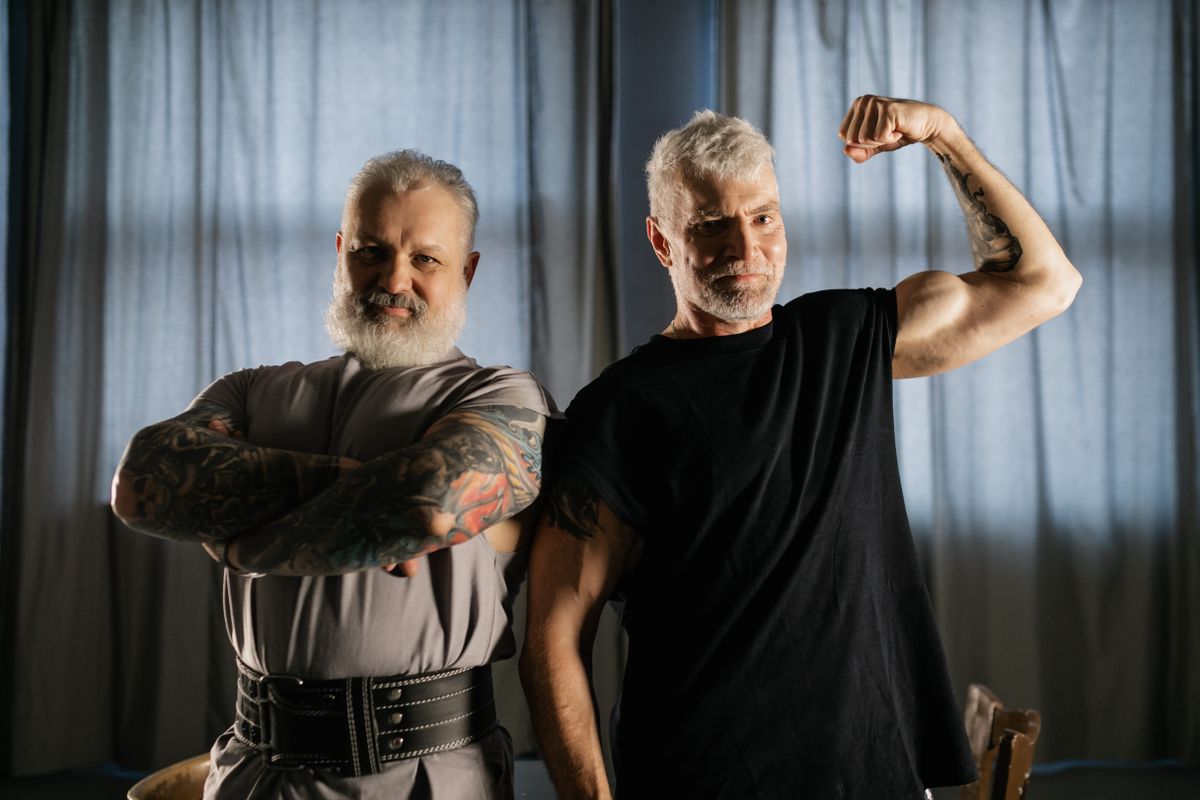 Elderly men flexing and showing their muscles, demonstrating strength and positive aging
Common Mistakes Beginners Over 50 Make
Starting too heavy. Your tendons and ligaments adapt more slowly than muscles. Collagen production decreases with age, meaning connective tissues need more time to strengthen. Spend at least two weeks with lighter weights before increasing load.
Skipping warm-ups. Five to ten minutes of light movement — walking, arm circles, bodyweight squats — increases blood flow to muscles and joints. A 2024 review confirmed that warm-ups reduce injury risk significantly in older populations.
Ignoring recovery. Muscle protein synthesis slows after 50, meaning recovery takes longer. Allow 48 to 72 hours between sessions targeting the same muscle groups. Sleep, hydration, and protein intake (aim for 1.2 to 1.6 grams per kilogram of bodyweight daily) all support recovery.
Training only with machines. Machines isolate muscles, but free weights and bodyweight exercises train balance, coordination, and stabilizer muscles — exactly the systems that decline with age and contribute to falls.
Avoiding compound movements. Exercises like squats, deadlifts, rows, and presses work multiple joints and muscle groups simultaneously. They build more functional strength than isolation exercises and are more time-efficient.
What About Protein?
Older adults need more protein than younger people to stimulate the same muscle-building response — a phenomenon researchers call anabolic resistance. The current evidence supports:
- 1.2 to 1.6 grams of protein per kilogram of bodyweight per day for active older adults (compared to 0.8 g/kg for the general population)
- 25 to 40 grams of protein per meal, with emphasis on the leucine content — the amino acid that triggers muscle protein synthesis
- A protein-rich meal within two hours after training to maximize the recovery window
A meta-analysis found that resistance training combined with adequate protein intake reduced the prevalence of sarcopenia from 35 percent to 0 percent in older adults after just 12 weeks.
Track Your Strength Training With Hiitify
Hiitify helps you build structured strength training sessions with customizable timers for work and rest intervals. Set your warm-up duration, track your workout consistency with streaks, and follow a progressive program that respects your recovery needs — whether you are in your first week or your fiftieth.
Free on iOS
TRAIN SMARTER
Build custom HIIT, Tabata, AMRAP, EMOM and Circuit workouts. Precision timer, streak tracking and analytics — free on iOS.
Sources & Further Reading
Research
- (2025). Optimal resistance training prescriptions to improve muscle strength, physical function, and muscle mass in older adults diagnosed with sarcopenia: a systematic review and meta-analysis. Aging Clinical and Experimental Research. View on PubMed
- (2025). Effects of resistance training on muscle mass, strength, and physical function in older women with sarcopenia: a systematic review and meta-analysis. Frontiers in Public Health. View on Frontiers
- (2025). Optimization of high-intensity resistance exercise protocols for improving bone mineral density in the elderly without chronic diseases: a systematic review and network meta-analysis. Frontiers in Physiology. View on Frontiers
- (2022). The Effect of Resistance Training on Bone Mineral Density in Older Adults: A Systematic Review and Meta-Analysis. Healthcare. View on PMC
- (2018). The effect of resistance training on cognitive function in the older adults: a systematic review of randomized clinical trials. Aging Clinical and Experimental Research. View on Springer
- (2025). Cognitive Stimulation and Strength Training in Older Adults with Mild Cognitive Impairment: A Randomized Controlled Trial. View on PMC
- (2025). Effects of Resistance Training on Sarcopenia Risk Among Healthy Older Adults: A Scoping Review of Physiological Mechanisms. View on PMC
Further Reading
- A Beginner's Guide to Strength Training After 50 — Mutual of Omaha
- Strength Training for Women 50+ — Stanford Lifestyle Medicine
- Fitness Tips for 50-Plus — Johns Hopkins Medicine
- The Many Benefits of Resistance Training as You Age — Mayo Clinic Press
Image Credits
- Cover: Man in Red Shirt Doing Shoulder Exercise Beside a Woman in Black Tank Top — Pexels
- An Elderly Couple Exercising Together — Pexels
- Elderly Men Showing Off Their Muscles — Pexels
All images free to use under the Pexels License.