Tabata and HIIT are used interchangeably across the fitness world — but they're not the same thing. Tabata is a specific type of HIIT, developed in a lab, tested on Olympic-level athletes, and defined by a protocol so rigid that changing the intervals means it's no longer Tabata. Standard HIIT is the broader category, with flexible intervals and scalable intensity.
So which one should you actually choose? Here's what the research says about how they compare — and when each format makes more sense.
The Core Difference: Protocol vs Category
The distinction is straightforward once you see it.
Tabata is a fixed protocol created by Dr. Izumi Tabata in 1996: 20 seconds of all-out effort at 170% of VO₂max, followed by 10 seconds of rest, repeated 8 times. Total working time: 4 minutes. The 2:1 work-to-rest ratio is intentional — 10 seconds is just enough to partially recover without fully recovering, keeping you in the oxygen debt zone that forces adaptation.
HIIT is any training format that alternates high-intensity work intervals with rest periods. Work intervals range from 20 seconds to 2 minutes, rest periods from 10 seconds to 2 minutes, and sessions typically last 20–40 minutes. You control the intensity, the intervals, and the volume.
| Tabata | Standard HIIT | |
|---|---|---|
| Work interval | Always 20 seconds | 20–120 seconds |
| Rest interval | Always 10 seconds | 10–120 seconds |
| Work-to-rest ratio | 2:1 | 1:1 to 1:2 (typical) |
| Rounds per set | Always 8 | Flexible |
| Intensity target | 170% VO₂max (near-maximum) | 80–95% max HR |
| Duration per set | Exactly 4 minutes | Varies |
| Session length | 4–20 minutes | 20–40 minutes |
The short rest is what makes Tabata uniquely demanding. In standard HIIT, you recover enough between intervals to sustain effort across a longer session. In Tabata, incomplete recovery is the mechanism — each round starts before you've caught your breath.
The Original Science: Why Tabata Works
Dr. Tabata's landmark 1996 study at Japan's National Institute of Health and Nutrition compared his protocol against traditional steady-state cardio in speed skaters over six weeks:
- Steady-state group: 60 minutes of cycling at 70% VO₂max, five days per week
- Tabata group: 7–8 rounds of 20s/10s at 170% VO₂max, four days per week plus one moderate session
The results were striking. The Tabata group improved VO₂max by 14% (vs 9.5% for steady-state) and increased anaerobic capacity by 28% — while the steady-state group saw no anaerobic improvement at all. Tabata achieved superior results in both aerobic and anaerobic systems with roughly one-third the weekly training time.
This dual adaptation — improving both energy systems simultaneously — is what sets Tabata apart from most training formats.
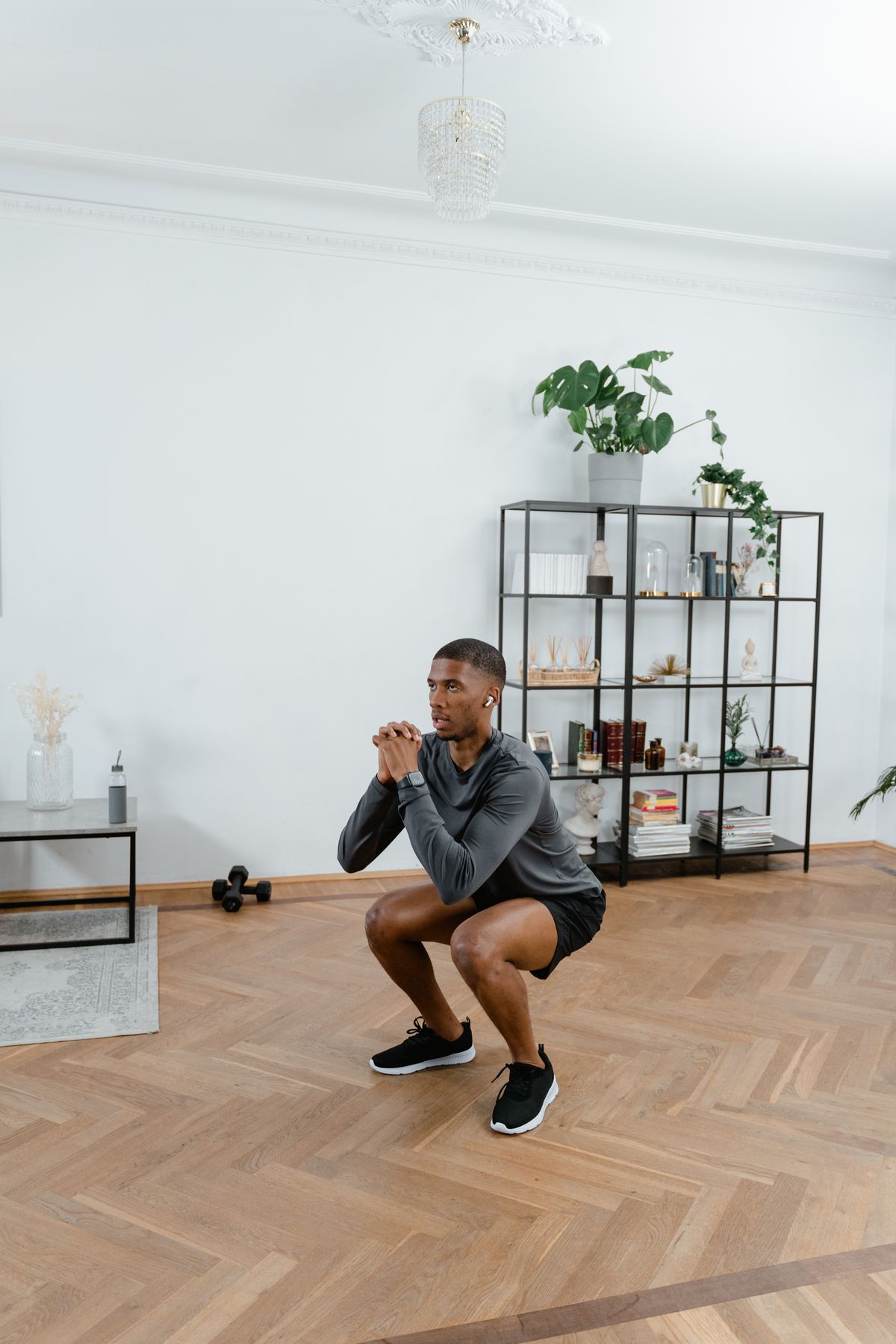 Man performing bodyweight squats during a home workout session
Calorie Burn and Fat Oxidation: Head to Head
This is where most people want the numbers — and the research delivers clear answers.
Free on iOS
TRAIN SMARTER
Build custom HIIT, Tabata, AMRAP, EMOM and Circuit workouts. Precision timer, streak tracking and analytics — free on iOS.
A 2024 study by Wang et al. in Frontiers in Endocrinology directly compared Tabata, HIIT, and moderate-intensity continuous training (MICT) in overweight male university students. The findings across both exercise and recovery phases:
| Metric | Tabata | HIIT | MICT |
|---|---|---|---|
| Energy expenditure rate | 5.76 kcal/min | 4.81 kcal/min | 3.45 kcal/min |
| Fat oxidation rate | 0.27 g/min | 0.20 g/min | 0.20 g/min |
Tabata burned 20% more energy per minute than HIIT and 67% more than steady-state cardio. Its fat oxidation rate was 35% higher than both HIIT and MICT — a statistically significant gap.
But here's the catch: per-minute rates don't tell the whole story. A 4-minute Tabata set burns roughly 23 calories. A 20-minute HIIT session burns approximately 96 calories. A 30-minute HIIT session burns roughly 144. If your goal is total calorie expenditure per session, longer HIIT wins on volume.
The counterargument? A 2025 study in Scientific Reports by Cheng et al. found that two Tabata cycles (8 minutes of work with a 10-minute rest between sets) produced the highest fat oxidation during the 30-minute recovery period — significantly more than one cycle or three. The researchers concluded that two Tabata cycles is the optimal volume for maximising post-exercise fat burning in overweight individuals.
Cardiovascular and Metabolic Adaptations
Both formats improve cardiovascular fitness — but through different mechanisms and at different rates.
A 2023 study in Frontiers in Physiology by Lu et al. found that a 12-week Tabata-style program in sedentary female university students increased VO₂max by nearly 13% and improved body composition. A 2025 randomised controlled trial by Padkao and Prasertsri confirmed that progressive Tabata training improved cardiorespiratory fitness and reduced body fat in overweight and obese participants.
Standard HIIT research shows consistent VO₂max improvements of 5–15% over 6–12 week programs, with the magnitude depending on starting fitness, intensity, and frequency. HIIT's advantage is flexibility — you can scale the protocol to your fitness level, making it accessible to more people.
Both formats trigger the afterburn effect (EPOC) — elevated calorie burning after your workout ends. Research shows HIIT and high-intensity protocols produce roughly double the post-exercise oxygen consumption compared to moderate-intensity exercise. The driver is intensity, not format: push hard enough with either protocol and the afterburn follows.
 Woman in red top running on an outdoor track field
Recovery and Injury Risk
Tabata's intensity comes at a cost: higher recovery demand per minute of training. The original protocol was designed for Olympic-calibre athletes on mechanically braked cycle ergometers — a controlled environment where form doesn't break down under fatigue.
When Tabata is performed with complex bodyweight movements like burpees or jump squats, form degradation in the final rounds becomes a real injury risk. Research consistently recommends at least 48 hours between HIIT sessions of any type. Because Tabata pushes closer to maximum capacity per round, some athletes find they need fewer weekly sessions (two vs three) to maintain the same recovery quality.
Standard HIIT is more forgiving. Longer rest periods mean better form maintenance, and the lower peak intensity per interval creates a smaller recovery footprint. Most people can sustain 3 HIIT sessions per week without overreaching — while 3 true Tabata sessions may push into overtraining territory.
Who Should Choose What?
There's no universal answer. The right choice depends on your fitness level, goals, and how much time you have.
Choose Tabata if you:
- Already have a solid cardiovascular base (4–6 weeks of regular training minimum)
- Want maximum metabolic impact in minimum time
- Prefer short, intense sessions over longer workouts
- Are training for sports that demand both aerobic and anaerobic power
Choose standard HIIT if you:
- Are new to high-intensity training or returning after a break
- Want more flexibility in exercise selection and interval design
- Prefer 20–40 minute sessions with manageable intensity
- Need a format that scales as your fitness improves
Combine both if you:
- Want the best of both worlds across a training week
- Use Tabata sets as finishers after a standard HIIT or strength session
- Enjoy variety and want to challenge different energy systems on different days
A practical weekly split: 2 HIIT sessions + 1 Tabata session, with at least one rest day between each. This gives you the flexibility and volume of HIIT alongside the metabolic punch of Tabata, without the recovery burden of three maximum-intensity days.
Track Your Tabata and HIIT Workouts With Hiitify
Whether you're running a strict 20/10 Tabata protocol or building a custom HIIT session with your own intervals, Hiitify handles both. Set your work and rest times, chain multiple rounds, and let audio cues manage the clock — so you can focus on effort, not counting. Save your favourite workouts and track your training streak to stay consistent.
Free on iOS
TRAIN SMARTER
Build custom HIIT, Tabata, AMRAP, EMOM and Circuit workouts. Precision timer, streak tracking and analytics — free on iOS.
Sources & Further Reading
Research
-
Tabata, I. et al. (1996). Effects of moderate-intensity endurance and high-intensity intermittent training on anaerobic capacity and VO₂max. Medicine & Science in Sports & Exercise, 28(10), 1327–1330. View on ResearchGate
-
Wang, Y. et al. (2024). A comparative analysis of energy expenditure and substrate metabolism in male university students with overweight/obesity: Tabata vs HIIT and MICT. Frontiers in Endocrinology. View on PMC
-
Cheng, Z. et al. (2025). Two Tabata cycles in a single training set maximize fat oxidation after exercise in male college students with overweight/obesity. Scientific Reports, 15, 34011. View on Nature
-
Lu, Y. et al. (2023). The effect of Tabata-style functional high-intensity interval training on cardiometabolic health and physical activity in female university students. Frontiers in Physiology, 14, 1095315. View on PMC
-
Padkao, T. & Prasertsri, P. (2025). The Impact of Modified Tabata Training on Segmental Fat Accumulation, Muscle Mass, Muscle Thickness, and Physical and Cardiorespiratory Fitness in Overweight and Obese Participants. PMC. View on PMC
Further Reading
- Tabata vs HIIT: Which Offers More Results? — ISSA
- Exercise Intensity and Energy Expenditure of a Tabata Workout — PMC
- Tabata vs HIIT: Differences & Calories Burned — Sole Treadmills
Image Credits
- Cover: Women exercising during group workout — Pexels
- Man doing squats at home — Pexels
- Woman running on track field — Pexels
All images free to use under the Pexels License.