If you've ever moved through a series of exercises back-to-back — squats, push-ups, lunges, planks — with barely a breath between them, you've done circuit training. It's one of the oldest, most researched, and most versatile workout formats in fitness, and it works whether your goal is fat loss, muscle building, or cardiovascular conditioning.
What Is Circuit Training?
Circuit training is a workout format where you perform a series of exercises targeting different muscle groups in quick succession, with minimal rest between moves and a longer rest between rounds.
A basic example:
- 12 bodyweight squats
- 10 push-ups
- 10 dumbbell rows (each arm)
- 12 reverse lunges (each leg)
- 30-second plank
Complete all five exercises — that's one circuit. Rest 60–90 seconds, then repeat 3–4 times. A full workout in under 30 minutes.
The format was developed in 1953 by R.E. Morgan and G.T. Adamson at the University of Leeds in England. Their goal was to create a training method that produced "holistic fitness" — improvements in both aerobic and anaerobic capacity in a single session. The original format used 9–12 stations with 15–45 seconds of work at each, and the basic structure hasn't changed much since.
Why Circuit Training Works: What the Research Says
Circuit training isn't just popular — it's one of the most studied workout formats in exercise science.
A 2021 systematic review and meta-analysis published in the International Journal of Environmental Research and Public Health analysed resistance circuit-based training across multiple populations. The findings were clear: circuit training is effective for decreasing total body fat and increasing muscle mass in adults, while simultaneously improving cardiorespiratory fitness with significant pre-to-post improvements in VO₂max.
A separate 2019 meta-analysis of nine randomised controlled trials found circuit training produced an average weight loss of 3.81 kg and a BMI reduction of 1.77 kg/m² in overweight participants.
And it's time-efficient. A 2011 study in the Journal of Strength and Conditioning Research found that circuit training produced similar results in muscle strength to traditional resistance training — in roughly half the time.
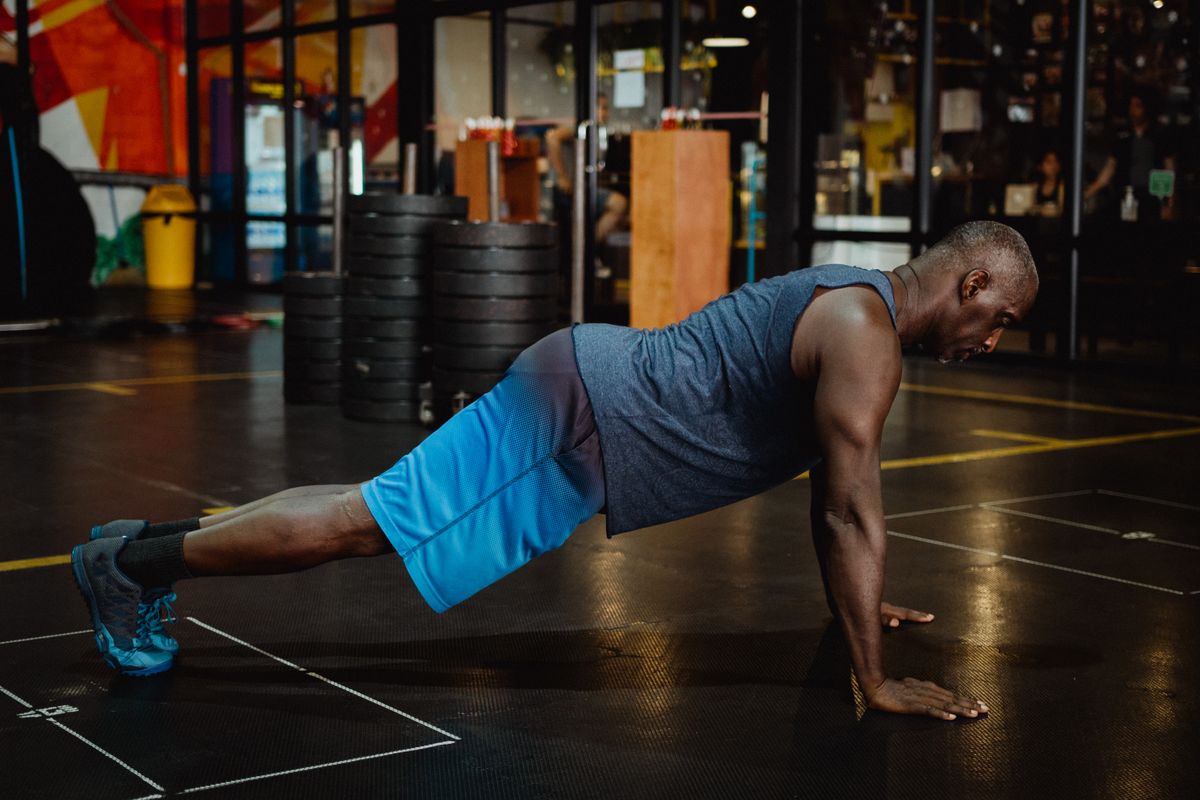 Man doing push-ups on a gym floor during a bodyweight circuit workout
Circuit Training vs HIIT vs Traditional Strength Training
These three formats overlap, but they target different outcomes:
Free on iOS
TRAIN SMARTER
Build custom HIIT, Tabata, AMRAP, EMOM and Circuit workouts. Precision timer, streak tracking and analytics — free on iOS.
| Circuit Training | HIIT | Traditional Strength | |
|---|---|---|---|
| Structure | 5–10 exercises in sequence | Fixed work/rest intervals | Sets and reps per exercise |
| Intensity | Moderate to high | High (80–95% max HR) | Moderate to high |
| Rest between exercises | 15–30 seconds | 10–30 seconds (fixed) | 60–180 seconds |
| Rest between rounds | 60–120 seconds | Built into intervals | N/A |
| Primary benefit | Strength + conditioning | Cardio + fat loss | Maximal strength + hypertrophy |
| Session length | 20–40 minutes | 15–30 minutes | 45–75 minutes |
| Muscle building | Good | Limited | Best |
| Cardio improvement | Good | Best | Minimal |
The key distinction: circuit training sits between HIIT and traditional lifting. You get meaningful strength stimulus because you're using resistance exercises, but the short rest periods keep your heart rate elevated enough to drive cardiovascular adaptation. A 2013 study in the British Journal of Sports Medicine found that high-intensity circuit training produced greater improvements in blood pressure, cholesterol, and triglycerides than both low-intensity circuits and traditional endurance training in overweight men.
How to Build a Circuit Workout
Step 1: Pick 5–8 exercises
Cover all major movement patterns:
- Push — push-ups, shoulder press, chest press
- Pull — dumbbell rows, band pull-aparts, inverted rows
- Squat — bodyweight squats, goblet squats, jump squats
- Hinge — deadlifts, kettlebell swings, hip thrusts
- Core — planks, mountain climbers, dead bugs
- Cardio burst — jumping jacks, high knees, burpees
Step 2: Order them smartly
Alternate upper body and lower body exercises so no single muscle group gets hit twice in a row. This reduces fatigue and keeps your pace consistent.
Step 3: Set your work parameters
| Level | Reps or Time | Rest Between Exercises | Rest Between Rounds | Rounds |
|---|---|---|---|---|
| Beginner | 8–10 reps or 30 sec | 30 seconds | 90 seconds | 2–3 |
| Intermediate | 12–15 reps or 40 sec | 15–20 seconds | 60 seconds | 3–4 |
| Advanced | 15–20 reps or 45 sec | 10–15 seconds | 45 seconds | 4–5 |
Step 4: Record your results
Track your total rounds, total reps, or completion time. Next session, try to do more work in the same time — or the same work in less time.
Sample Circuit Workouts
Beginner Circuit — No Equipment (20 minutes)
- 10 bodyweight squats
- 8 push-ups (on knees if needed)
- 10 alternating reverse lunges
- 20-second plank hold
- 15 jumping jacks
Rest 30 seconds between exercises. Rest 90 seconds between rounds. Repeat 3 times.
Intermediate Circuit — Dumbbells (25 minutes)
- 12 goblet squats
- 10 dumbbell push press
- 12 dumbbell rows (each arm)
- 10 reverse lunges (each leg)
- 12 mountain climbers (each side)
- 10 dumbbell deadlifts
Rest 15 seconds between exercises. Rest 60 seconds between rounds. Repeat 3–4 times.
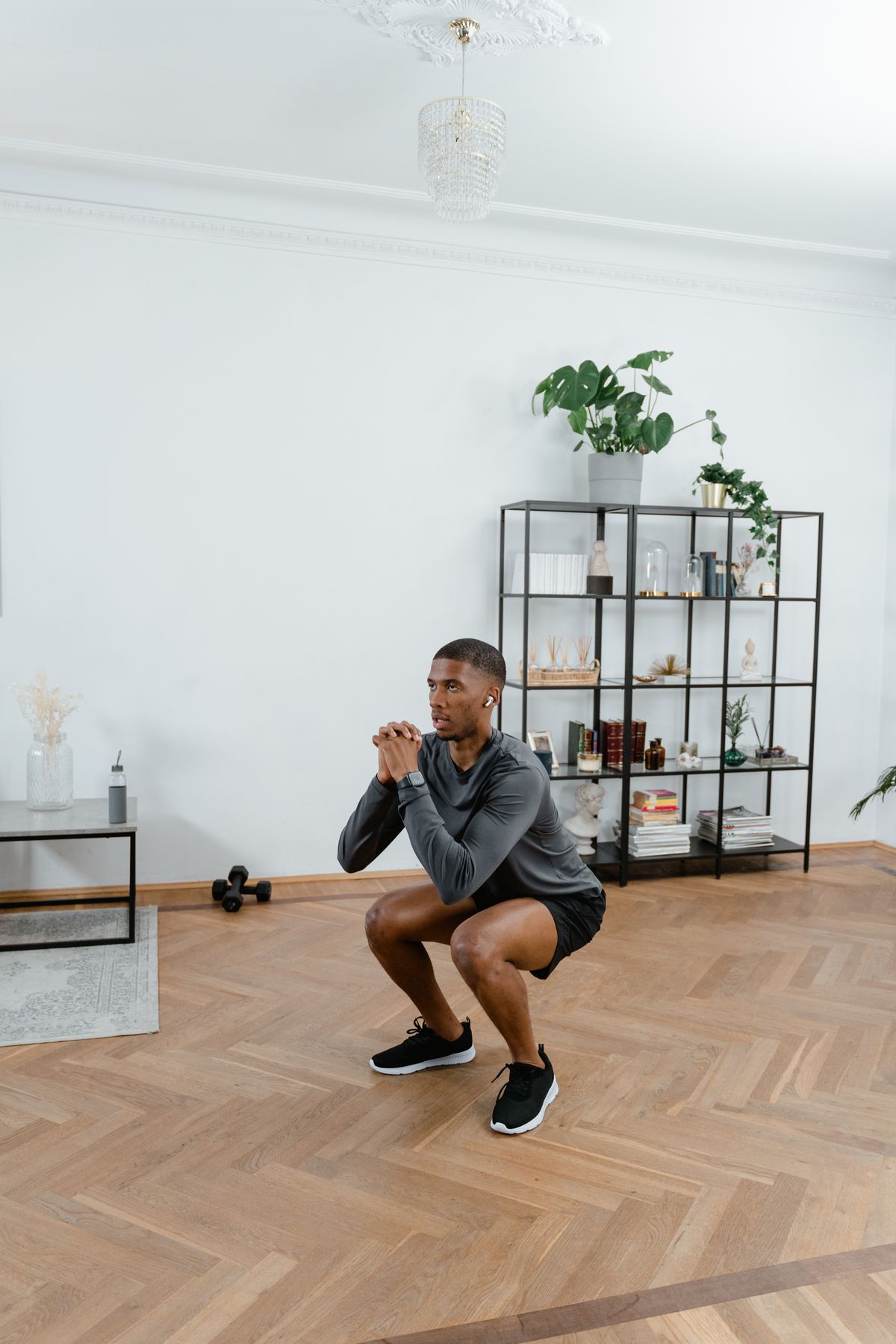 Man performing bodyweight squats at home during a circuit training session
Advanced Circuit — Full Gym (30 minutes)
- 15 barbell squats
- 12 pull-ups
- 15 kettlebell swings
- 12 dumbbell bench press
- 20 mountain climbers (each side)
- 12 barbell deadlifts
- 30-second battle rope slams
Rest 10 seconds between exercises. Rest 45 seconds between rounds. Repeat 4–5 times.
Common Mistakes to Avoid
Sacrificing form for speed. Circuit training moves fast, but sloppy reps lead to injuries. Reduce the weight or reps before you let technique break down.
Skipping the warm-up. Five minutes of light cardio and dynamic stretches (leg swings, arm circles, bodyweight squats) prepares your muscles and reduces injury risk.
Using the same circuit every session. Your body adapts. Change exercises, rep schemes, or rest periods every 3–4 weeks to keep progressing.
Going too heavy. Circuit training isn't powerlifting. Use loads you can move with control for the full rep range — typically 40–60% of your one-rep max.
Track Your Circuit Workouts With Hiitify
Hiitify has a dedicated Circuit timer built for exactly this format. Add your exercises, set work and rest intervals per station, and let the app manage the transitions with audio cues and voice prompts — so you can focus on training instead of watching a clock.
Free on iOS
TRAIN SMARTER
Build custom HIIT, Tabata, AMRAP, EMOM and Circuit workouts. Precision timer, streak tracking and analytics — free on iOS.
Sources & Further Reading
Research
-
Sonchan, W. et al. (2019). Weight loss effects of circuit training interventions: A systematic review and meta-analysis. View on PubMed
-
Marques, D. et al. (2021). Effects of Resistance Circuit-Based Training on Body Composition, Strength and Cardiorespiratory Fitness: A Systematic Review and Meta-Analysis. Int J Environ Res Public Health. View on PMC
-
Paoli, A. et al. (2013). Effects of high-intensity circuit training, low-intensity circuit training and endurance training on blood pressure and lipoproteins in middle-aged overweight men. Br J Sports Med. View on PMC
-
Alcaraz, P.E. et al. (2008). Physical performance and cardiovascular responses to an acute bout of heavy resistance circuit training versus traditional strength training. J Strength Cond Res. View on PubMed
-
Romero-Arenas, S. et al. (2025). Effects of High Intensity Circuit Versus Traditional Strength Training on Physiological Responses in Trained Women. View on PMC
Further Reading
- 9 Science-Backed Benefits of Circuit Training — Healthline
- The Benefits of Circuit Training — NASM
- How to Create an Effective Circuit Workout — ACE Fitness
Image Credits
- Cover: Woman doing exercise inside gym — Pexels
- Man doing push-ups — Pexels
- Man doing squats — Pexels
All images free to use under the Pexels License.