You can bench press your bodyweight, hold a plank for two minutes, and run a decent 5K. But if you throw out your back picking up a suitcase or lose your balance stepping off a curb, something is missing from your training. That something is functional fitness — and it might be the most important style of training you are not doing.
What Functional Fitness Actually Means
Functional fitness is training that prepares your body for the movements you perform every day. Instead of isolating a single muscle on a machine, functional exercises work multiple joints and muscle groups together — the way your body actually moves in real life.
Think about what your body does outside the gym: you squat down to pick up a child, hinge at the hips to lift a box, lunge forward to catch a door, push a heavy cart, pull open a stuck drawer, twist to check a blind spot while driving, and walk or run to catch a bus. These are not gym exercises. They are life — and functional fitness trains you to do them better.
The concept is built around seven primal movement patterns that cover nearly every physical task your body performs:
| Movement Pattern | Real-Life Example | Exercise Example |
|---|---|---|
| Squat | Sitting down and standing up | Goblet squat |
| Hinge | Picking something off the floor | Deadlift, kettlebell swing |
| Lunge | Climbing stairs, stepping over objects | Walking lunge |
| Push | Pushing a door, lifting overhead | Push-up, overhead press |
| Pull | Opening a drawer, pulling a suitcase | Row, pull-up |
| Rotation | Twisting to reach behind you | Wood chop, Russian twist |
| Gait | Walking, running, carrying loads | Farmer's carry, sprints |
A well-designed functional fitness program trains all seven patterns. Miss one, and you are building strength with a blind spot.
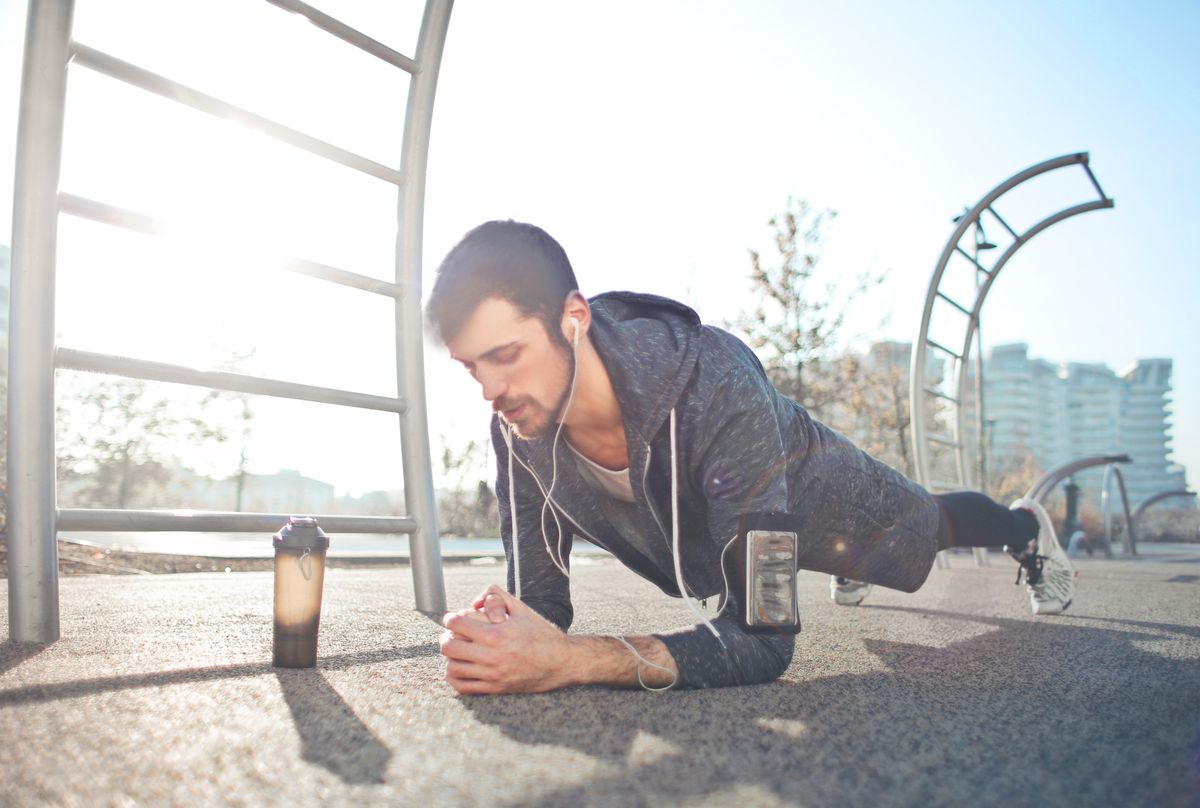 Young man training outdoors with bodyweight exercises on a sports ground
Free on iOS
TRAIN SMARTER
Build custom HIIT, Tabata, AMRAP, EMOM and Circuit workouts. Precision timer, streak tracking and analytics — free on iOS.
What the Research Says About Functional Training
Functional fitness is not just a gym trend — it has a growing body of peer-reviewed evidence behind it.
A 2025 systematic review and meta-analysis by Wang et al., published in BMC Public Health, analyzed 19 studies involving 911 healthy individuals. The results showed that high-intensity functional training produced significant improvements across nearly every fitness metric:
| Fitness Component | Effect Size | Significance |
|---|---|---|
| Strength | 1.38 | p < 0.001 |
| Power | 1.32 | p < 0.001 |
| Endurance | 1.80 | p < 0.001 |
| Speed | 3.09 | p < 0.001 |
| Agility | 2.09 | p < 0.001 |
| Flexibility | 0.64 | Not significant |
Programs lasting 12 weeks or more produced stronger improvements than shorter interventions, reinforcing the importance of consistency.
An earlier 2021 systematic review by Xiao et al. in Frontiers in Physiology examined 9 studies covering 330 athletes and found strong evidence that functional training improved speed, muscular strength, and balance in competitive athletes across sports including football, handball, martial arts, and volleyball.
Functional Fitness vs Traditional Strength Training
This is not an either-or decision — both styles build strength. But they do it differently, and the carryover to daily life is not the same.
Traditional strength training typically uses machines that lock you into a fixed path of motion. A leg press, for example, builds quadriceps strength effectively, but it does not require your core to stabilize, your ankles to balance, or your hips to coordinate the movement. In real life, you never push a load while lying on your back with your feet on a platform.
Functional training uses free weights, bodyweight, and unstable surfaces to force your body to stabilize itself while producing force. A goblet squat, a single-leg deadlift, or a Turkish get-up demands coordination across multiple joints — the same kind of coordination you need to carry a heavy box up a flight of stairs.
Research confirms this distinction. A study published in the Journal of Strength and Conditioning Research compared functional and traditional training in adults and found that while both protocols improved strength similarly, functional training produced greater improvements in balance and coordination — qualities that directly reduce injury risk in daily life.
Why Functional Fitness Matters More as You Age
Here is a statistic worth remembering: 28 to 35 percent of adults over 65 experience at least one fall per year, and 15 percent report recurrent falls. Falls are the leading cause of injury-related death in older adults, and the primary risk factors — poor balance, reduced muscle power, and limited mobility — are exactly what functional training targets.
A 2024 systematic review published in Experimental Gerontology found that functional exercise programs significantly improved balance, gait, and mobility in adults aged 60 and older, with direct positive effects on daily activities and independence.
A 2025 Frontiers in Public Health review analyzing multicomponent exercise programs (which combine functional movements with strength and balance work) found they outperformed single-component programs. Participants showed:
- A 1-second faster Timed Up and Go test
- An 8 to 20 percent improvement in balance reach tests
- A 55 percent increase in chair stand repetitions
You do not need to be over 60 to benefit. Building functional strength now means you are investing in your ability to move independently for decades to come.
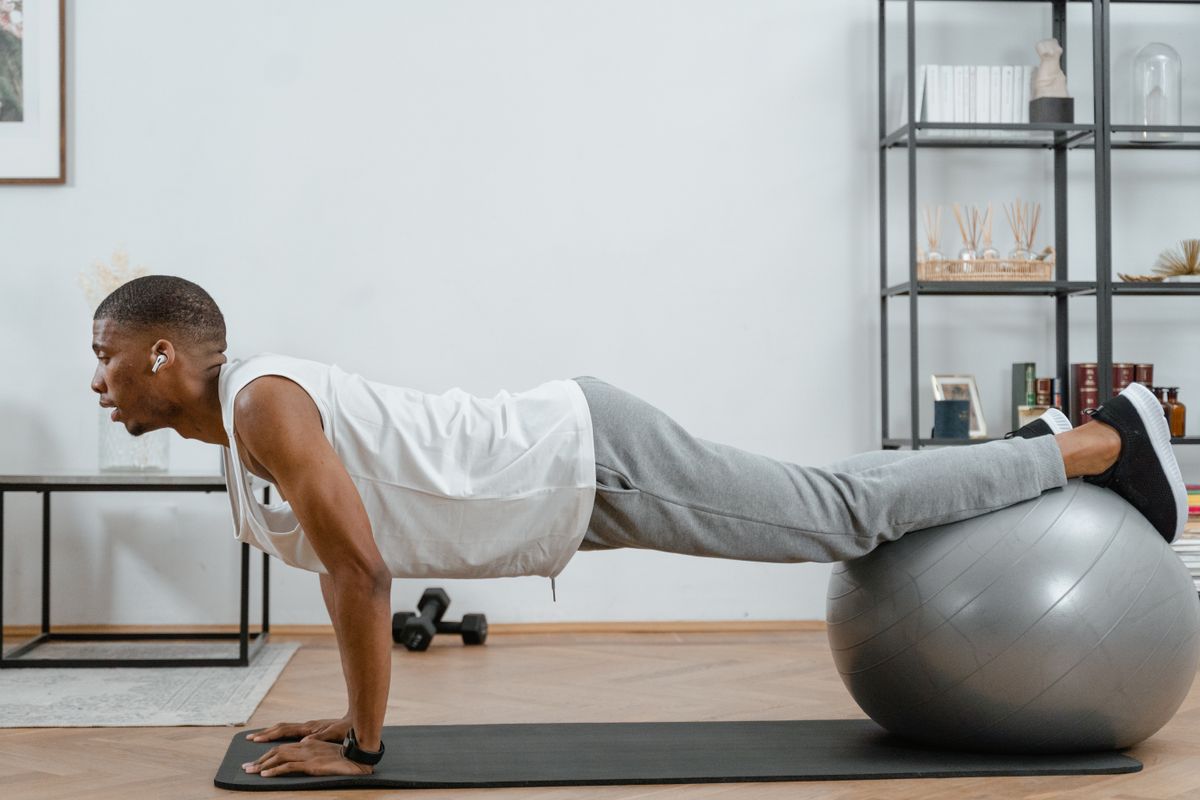 Man exercising with a stability ball for core and balance training
A Beginner Functional Fitness Routine
You do not need a gym. This bodyweight routine covers all seven movement patterns and takes about 20 minutes.
| Exercise | Pattern | Sets x Reps |
|---|---|---|
| Bodyweight squat | Squat | 3 x 12 |
| Romanian deadlift (bodyweight) | Hinge | 3 x 10 |
| Reverse lunge | Lunge | 3 x 10 per side |
| Push-up (or incline push-up) | Push | 3 x 8–12 |
| Inverted row (or towel row) | Pull | 3 x 8–10 |
| Standing wood chop | Rotation | 3 x 10 per side |
| Farmer's carry (use bags, bottles) | Gait | 3 x 30 seconds |
How to progress: Once you can complete all sets with good form, add resistance. Hold water bottles or a backpack for squats and lunges. Elevate your feet for push-ups. Increase carry weight or distance. The goal is gradual overload using the same movement patterns — not switching to a machine.
Track Your Functional Fitness With Hiitify
Hiitify is built for exactly this kind of training. Use the customizable interval timer to structure your functional workouts with precise work and rest periods, track your workout streaks to stay consistent, and monitor your progress over time. Whether you are running through a circuit of all seven movement patterns or focusing on a specific weakness, Hiitify keeps your sessions structured and your momentum visible.
Free on iOS
TRAIN SMARTER
Build custom HIIT, Tabata, AMRAP, EMOM and Circuit workouts. Precision timer, streak tracking and analytics — free on iOS.
Sources & Further Reading
Research
- Wang, Y. et al. (2025). Effects of high-intensity functional training on physical fitness in healthy individuals: a systematic review with meta-analysis. BMC Public Health. View on PMC
- Xiao, W. et al. (2021). Effect of Functional Training on Physical Fitness Among Athletes: A Systematic Review. Frontiers in Physiology. View on PMC
- De Vreede, P.L. et al. (2005). Functional-task exercise versus resistance strength exercise to improve daily function in older women: a randomized, controlled trial. Journal of the American Geriatrics Society. View on PubMed
- Krebs, D.E. et al. (2007). Traditional versus functional strength training: effects on muscle strength and power in the elderly. Journal of Strength and Conditioning Research. View on PubMed
- Santos, L.M. et al. (2024). The effect of functional exercise program on physical functioning in older adults aged 60 years or more: A systematic review and meta-analysis. Experimental Gerontology. View on PubMed
Further Reading
- What Is Functional Training? — Live Science
- 10 Functional Fitness Exercises That Improve Strength — TODAY
- Functional Fitness 101: Practical Exercises for Everyday Strength — Remix Fitness
Image Credits
- Cover: A Woman Doing a Deadlift — Pexels
- Young Man Training on Street Sports Ground — Pexels
- Man Exercising With a Stability Ball — Pexels
All images free to use under the Pexels License.